An Ode to Awfulness
The oppressive heat of the late afternoon summer clung to the old Oakhaven Playhouse like a damp shroud, permeating the velvet seats and the dusty stage. Every breath felt thick with the smell of old wood, sweat, and the faint, metallic tang of forgotten stage lights. On the stage, under a single, unforgiving work light, two figures moved with the weary grace of those accustomed to carrying the weight of absurdity.
Nancy’s inner monologue, a silent scream, warred with the polite smile pasted on her face. Another two acts. Another two hundred lines of this… poetry. Her fingers, sticky from a melting ice lolly she’d abandoned backstage, traced the words on her script. 'Indeed, the dew upon the nascent morn doth weep for my shattered honour.' She read the line for the eleventh time, feeling the paper crinkle under her thumb, its edges already soft and dog-eared from relentless scrutiny. It wasn't just bad; it was epically, profoundly, offensively bad. A genuine masterpiece of theatrical incompetence. And yet, she had to deliver it, night after night, as if her very soul believed in the weeping dew and the shattered honour of a fictional Viscountess named Seraphina. The thought was enough to make her stomach do a small, unpleasant flip. The smell of old wood, a faint metallic tang of forgotten stage lights, and the persistent, cloying sweetness of Ms. Carson's rosewater perfume lingered in the air, creating a sensory assault that Nancy had become intimately familiar with over the last sweltering weeks of summer rehearsals.
Across the stage, Johnny, her co-star and partner in this particular purgatory, cleared his throat with a sound that could only be described as a dramatic, preparatory rumble. He was already in character, leaning against a wobbly cardboard pillar meant to evoke ancient castle grandeur. Even in his faded band t-shirt and cargo shorts, he carried an air of self-importance that Nancy found both irritating and endlessly endearing. They were both young, barely out of their teens, still navigating the awkward transition from college drama projects to the terrifying reality of actual paid (albeit poorly paid) work. Johnny, however, managed to elevate every movement, every sigh, into a grand pronouncement. He caught her eye, a glint of shared desperation and dark humour passing between them like a secret handshake.
“My dearest Seraphina,” Johnny intoned, his voice booming a little too loudly in the empty Oakhaven Playhouse, “Dost thou truly perceive the tempest of my soul, stirred by the treacherous winds of deceit and the vile machinations of my nefarious brother?” He delivered the lines with a flourish, sweeping his hand dramatically towards the non-existent wings. Nancy, despite herself, almost giggled. The line was a mouthful, a convoluted mess of overwrought metaphors that even Shakespeare would have found excessive. She bit her lip, forcing her facial muscles to adopt the appropriate expression of agonised sympathy.
“Oh, my beloved Viscount, Percival,” Nancy replied, adopting the slightly breathy, overly earnest tone they’d decided was suitable for Seraphina, a character who seemed to exist solely to react to Percival’s endless monologues. “Indeed, the very air doth thicken with the noxious fumes of villainy. Yet, my heart, a fragile bloom, doth cling to the verdant promise of thy honour.” She emphasised ‘verdant’ with a particular, almost imperceptible tremor in her voice, a silent nod to the ridiculousness of the play’s title. The phrase 'noxious fumes of villainy' always made her think of old socks. It was Ms. Carson’s singular genius to combine such florid language with a plot that defied all logic.
Johnny took a step forward, his boot scuffing against a loose floorboard that always seemed to creak at the most inopportune moments. He didn’t miss a beat, using the slight stumble to inject a sudden, intense physicality into Percival. It was a testament to his skill, and perhaps their shared insanity, that they could wring so much from such terrible material. His eyes, usually dancing with mischief, were wide with feigned anguish. “Alas, Seraphina! The Oakhaven Scroll, our very legacy, our beacon of truth, hath vanished from the archives! A dark omen, surely, portending doom for our ancestral line and, dare I say, the very scones of the village baker!” He paused, clearly trying to hold back a smile at the ridiculous segue into baked goods.
Nancy allowed herself a small, theatrical gasp, placing a hand over her heart. “The Scroll? Gone? But… the Oakhaven Historical Society held it in such… veneration!” She almost choked on the word. The missing Oakhaven Scroll was a local rumour, a quaint little mystery that had kept the village gossiping for weeks. Someone had apparently 'misplaced' a centuries-old document from the village archives, a scroll detailing the founding of the Oakhaven Bakehouse. The absurdity of a real-life minor village kerfuffle finding its way into this play, even as a throwaway line, was classic Ms. Carson. It was the only part of the play that felt remotely grounded, and even then, it was ludicrously exaggerated.
“Veneration, indeed!” Johnny scoffed, though the scoff was performed with the elegance of a trained opera singer. He advanced further, now standing directly in front of Nancy. She could smell the faint peppermint of his breath mint. “And rumour has it, dear Seraphina, that the culprit possessed a fondness for… marmalade, leaving but a sticky residue where the scroll once lay!” He leaned in conspiratorially, his eyes twinkling. They both knew the 'marmalade culprit' was a fabrication by Ms. Carson, added during last week’s rewrite session because she felt the play needed more 'culinary intrigue.' The real investigation, if one could even call it that, was being handled by Mrs. Henderson, the librarian, who suspected old Mr. Peabody of accidentally filing it under ‘local recipes.’
“Marmalade?” Nancy repeated, her voice rising to a pitch of feigned horror. “A sweet, yet sinister, detail, my Viscount! This villain… this marmalade menace… he must be brought to justice!” She punctuated her line with a sharp, decisive nod, trying to channel a conviction she certainly didn’t feel for the fate of a fictional scroll, let alone a real one that was probably sitting in a box labelled 'Elderly Gentlemen's Ramblings'. The fast-paced dialogue, despite its formal trappings, kept their energy high, a comedic ballet of dramatic overstatement.
A Director's Demands
A shrill clap echoed from the dark auditorium, making both actors jump. Ms. Carson, a figure of formidable eccentricities, emerged from the shadows, her magenta scarf trailing behind her like a theatrical banner. She wore sunglasses indoors, even at this hour, and carried a bedazzled clipboard. Nancy felt a familiar wave of dread wash over her. Ms. Carson’s notes were legendary for their obtuseness. Johnny shifted his weight, his Percival persona instantly dropping, replaced by the guarded weariness of a young actor facing their director.
“Darlings, darlings!” Ms. Carson exclaimed, her voice a melodious, yet piercing, vibrato that seemed to vibrate the very floorboards. “Magnificent! Truly! The pathos of the missing scroll, the culinary intrigue of the marmalade, the sheer emotional architecture of Percival’s shattered honour! It sang! It soared! One might almost believe it was penned by a modern maestro, not… well, you know.” She waved a dismissive hand, implying the original playwright was a long-forgotten genius, when in fact, the script was barely six months old and widely considered a local laughingstock.
Johnny cleared his throat. “Ms. Carson, might I inquire about the… continuity of the marmalade detail? Percival mentions it almost as an afterthought, yet Seraphina reacts as if it is the crux of the villainy.” He raised an eyebrow, a subtle plea for logical consistency in a world devoid of it. He was always the one to bravely (or foolishly) attempt to inject sense into Ms. Carson’s vision. Nancy internally cheered him on, though she remained outwardly composed, hands clasped demurely in front of her. The heat of the afternoon was starting to make her scalp itch, a small, irritating detail that made it hard to focus on Ms. Carson's latest pronouncements.
Ms. Carson removed her sunglasses, revealing eyes that glittered with an unsettling intensity. “My dear Johnny! Continuity is for chronologists, not creators! The marmalade is a motif! A sensory anchor! It is the sweetness that masks the bitterness of betrayal! Do you not feel the sticky metaphor?” She gestured wildly, almost knocking over a stack of prop crates. A faint scent of static electricity, not static, seemed to emanate from her, a sign of her charged energy. Nancy stifled a sigh. The director loved her motifs, particularly if they involved food.
“Indeed, Ms. Carson,” Nancy interjected, her voice carefully modulated, attempting to soothe the ruffled feathers of creative genius. “The motif is… quite vivid. Perhaps, for clarity, we could have Percival perhaps discover a marmalade jar at the scene? A tangible, rather than abstract, clue?” She offered the suggestion with the air of a diplomat negotiating a fragile peace treaty, knowing full well it would likely be rejected, or worse, misinterpreted as a challenge.
Ms. Carson pondered this, her head tilted at an angle that suggested profound philosophical contemplation. Her silver earrings, shaped like tiny teapots, jingled. “A jar, you say? Hmm. Too pedestrian. Too… literal. No, no. The suggestion of marmalade. The spectral presence of marmalade! That is where the true horror lies, my dears! The phantom tang of citrus in the mind of the audience!” She beamed, clearly delighted with her own pronouncements. Johnny caught Nancy’s eye and rolled his. The heat in the theatre was starting to feel oppressive, a thick, invisible blanket that pressed down on them.
“But, if the audience cannot smell it,” Johnny ventured, ever the practical one, “will they truly grasp the phantom tang?” He made a show of sniffing the air, then wrinkled his nose, pretending to detect the spectral citrus. It was a subtle act of rebellion, a small crack in the formal theatrical mask. Nancy had to press her lips together to keep from laughing aloud. The creak of an old fan from the back of the auditorium, struggling against the heat, was the only other sound.
“Ah, Johnny, my young enthusiast!” Ms. Carson declared, clapping her hands together. “That is where you come in! Your performance! Your gestures! You must evoke the marmalade! Perhaps… a slight, involuntary lick of the lips? A subtle shudder as if recalling a particularly cloying taste? Show them the phantom tang!” She demonstrated, making a truly grotesque licking motion with her tongue that made Nancy wince. The stage, with its peeling paint and threadbare curtains, felt suddenly smaller, more intimate in its shared misery.
---
Nancy felt a faint prickle of sweat trace a path down her spine. The play was a train wreck, and Ms. Carson was the conductor gleefully shovelling coal into the engine. After another ten minutes of Ms. Carson’s 'notes,' which mostly consisted of her performing exaggerated versions of their lines and demanding more 'emotional resonance' from inanimate objects, she finally retreated backstage, presumably to find more esoteric props or to commune with the theatre’s resident ghost, Old Man Hemlock, who was rumoured to haunt the prop room.
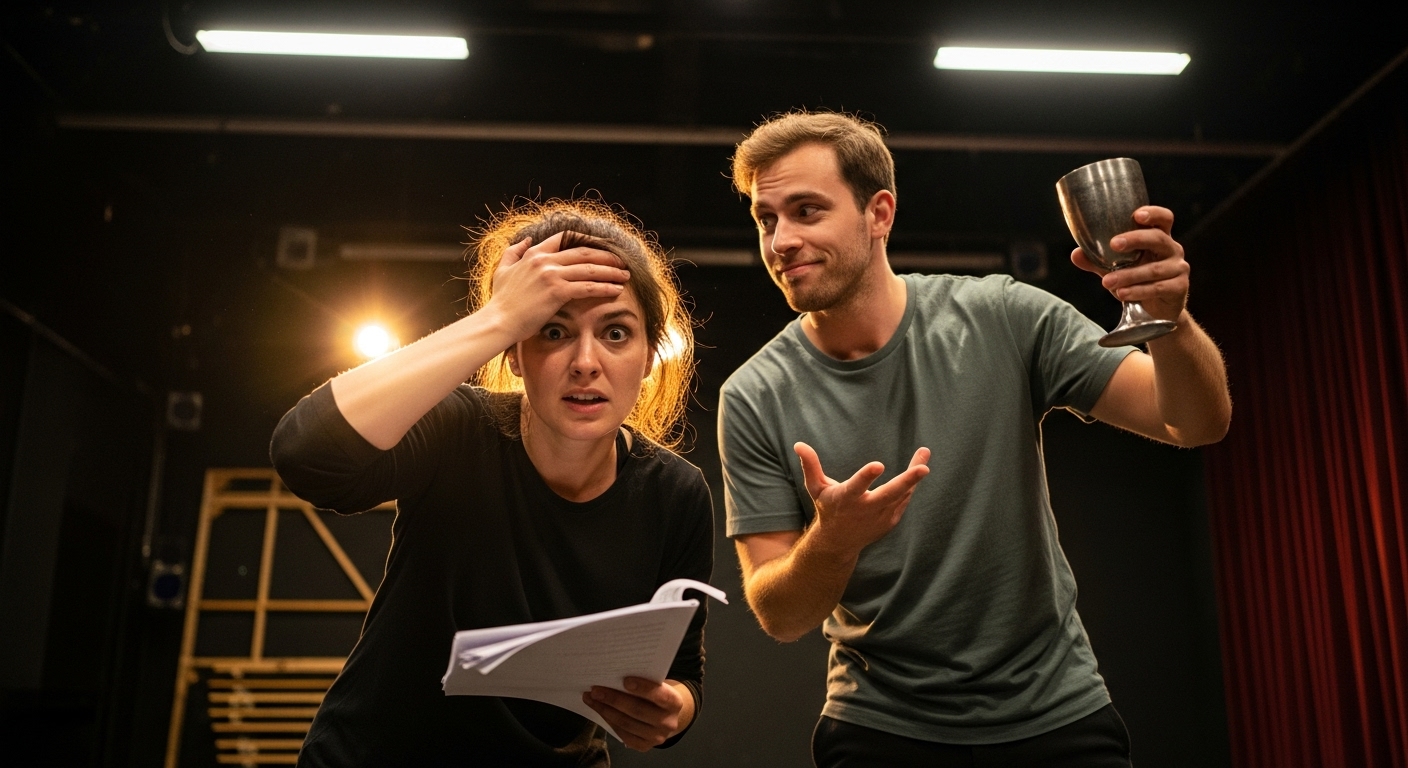
“A spectral presence,” Johnny muttered, once the coast was clear, running a hand through his slightly damp hair. “I shall endeavour to manifest the ethereal stickiness of citrus, dearest Seraphina, for the audience’s… gastronomical enlightenment.” He bowed deeply, his eyes dancing with a familiar, sardonic humour. He looked exhausted, though, the faint shadow of a sleepless night under his eyes. Nancy noticed the slight tremble in his hand as he picked up his prop goblet.
“And I, my Percival,” Nancy responded, returning his bow with an equally grand flourish, “shall strive to recoil from this phantom tang with the appropriate measure of noble revulsion.” She slumped onto the edge of the stage, pulling her script onto her lap. The paper felt hot against her thighs. “Seriously, how do we make this not sound like a bad parody?”
Johnny joined her, sitting cross-legged, his elbows resting on his knees. He fiddled with the brim of a stray top hat that had been left on the stage. “The entire play is a bad parody, Nancy. Our challenge, as professional purveyors of the dramatic arts, is to make it a brilliant bad parody. An intentional bad parody. That, my friend, is the secret.” He spun the top hat on his finger. “We lean into it. We make it so over-the-top, so melodramatic, so utterly self-aware that the audience applauds our sheer audacity, not the script’s… merits.”
“So, the noble revulsion for the phantom tang of marmalade becomes… a silent scream that echoes through the annals of time?” Nancy suggested, trying out a dramatic gesture, her hand clawing at the air. The words felt heavy, even in jest. She noticed a tiny tear in the hem of her rehearsal shorts, an almost imperceptible flaw that only she would ever see. The distant, almost forgotten chirping of crickets outside the theatre was beginning to filter through the thick walls, a subtle reminder of the summer night that was approaching.
“Precisely!” Johnny snapped his fingers. “And my shattered honour will not merely be shattered; it shall be pulverised! Ground to a fine, tragic dust, scattered across the very stage upon which we stand!” He punctuated this with a vigorous stomp, sending up a puff of dust from the wooden planks. The dust motes, caught in the beam of the work light, seemed to dance, a fleeting, almost beautiful sight.
“And what of the missing Oakhaven Scroll?” Nancy mused, shifting the topic slightly, the mundane reality of the village mystery a welcome distraction from the play’s absurdities. “Do we elevate that to a grand, existential quest? A search for truth in a world of… marmalade-stained lies?” She picked at a loose thread on her shirt, her gaze fixed on a cobweb-draped corner of the stage. A faint scent of old canvas and dried paint hung in the air.
Johnny stroked his chin thoughtfully. “Perhaps the scroll itself is merely a macguffin. A symbol of lost innocence, stolen by the villainous Sir Reginald, who, of course, despises all things baked goods related.” He adopted a villainous leer. “And who, rumour has it, also smells faintly of burnt sugar. A counter-motif, if you will, to the marmalade.” They had invented Sir Reginald’s burnt sugar scent last week as a running joke. The joke felt more real than the actual plot.
“A counter-motif of burnt sugar,” Nancy repeated, a slow smile spreading across her face. “Yes. Ms. Carson would adore that. We’ll tell her it symbolises the slow, agonising incineration of Percival’s hopes.” She felt a little lift in her chest, a faint surge of energy. This was how they survived, how they found joy in the work, even when the material was so dire. Their shared mission to make bad theatre ironically brilliant was a bond, a silent conspiracy against the mundane and the truly awful.
“My hopes, dear Seraphina, are but embers upon the hearth of destiny!” Johnny declared, striking a heroic pose, his hand pressed dramatically against his chest. He looked so earnestly ridiculous that Nancy burst out laughing, a genuine, unforced sound that echoed warmly in the empty theatre. The acoustics of the old building always amplified human joy in a way that felt strangely comforting.
He joined her, his laughter a rich, booming sound that filled the space. For a moment, they weren’t just two actors trying to salvage a disastrous play; they were simply Johnny and Nancy, two friends finding genuine amusement in a shared struggle. The summer air, thick with the promise of evening, felt less heavy, a gentle breeze stirring through the cracked windows of the playhouse, bringing with it the distant, faint smell of freshly cut grass and the promise of rain. Their laughter eventually subsided, leaving a comfortable quiet. Johnny picked up his script again, running a thumb over the page. Nancy watched him, noticing the subtle tension in his shoulders, the small sigh he exhaled. They still had an uphill battle, but the burden, for now, felt lighter. The lingering warmth of the day outside the theatre softened the edges of the room, turning the dust motes into tiny, glittering specks. The thought of an actual audience, soon, felt less terrifying and more like an opportunity to truly perform, to truly play.
A sharp, insistent rap echoed from the stage door, and then Ms. Carson's unmistakable voice, a little too close, a little too loud, pierced the quiet: "Darlings! I have had a 2px4px_rgba(0,0,0,0.8)]">revelation!" Nancy and Johnny exchanged a look that spoke volumes of shared doom, the summer night suddenly feeling a shade colder.
Share This Story


