A Conflagration of Bureaucracy
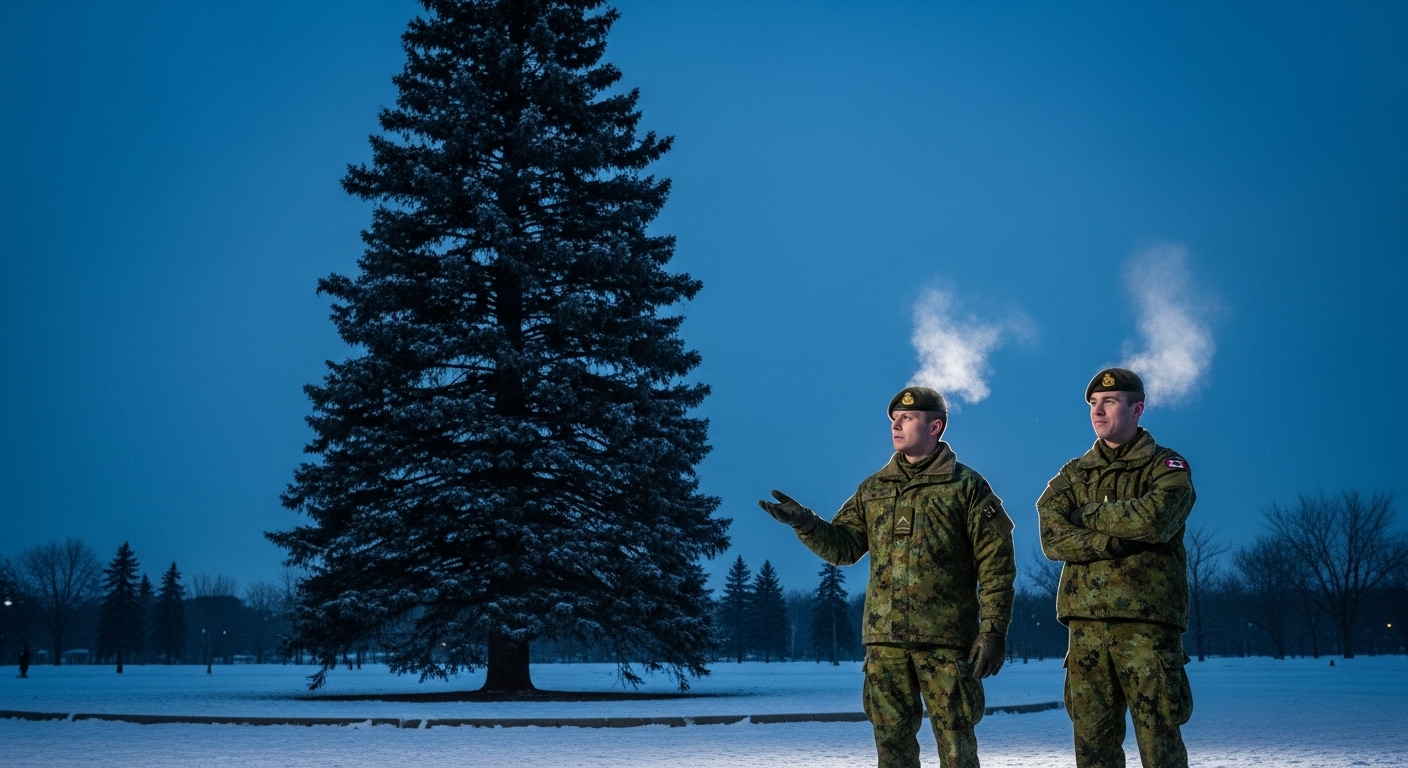
The wind, a malevolent, unseen entity, whipped through the parade square, carrying with it the scent of damp earth and distant, churning diesel. Every gust threatened to pluck the earflaps from under Captain Napson’s service cap, his face already a deepening crimson against the grey, unforgiving sky. Below the flagpole, an evergreen, monstrous in its height and girth, stood as a monument to unfulfilled festive ambition. Its branches, stiff with latent ice, seemed to mock the two figures who stood before it, contemplating their impossible task. The air bit at exposed skin, promising chilblains and frostnip, a bleak pre-Christmas forecast.
“Sergeant Davidson, pray tell, how does one illuminate a veritable arboreal behemoth with naught but a single string of lights and a directive for… ‘profound optimism’?” Captain Napson’s voice, though usually modulated with military precision, held a distinct tremor of the ludicrous. He gestured towards the colossal evergreen, its uppermost branches scraping at the low-hanging cloud cover, as if attempting to escape the impending festive indignity.
Sergeant Davidson, a man whose permanent expression suggested he had personally witnessed the futility of all human endeavour, merely grunted, rubbing gloved hands together. “Sir, I confess that ‘profound optimism’ is not a standard issue utility, nor does it appear on the quarterly inventory. We have, however, managed to procure an assortment of extension cords, most of which appear to predate the invention of electricity.”
Napson sighed, a plume of vapor instantly snatched by the biting wind. “The order, Sergeant, explicitly states: ‘Operation Starlight Beacon: a symbolic illumination of future prospects, heralding the dawn of 2025 with a visual testament to resilience and collective hope.’ One suspects the individual who penned this particular missive has never personally wrestled with an outdoor electrical outlet in sub-zero temperatures.”
“Indeed, Sir. Or perhaps they possess a rather abstract understanding of ‘illumination’. A single fairy light, in their estimation, might well be considered a beacon.” Davidson’s tone was dry, a desert in the Arctic. He shifted his weight, the crunch of frozen snow beneath his boots a stark counterpoint to the absurd conversation. The sun, a pale, indifferent orb, was beginning its sluggish descent, promising an even colder, darker evening.
---
The Perils of Festivity
Their initial foray into Operation Starlight Beacon had been, to put it mildly, an exercise in Sisyphean futility. Lieutenant Montgomery, fresh out of staff college and brimming with an unshakeable, if naïve, enthusiasm, had attempted to scale the lower branches with a spool of heavy-duty, industrial-grade LED lights. He’d lasted approximately seventeen minutes before a stubborn branch, slick with rime, had sent him sliding ignominiously into a snowdrift, a flurry of swear words echoing across the silent square.
“Lieutenant, one must commend your spirit, if not your arboreal dexterity,” Napson had observed, pulling Montgomery from the snow, whose face was now a vibrant shade of purple. “Perhaps a more… grounded approach would be advisable.”
Corporal Singh, a pragmatic woman with an encyclopaedic knowledge of electrical circuits and a deep-seated distrust of anything vaguely artistic, had then spent a full hour attempting to trace the faulty connections on the aforementioned ‘assortment of extension cords’. Her muttered imprecations in Punjabi had been far more colourful than any Christmas decoration.
“Sir, this particular cable,” Singh had declared, holding aloft a length of frayed, ancient wire that resembled a desiccated snake, “appears to have been chewed by a particularly discerning beaver, perhaps during the Crimean War. Its capacity to carry electricity is, shall we say, theoretical.”
Napson had pinched the bridge of his nose, feeling the beginnings of a formidable headache. “Theoretical electricity will not, I fear, satisfy the ‘visual testament to resilience’ clause, Corporal.”
“Theoretically, Sir,” Singh had countered, “neither will our collective frostbite, yet here we are.” Her point was undeniable. The cold seeped into their very bones, despite the layers of thermals and combat fatigues. Every breath was a small, visible cloud, a testament to the biting air.
Davidson, meanwhile, had been meticulously mapping out a hypothetical wiring diagram, sketching in the snow with the toe of his boot. “The sheer wattage required, Sir, to make this… verdant monument truly ‘sparkle’ would likely necessitate diverting power from the entire mess hall, thereby plunging the troops into a pre-Christmas supper of lukewarm gruel and simmering resentment.”
“An unacceptable collateral damage, Sergeant,” Napson affirmed, shivering despite himself. He looked at the vast, dark expanse of the tree. It was a beautiful specimen, certainly, but it stubbornly refused to radiate hope. It radiated, instead, a profound, unshakeable wintry stoicism.
---
Of Lights and Languor
The afternoon had waned, bleeding from grey to a bruised purple, and still, the tree remained a shadow against the deepening gloom. The single, modern string of LED lights, procured at immense logistical cost from the nearest civilian hardware store a hundred kilometres away, lay coiled at the base, an impotent snake. It had tested perfectly in the warmth of the quartermaster’s office, a fact that now felt like a cruel cosmic jest.
“The generator, Sir,” Singh reported, her voice laced with an unusual strain of defeat, “it coughs. It sputters. It refuses. I suspect a fundamental disagreement between its internal combustion principles and the sub-zero atmospheric conditions. Perhaps it too, craves ‘profound optimism’ to function.”
Napson stared at the monstrous generator, a beast of faded green metal that wheezed like an old man trying to recall a forgotten punchline. “The irony, Corporal, is quite exquisite. We are tasked with projecting hope, yet our primary tool for this endeavour lacks even the basic will to operate.”
Davidson, leaning against a snow-covered bollard, offered his insight. “It’s a metaphor, Sir. For everything, really. Grand designs, noble intentions, all brought low by a faulty spark plug and a pervasive lack of enthusiasm from the machinery of existence.” His gaze swept across the desolate parade square, then upwards, towards the first faint stars pricking through the darkening sky. The constellations, ancient and indifferent, offered no practical solutions.
Montgomery, having recovered somewhat from his aerial escapade, had been sent on a forlorn mission to scour the deeper recesses of the stores for any forgotten festive accoutrements. He returned, moments later, holding a battered cardboard box, a fine layer of dust clinging to its surface.
“Sir,” he panted, breath fogging the frigid air, “I found… this. Labelled ‘Emergency Festive Illumination Kit – Pre-Recce Era’.” He opened the box, revealing a tangled mess of what appeared to be incandescent bulbs, each one a relic from a bygone electrical epoch, their glass coated in years of grime. A peculiar, almost metallic scent, like static and old circuitry, emanated from the box.
Napson peered into the box. “Pre-Recce Era? Good heavens, Lieutenant, these look like they were salvaged from the original Christmas Truce.”
“They’re glass, Sir,” Singh observed, picking one up with a delicate, almost reverent touch. “Proper, old-fashioned, delicate glass. And the wiring… it’s a terrifying spaghetti of copper and dubious insulation.” She held it up to the dimming light, and even in the near dark, the fine filigree of dust on the bulb shimmered like forgotten starlight.
“But do they… work?” Napson asked, a glimmer of desperate, improbable hope sparking in his own chest. His hands, though numb with cold, tingled slightly. He didn’t know if this was supposed to feel… anything. Warm? Comforting? He just… didn’t feel alone, not for a second, standing there with his crew.
Corporal Singh, ever the pragmatist, shrugged. “In theory, Sir. If the individual filaments have not oxidised into oblivion, and if the main power grid doesn’t spontaneously combust upon connection, then… perhaps.” She paused, then added, “They’re certainly not ‘LED energy-efficient’, Sir. These would draw enough power to light a small village.”
Davidson chuckled, a rare, gruff sound. “Now that’s a beacon, Sir. A proper, glorious, inefficient beacon. It would surely send a clear message: ‘We are here, we are extravagant, and we refuse to be defeated by modern energy-saving regulations’.”
The absurdity of it was, in its own way, invigorating. This wasn’t about sleek, modern solutions; it was about sheer, stubborn will. It was about making do, about finding a flicker of light in the most unlikely of places. This wasn’t some clean, efficient operation. This was life. Messy, complicated, and a little bit dangerous. He should be scared. He was scared. But it was also kind of… exciting? Stupidly exciting. God, why did he even bother with the new ones when these felt so right?
---
A Fragile Radiance
The next hour passed in a flurry of activity, bordering on frantic. Singh, with surprising tenderness, began to untangle the ancient wires, carefully testing each bulb with a multimeter that she kept muttering was far too sophisticated for this ‘archaeological dig’. Montgomery, stripped of his earlier hubris, now worked diligently, his hands scraped raw from tying fragile strands to the lower branches, his movements clumsy but determined. Napson and Davidson, surprisingly, found themselves in a rhythm, passing up sections of the antiquated lights, their formal dialogue punctuated by grunts of effort and the occasional, almost affectionate, curse when a bulb invariably shattered under an ill-placed grip. The sheer concentration involved, the shared struggle against the cold and the material’s defiance, momentarily eclipsed the earlier bureaucratic frustrations.
“Careful with that section, Lieutenant,” Napson instructed, his voice low, almost intimate in the growing dark. “Its insulation appears to be held together by little more than hope and the faint lingering scent of… well, of something vaguely flammable.”
“Understood, Sir,” Montgomery replied, his breath pluming. “The structural integrity is… compromised, certainly. A metaphor, perhaps, for the current global political climate?”
Davidson snorted. “A trifle dramatic, Lieutenant. More akin to the structural integrity of my Aunt Mildred’s fruitcake after a fortnight in the sun.”
The wind still bit, but their focus was so absolute, the chill felt less piercing. Their fingers, though numb, moved with a strange precision. A moth, drawn by the distant glow of a guardhouse lamp, fluttered clumsily past Napson’s face, a brief, irrelevant distraction in the focused chaos. He swatted at it, missing, his mind already back on the precarious loop of wire he was attempting to secure.
After what felt like an eternity, Singh finally straightened, wiping a smudge of grease from her cheek. “The primary circuit is… established, Sir. It is, by all reasonable electrical standards, a miracle waiting to happen. Or, indeed, a small localized incident.” She looked expectantly at the generator, which, after considerable cajoling, had finally settled into a more consistent, if still rattling, thrum.
Napson nodded, a knot of anticipation tightening in his stomach. “Proceed, Corporal.”
With a deep breath, Singh threw the switch. For a moment, nothing. The parade square remained cloaked in the oppressive grey of twilight, the massive tree a dark, hulking presence. Then, with a soft, almost hesitant pop, a single, warm, amber light flickered to life on a lower branch. Then another. And another. Soon, a string of them, like a fragile necklace, began to glow, not with the harsh, modern brilliance of LEDs, but with a deep, nostalgic warmth.
A collective gasp, soft and involuntary, escaped their lips. The lights were imperfect, certainly. Some were dimmer than others, some pulsed with a slight, erratic beat. But they were on. They cast a soft, golden aura against the stark white snow, illuminating the rough bark of the evergreen, making the frozen needles gleam like scattered jewels. It wasn’t a dazzling spectacle, not a 'beacon' in the grand, governmental sense, but it was profoundly, beautifully real. The green trails of the tree against the dark, that was something. Oxygen, or something. Made the sky all weirdly bright. And he felt… weird. Like maybe everything would be okay. Maybe not.
Napson stood, transfixed. The heat from the glowing bulbs, though distant, seemed to warm his very soul. He didn’t know if this was hope, exactly, but it was certainly a defiant joy. It was the joy of creation, of overcoming the stubbornness of inanimate objects, of finding a spark in the darkest of places. The small imperfections, the flickering, the uneven glow – they made it more authentic, more human. They were like the tiny inconsistencies in a conversation, the awkwardness in a gesture, the things that make life feel real. He remembered his brother yelling at him for breaking his telescope last summer. Now, this, this felt like finding a new star. He didn't know if this was Perseus. Or Cygnus. Whatever. Bright. He liked bright.
Davidson, too, seemed to have shed some of his customary cynicism. His gaze was fixed on the tree, a faint, almost wistful smile playing on his lips. “Remarkable, Sir. A genuine triumph of archaic technology over modern expectation.”
Montgomery, his face still red from the cold, beamed. “It’s… beautiful, Sir. Truly.”
Even Singh, the most pragmatic of the group, allowed herself a small, almost imperceptible nod of satisfaction. “It will, Sir, certainly draw a considerable amount of power. I foresee the mess hall operating at a rather diminished capacity this evening. But it does, undeniably, function.”
The lights pulsed, a living, breathing thing against the winter night. They weren’t merely decorative; they were a quiet, insistent statement. A statement that even in the bleakest of seasons, amidst the rigid strictures of military life and the ever-present shadow of larger conflicts, a tiny, human-made glow could persist. This, Napson thought, this was the narrative of hope. Not some grand, abstract concept, but this small, fragile, incandescent victory.
His thoughts were interrupted by the crisp crunch of boots on snow, approaching from the direction of command headquarters. A figure, tall and austere, emerged from the twilight, their silhouette sharp against the distant administrative buildings. It was Major O’Connell, her presence always a harbinger of either bureaucratic doom or an entirely new, equally absurd directive. Napson braced himself, the warmth from the tree suddenly feeling a little less potent.
“It is imperative that this display be… exemplary,” Major O’Connell announced, her voice a chilling pronouncement against the sudden silence, “as the General himself has taken a keen interest in its inaugural illumination, scheduled for precisely zero-seven hundred tomorrow. And he expects… a narrative, Captain, a 2px4px_rgba(0,0,0,0.8)]">narrative of hope to accompany his inspection.”
Share This Story


