Two Actors, One Awful Play
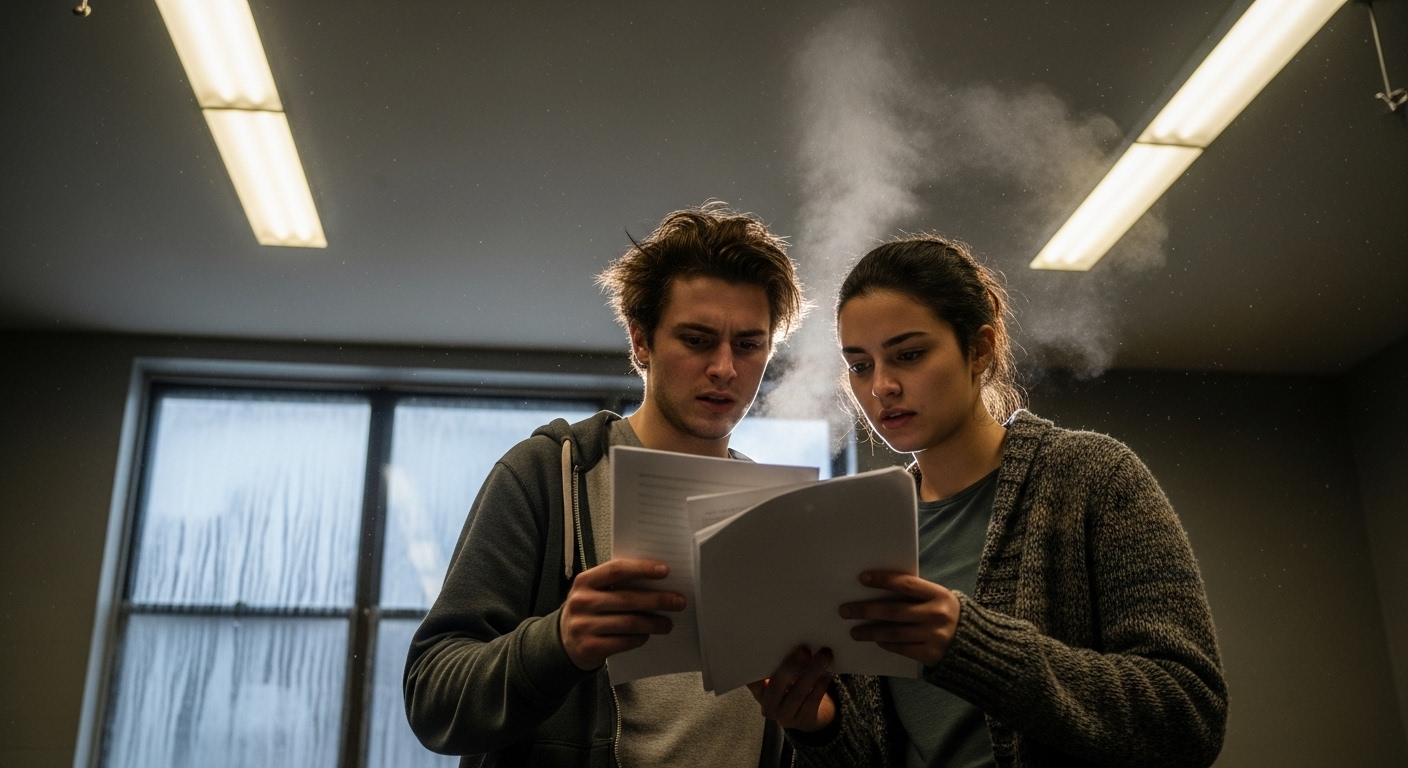
The air in the rehearsal room hung thick and cold, smelling of stale coffee and damp plaster. Outside, a relentless winter wind rattled the single-paned windows, a bleak counterpoint to the increasingly frantic whispers inside. Fluorescent tubes hummed overhead, casting a sickly yellow glow on the worn floorboards and the two figures huddled over a script, their expressions a grim testament to the artistic torture they endured.
Casey’s index finger jabbed at the page, leaving a faint crease on the cheap paper. “No. I still don’t get it. ‘My heart, a paperweight, anchors me to this desolate hearth of forgotten embers.’ What does that even mean?” She looked at Jack, who was gnawing on the end of a pencil, his brow furrowed in a caricature of profound thought. He glanced up, his eyes wide and innocent, a slight smudge of graphite on his cheekbone.
“It means… she’s sad, Casey. Profoundly sad. Her heart is… heavy. Like a paperweight.” Jack’s voice stretched the words out, trying to lend them gravitas, but it sounded thin, like a frayed rope. The air in the unheated hall felt like a damp cloth draped over their shoulders. Condensation was bleeding down the high windows, blurring the already grey winter afternoon into an indistinguishable smear.
“Heavy, like a paperweight,” Casey repeated, trying the line aloud, her voice flat. “It sounds like she ate too much lunch. Or swallowed a brick.” She slumped against the wobbly table, sending a stack of dusty old playbills skittering. One fluttered to the floor, displaying a faded, toothy grin from a forgotten local production of Our Town.
Jack coughed, a dry, rasping sound. “Perhaps it’s… metaphorical? A paperweight, you know, holds things down. Like her despair holds her down?” He gestured vaguely with the pencil, then winced as it snapped. He stared at the two pieces, then shrugged, tossing them onto the table. “Well, that’s useful.”
Casey rubbed her temples. The fluorescent lights overhead buzzed, a constant, low thrum that did little to warm the vast, empty space. This play, The Crimson Willow, was a masterpiece of unintentional comedy. Every line was a convoluted riddle, every plot twist an illogical leap of faith. And their director, the enigmatic Ms. Dubois, insisted it was ‘ground-breaking’.
“Okay,” Casey said, pushing off the table. Her jeans clung to her, chilled. “Let’s take it from the top of page thirty-seven. The scene where I, Lady Beatrice, confront you, Sir Reginald, about your… ‘unsettling affection for the topiary garden’.” She shivered, not just from the cold seeping through the walls, but from the sheer ridiculousness of it all. “Honestly, topiary gardens? Who writes this stuff?”
“A genius, Casey, a visionary!” Jack chirped, springing into an exaggerated stance, one hand held to his chest, the other dramatically sweeping towards an imaginary, pruned shrubbery. “And your delivery, my dear Lady Beatrice, must convey not just disdain, but a deep, existential fear of my… arboreal devotion.” He wiggled his eyebrows suggestively.
Casey snorted. “Arboreal devotion. Right. As if that’s a thing.” She took her position, hands clasped, trying to channel aristocratic bewilderment. The floorboards creaked under her worn boots. A faint scent of old paint and something metallic, like static electricity, hung in the air.
“Action!” Jack commanded, then immediately dropped character to clear his throat. “Sorry. My throat’s like sandpaper. Anyone got a lozenge? No? Right. Carry on.”
Casey took a deep, shaky breath, the cold air biting at her lungs. “Sir Reginald,” she began, projecting, forcing her voice to adopt a regal tremor. “Your… your dalliances in the yew maze. They have become… the talk of the manor.”
Jack’s face, however, was already contorted. He pressed his lips together, trying to suppress a giggle. A tiny snort escaped him. “I’m sorry, I just… ‘dalliances in the yew maze’,” he choked out, shoulders shaking. “It sounds like a bad euphemism for… for something unspeakable involving hedge trimmers.”
Casey dropped her pose, letting out a frustrated sigh. “Exactly! It’s impossible to deliver it straight. We’re going to look like idiots. And Ms. Dubois will just say we’re ‘not finding the truth of the text’.” She kicked at a loose floorboard. The sound echoed in the cavernous room.
“Okay, okay,” Jack said, straightening up, wiping a tear of mirth from his eye. “Let’s approach this… creatively. How do we make ‘dalliances in the yew maze’ less… absurd?” He tapped his chin, his gaze drifting to the bare bulb hanging from the ceiling, as if answers resided in its flickering glow.
“A prop?” Casey suggested, her mind racing. “What if… what if I’m holding something, like a tiny, distressed squirrel? And I keep nudging it towards him, as if to say, ‘Look what your dalliances have done!’”
Jack clapped his hands. “Brilliant! A traumatised squirrel! Or, even better, a particularly judgmental garden gnome! We could have him enter with a small, meticulously crafted topiary miniature of a… well, a badger. And he’s petting it. Obsessively.”
Casey grinned, a genuine, unforced smile that softened the lines of worry on her face. This was what she loved. The ridiculous, the improvisational. The shared, desperate mission to make something out of nothing. “Yes! And then my line, ‘Your arboreal devotion frightens me, Reginald,’ could be delivered with me trying to shield the gnome from his creepy badger.”
“Perfect!” Jack laughed, a bright, booming sound that momentarily chased away the gloom. “That gives it layers! Subtext! And Ms. Dubois will be none the wiser. She’ll just think it’s our ‘artistic interpretation’.” He mimed a conspiratorial wink.
“Remember when she insisted Sir Reginald carry that actual, live pigeon?” Casey shuddered. “That poor bird nearly escaped into the ventilation system. And she swore it symbolised his ‘desire for freedom within the confines of societal expectation’.”
Jack groaned. “And then it pooped on the Baroness. The irony.” He paced across the room, his footsteps heavy. “Alright. New plan for the paperweight line. ‘My heart, a paperweight, anchors me to this desolate hearth of forgotten embers.’ What if, when you say ‘paperweight,’ you pull out an actual paperweight from your corset? A really heavy, ugly one. And you just… set it down. Thud. Like you’re physically demonstrating the burden.”
Casey considered this. “A literal paperweight. From my corset. In a ballgown?” She imagined the scene, the jarring clunk. It was gloriously, profoundly stupid. “Yes. Yes, I like it. It’s so jarringly out of place, it might actually work. It’ll be so bad it cycles back to being good.”
“Exactly!” Jack beamed. “And then, as you say ‘desolate hearth of forgotten embers’, I could be… quietly trying to rekindle a tiny, unconvincing fire in a miniature fireplace with a miniature bellows.” He began to mime the action, puffing his cheeks out, making small 'whoosh' sounds.
Casey watched him, a warmth spreading through her despite the cold. Jack, with his boundless, slightly unhinged energy, was the only reason she hadn’t walked out on The Crimson Willow weeks ago. They were a team, a comedic duo trapped in a dramatic farce. “Okay,” she said, pulling a tattered copy of the script towards her. “Let’s try it with the paperweight and the tiny bellows. And the traumatised garden gnome. We’ll need to find a gnome.”
The Crimson Willow's Burden
They spent the next hour meticulously dissecting the absurdity of Act Two, scene three. Jack proposed that Lady Beatrice’s maid, a character who had exactly three lines, should, in one of them, be silently polishing a very specific, tarnished silver teapot, polishing it with such vigour that it became a commentary on the futility of domestic labour in a decaying aristocracy. Casey countered that the teapot should be dented, a relic of an unmentioned, violent tea party from years past.
“And what about this?” Casey pointed to a line where Sir Reginald declares, ‘My soul yearns for the simple purity of the turnip patch.’ “A turnip patch, Jack. Not even a rose garden. A turnip patch.” Her voice was laced with an almost desperate plea for sanity.
Jack hummed, rubbing his chin. “Well, that’s just… honest, isn’t it? He’s tired of the pomp, the circumstance. He craves root vegetables.” He shrugged, utterly sincere. “Okay, what if… what if you’re actually holding a turnip? A large, earthy turnip. And you clutch it to your chest with a yearning so profound, so utterly bizarre, that the audience questions everything?”
“A turnip.” Casey deadpanned. “Onstage. In a drawing-room scene.”
“Yes! And when you say ‘purity’, you could even… sniff it. Gently. A moment of profound, turnip-induced peace.” Jack’s eyes gleamed with mischief. “It’ll be like… Method acting, but with vegetables.”
Casey couldn’t help but laugh, a genuine, bubbling sound that made her shoulders shake. “Okay, you’re officially insane. But… it just might work. It’s so off-kilter it becomes its own logic.” She could almost picture it, the confused gasps, the uncertain titters, then the slow, dawning realisation that this was, indeed, the only way to play Sir Reginald.
“We’ll make it a very clean turnip, of course,” Jack added, ever the professional. “No soil. Unless the soil is part of the character’s emotional journey.” He paused, considering. “No, probably too much. Just a pristine turnip.”
The room fell silent for a moment, save for the rhythmic shudder of the windowpanes against the winter gale. Casey looked at Jack, and he looked back, a silent understanding passing between them. They were in this together, two young people adrift in a sea of terrible prose, clinging to each other’s absurd ideas to stay afloat. The theatre wasn't always glamour; often, it was cold rooms, impossible scripts, and the camaraderie born of shared struggle.
“So, the turnip,” Casey murmured, a new energy coursing through her. “We need to source a truly magnificent turnip. And a garden gnome. Perhaps a slightly chipped one, for emotional depth.”
Jack nodded, already making a note on the margin of his script. “And the paperweight. Something heavy. Something… evocative of despair.” He squinted at the stage, already visualizing. “I’m thinking antique, slightly tarnished brass. With a tiny, chipped cherub on top.”
---
Casey straightened her posture, suddenly feeling the ache in her lower back from leaning over the table. The clock on the wall, a cheap plastic thing, showed it was past five. Ms. Dubois would be arriving soon, brimming with fresh, bewildering 'notes'. The thought sent a nervous flutter through Casey's stomach. The stakes felt incredibly high, not for critical acclaim, but for simply not embarrassing themselves in front of an audience, or worse, in front of their director's boundless, misguided optimism.
“Alright,” Casey announced, pushing away from the table, a renewed sense of purpose firming her jaw. “Let’s run through Act Two, Scene Three again. With the turnip, the gnome, the paperweight. All of it. We need to solidify our… creative choices.” She took a deep breath, flexing her fingers.
Jack mirrored her, his playful energy giving way to a focused intensity. “And the maid with the furious teapot polishing. We can’t forget her existential crisis.” He picked up his prop teacup, then paused, a sudden thought striking him. “Wait. What if I spill tea on the turnip? Accidentally. It could be a moment of pure, unadulterated human clumsiness amidst the melodrama.”
Casey stared at him. The idea was so monumentally, brilliantly awful, so perfectly in line with the play's inherent flaws, that it had to be a stroke of genius. It wouldn't just distract from the terrible dialogue; it would enhance it. Make it memorable. Make it uniquely theirs. “Jack,” she breathed, a slow, wide grin spreading across her face. “You’re a monster. A beautiful, terrible monster.”
He bowed dramatically. “Only for my art, Lady Beatrice. Only for my art.” He held out the teacup, a tiny, chipped thing, its handle almost worn smooth. “Shall we?”
Casey felt a spark of genuine excitement, a flicker of joy that cut through the rehearsal room's chill. They might be doomed, but they were going down swinging, armed with turnips and gnomes and spilled tea. This wasn't just about surviving The Crimson Willow; it was about making it their own, twisting its bland awfulness into something unexpectedly hilarious. It was a defiant act of artistic vandalism, and she couldn't wait. A sharp rap on the door, three distinct knocks that vibrated through the floorboards, froze them both. The Director. And he had that glint in his eye, the one that promised 'innovative' last-minute changes that would surely make 'The Crimson Willow' even more brilliantly awful.
A sharp rap on the door, three distinct knocks that vibrated through the floorboards, froze them both. The Director. And he had that glint in his eye, the one that promised 'innovative' last-minute changes that would surely make 'The Crimson Willow' even more brilliantly awful.
Share This Story


