The Stubborn Ice
The smell of stale coffee and damp wood hung heavy in the air, a familiar comfort that couldn't quite mask the chill seeping from the ice. Outside, the last stubborn leaves of the aspens clung to branches, a final defiant splash of yellow against the encroaching grey of an Ontario autumn. Inside, the rink's single working fluorescent tube hummed a tired tune, casting a sickly glow over the worn, uneven sheet of ice where my broom met its match.
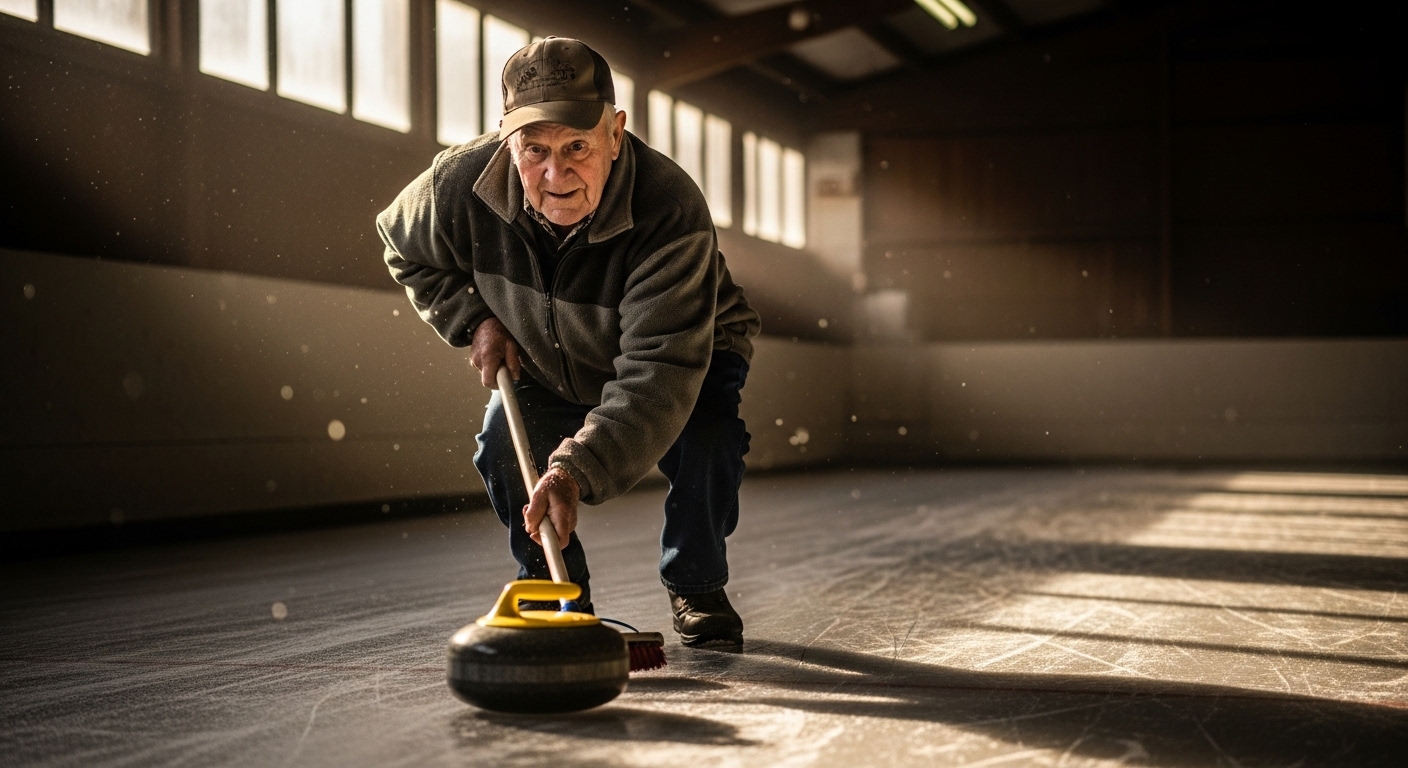
My boot skidded, just a touch. Not much, but enough. The stone, a hefty slab of polished granite, veered left, catching a patch of frost near the hog line, slowing, then wobbling to an ignominious halt a full metre shy of the house. I stopped sweeping, the synthetic bristles of my broom scraping a final, hollow sound on the ice. The air, already crisp with the promise of deep winter, felt colder in my lungs. I blew out a breath, a white plume in the chilly silence.
"Damn it all," I mumbled, more to myself than to the empty rink. My knees ached from the crouch, and a familiar twinge shot through my lower back. Seventy-six years, and the ice still thought it could outsmart me. The problem wasn't the stone, not truly. It was that spot, just past the half-way mark, where the ice always seemed to buckle, a subtle rise that caught every well-aimed shot. I’d complained about it for years. Carole, bless her pragmatic soul, always just shrugged. "We make do, Andy," she’d say. And we did.
I stood, slowly, my spine cracking like old timber. The rhythmic hum of the ancient refrigerator unit, barely holding its own against the chill of the Canadian Shield, was the only other sound. Outside, the birches were losing their last golden coins. The sun, a weak orange smear in the grey autumn sky, filtered through the high windows, illuminating the swirling dust that never quite settled in the high beams. Each particle, I imagined, was a ghost of a puck, a whisper of a cheer, from decades past. This old rink, our community's heart for generations, felt more like a stubborn old man holding onto a past that was quickly fading.
I picked up the stone, its cold, smooth surface a familiar weight in my hand, and carried it back to the hack. My breath hitched, a small, involuntary sound, as my foot slipped on a rogue ice shaving. No, no injury today. Just a reminder. A small, persistent voice in my head, the one that sounded an awful lot like Carole, reminded me that everything, eventually, gives out. I ignored it. Not today. Not this rink.
I took a deep breath, adjusted my grip, and pushed off. The glide was smooth, the release clean. This time, I hit the broom head-on, sweeping with a ferocity that belied my years. My arms pumped, shoulders burning, the broom a furious extension of my will. I focused, not on the ache, not on the dust, but on the precise, delicate physics of the stone's path. It was a dance, a ballet of ice and granite and human effort, an art form in its own way.
The stone slid, straight and true, past the troublesome hump, gaining speed. I kept sweeping, long, powerful strokes. My eyes, though not as sharp as they once were, tracked its every millimetre. It crossed the hog line, then the tee line, coming to rest perfectly in the four-foot, just touching the button. Bullseye. A grunt of satisfaction escaped my lips. There. See? It wasn't impossible.
"Show-off!" A voice, sharp and knowing, cut through the quiet. Carole. I didn't even need to turn around to know she was leaning against the entrance to the rink, arms crossed, a sensible wool scarf wrapped twice around her neck. She always arrived precisely at ten past, after her morning radio show and her second cup of tea. Her gaze, as ever, was practical, observing my small victory with a mixture of approval and exasperation.
"Just getting a feel for the ice, Bea," I said, a little breathless. My chest heaved. I leaned on my broom, trying to look casual, as if I hadn't just emptied my lungs and half my energy into a single perfect shot. The scent of her strong coffee, bitter and warm, drifted over to me.
She pushed off the frame, her boots crunching softly on the concrete. She held a clipboard, of course, its papers fluttering in the slight draft from the still-open front door. "A feel? Or proving a point?" she asked, her eyebrows, thin and grey, raising slightly. "Because the point right now, Andy, is that we're losing the battle on several fronts." Her words were clipped, as usual.
"Oh?" I said, feigning nonchalance. I knew this tone. This was the 'trouble' tone. The kind that usually involved budget shortfalls, crumbling infrastructure, or the dwindling interest of the younger generation.
"The hall furnace, for starters," she stated, walking towards me, her sensible shoes making soft thuds. "Gerald says it's making a noise like a dying moose. Maintenance says it'll cost a small fortune for parts, and a larger one for labour, if they can even find someone to drive this far out." She gestured vaguely towards the window, implying the vast, indifferent wilderness of Northwestern Ontario.
I nodded. "That's… not ideal." The community hall. Right next to the rink, sharing a wall. And more importantly, sharing an even older electrical panel. If the hall's heating went, so did the last pretence of a warm space for post-game chats, or for the meagre canteen.
"Not ideal?" Carole scoffed, stopping a few feet from me. "Andy, it's October. If that furnace goes, the pipes freeze. The hall's finished for the season. And if the hall's finished, our meagre little 'youth programme' for the winter, the one that uses the hall for crafts and snacks, well…" She trailed off, her meaning clear. No warm hall, no programme. No programme, and another piece of our struggling community would just… fade.
"What about the grant?" I asked, hopefully. I knew the answer, of course. We'd applied for every grant under the sun for years. They always seemed to go to 'vibrant urban centres' or 'historically significant landmarks.' Our rink, our hall, our community, was neither of those things. We were just… here. Struggling. Living.
"Rejected. Again." She sighed, a rare display of true weariness. "'Lack of innovative programming,' they said. 'Insufficient youth engagement numbers.' I swear, those bureaucrats in Toronto think every rural community is just waiting for a troupe of avant-garde interpretive dancers to descend from the sky." She looked at me, her eyes sharp. "We need to do something, Andy. Something… dramatic."
Dramatic. Carole wasn't a dramatic woman. Her idea of 'dramatic' was usually adding an extra scoop of instant coffee to the pot. This was serious. My mind, usually focused on strategy on the ice, began to churn. "Dramatic, you say?"
"Bloody hell, Bea, you didn't have to tell him like that." Gerald, our third, lumbered in, his boots scraping louder than Carole's. He carried a battered thermos, condensation blooming on its metal surface. His face, usually a map of perpetual mild annoyance, was etched with genuine concern. Gerald was the youngest of us, only sixty-eight, but he moved like he was eighty. He’d torn his rotator cuff twenty years back lifting a particularly large northern pike, and it had never quite healed right. He was, however, the best 'skip' in our league, his strategic mind still sharp as a freshly honed skate.
"He needs to know the truth," Carole replied, unyielding. "No use sugar-coating it. The community, this whole place, it's on a knife-edge. We lose the hall, we lose the rink, what do we have left? Just the lake and a hundred kilometres of trees." She shivered, though the rink wasn't that cold yet.
Gerald grunted, uncorking his thermos. The rich, sweet smell of black currant tea wafted out, a small comfort. "True enough. Still. Dramatic. What's dramatic enough to fix a whole furnace? A bake sale won't cut it. Maybe… a curling marathon? Forty-eight hours straight?"
I shook my head, already picturing my joints seizing up after a mere two hours. "We'd all be in traction. And who'd watch us? Two spectators, maybe?"
"Hmm." Gerald took a long sip of his tea. His eyes, usually half-lidded, flickered around the rink, then to the high, dusty ceiling, then back to the ice. A slow, thoughtful expression spread across his face, one I recognised from when he was contemplating a particularly tricky draw shot. "What if," he began, his voice taking on a speculative, almost mischievous, tone, "we made it… an event? You know. A real show."
Carole raised an eyebrow. "A show, Gerald? We're curlers. Not Cirque du Soleil. And we're not exactly in a cultural hub. Our last 'show' was Mrs. Henderson's interpretive dance to 'O Canada' at the Legion, and that was twenty years ago. The trauma still lingers."
Gerald waved a dismissive hand. "No, not that kind of show. Something… artistic. Creative. We're in Northwestern Ontario, Bea. We might not have a grand theatre, but we've got… ingenuity. Think of the ice. A stage, right? And curling. It's got grace. Precision. What if we combined it? Art and sport?"
I looked at him, then at Carole. The idea was… preposterous. And yet. A small spark ignited in my chest. "You mean like… a curling ballet?" I asked, my voice dry.
Gerald's face lit up. "Exactly! Or synchronised sweeping! We could have costumes! Music! Young people love that kind of… experimental stuff, don't they? They're always looking for new ways to express themselves, to find a voice here, you know? Our community might be small, but we’ve got talented kids. Kids who sketch incredible things, who play guitar like nobody’s business, who write stories that make you cry. They just need a platform. A unique one."
Carole pinched the bridge of her nose. "Gerald. The hall furnace. Not an avant-garde ice caper."
"But it could fund the furnace!" Gerald insisted. "Think big! 'The Grand Northern Jamboree on Ice'! We could get donations, sponsors! Everyone loves a good spectacle, especially if it's for a good cause. And it's for the kids, Bea. They need something. Something to keep them here, to make them feel like this place isn't just… fading. Give them a reason to imagine, to create, even if it's on a sheet of ice."
I looked at the perfectly placed stone on the button, then out to the grey, autumnal world beyond the rink. He had a point. The kids. They were the reason we kept fighting, kept sweeping, kept patching up this old place. Our little community, isolated as it was, needed anchors, places where creativity could thrive, where people could gather, even if it was just to watch old people slide stones around.
We had a few teenagers, I knew, who were truly exceptional. Little Margaret, who could draw anything she saw with uncanny realism. Her brother, Samuel, who played the fiddle like a demon, his music echoing through the forest on quiet evenings. And Liam, the quiet one, who wrote poetry that somehow captured the vastness of the lake and the loneliness of the long winters, even though he was barely sixteen. These weren't 'artists' in the city sense, but they found their expression in the quiet corners of this wild place.
The idea, for all its absurdity, started to take root. A way to merge the utilitarian need for a furnace with the almost artistic dedication we had to our sport, and to the creative spirit of the young people here. It wasn't about high art, it was about homegrown ingenuity, about proving that even in the most modest of facilities, surrounded by endless trees, imagination could find a way.
"Costumes, you said?" I heard myself ask. The corners of my mouth twitched. The thought of Gerald in a sequined curling uniform was enough to make me smile for the first time that morning. The ache in my back lessened, just a fraction. This was it. Our desperate, ludicrous, quintessentially Northwestern Ontario plan.
---
Carole looked from me to Gerald, then back to her clipboard, as if hoping the answer to our predicament would magically appear between the lines of her budget report. She sighed again, a longer, more defeated sound this time. "You two are mad. Utterly, completely mad. A curling ballet. What next? Synchronised ice fishing?"
"Now there's an idea!" Gerald chirped, clearly emboldened by my tentative approval. He was already half-way to concocting some sort of fishing-themed performance.
"No, Gerald," Carole said, her voice firm, cutting off that particular flight of fancy before it could truly take wing. "One catastrophe at a time. But…" She paused, and I saw a flicker of something in her eyes. Not hope, not yet. Perhaps reluctant acceptance. Or resignation. "If we're going to do this… this thing… it has to be organised. Properly. And it has to actually raise money. Not just provide entertainment for the two of you."
I nodded, a seriousness coming over me. "It will. For the furnace. For the hall. For the kids. This isn't just about throwing stones anymore, Bea. It's about… keeping a flicker going. This place. It needs something." I looked around the old rink, the peeling paint, the faint scent of mould and ammonia, the quiet hum of the ancient machinery. It wasn't much, but it was ours. It was a space.
"Right," Carole said, pushing herself off the wall, a determined set to her jaw. "Then we need a committee. And a budget. And a schedule. And a marketing plan, however rudimentary." She was already listing things, her practical mind snapping into action, finding order in the chaos we’d just proposed. "Who's going to approach the high school for performers? Who's going to talk to Mrs. Peterson about making the costumes? God help us all if she gets her hands on a sewing machine and a vision."
Gerald and I exchanged a look. Mrs. Peterson's sewing abilities were legendary, as were her ideas about 'flair.' The thought of her designing anything for a curling routine was terrifying and, at the same time, perfectly in keeping with the ridiculousness of our plan.
"I'll… I'll talk to Liam about his poetry," I offered, feeling a strange sort of lightness in my chest. If we could get him to read his work, to share his voice, it would be a triumph in itself, far beyond any money we might raise for a furnace. It was about creating something new, something that had never been seen on this ice before, something that might just make a difference.
"And Samuel with his fiddle," Gerald added, his eyes bright. "And Margaret for set design, perhaps? We could project her drawings onto the ice. An art installation on skates!" His imagination was running wild, a rare sight for the usually gruff Gerald.
Carole just shook her head, a small, exasperated smile playing on her lips. "Fine. But no explosions. And no live animals. And someone has to clean up all this dust." She tapped her clipboard decisively. "Meeting at my place tonight, seven o'clock. Bring ideas. Sensible ones, if you can manage it." She cast a withering glance at Gerald, who was already humming a jaunty, unrecognisable tune.
I walked over to my stone, still sitting pretty on the button. The ice, despite its imperfections, had held true. Just like our little community, despite its challenges. It wasn't about perfection; it was about finding the line, making the shot, and knowing that sometimes, a little bit of creative sweeping could get you exactly where you needed to be.
The rink grew quiet again, the hum of the fridge a low thrumming against the silence. Outside, the last light of day was fading, taking with it the last of the autumn warmth. Winter was coming, and with it, the cold bite of reality. But for a moment, standing there, broom in hand, I felt a flicker of warmth, a spark of something new on the horizon.
I wiped my hand on my fleece. "Right then," I said, a smile pulling at the corners of my mouth despite myself. "A grand-scale, highly artistic curling-themed variety show. What could possibly go wrong?" The silence that followed was thick, punctuated only by the groan of the old Zamboni in the corner, as if in agreement.
Share This Story


