The Stain on Page Thirty-Two
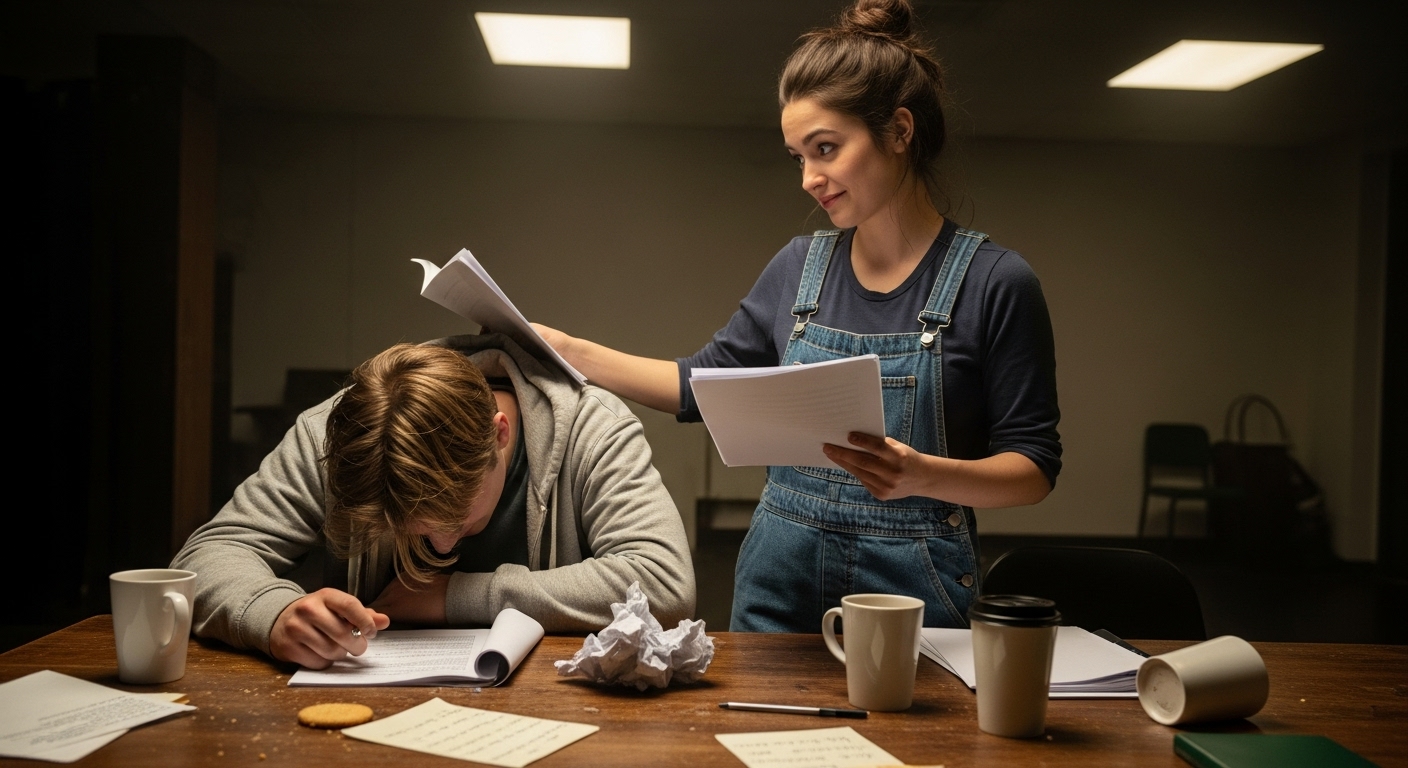
The air in the dusty rehearsal room hung thick with the ghosts of forgotten lines and stale coffee. Outside, autumn rain lashed against the theatre's grimy windows, a fitting percussive accompaniment to the internal storm brewing between Connie and Terry as they stared at the offending script. A singular, inexplicable ink blot marred page thirty-two, right over the most ludicrous monologue, a tiny, dark omen, like a splotch of dried blood on a map to nowhere. It was a detail only they, the doomed navigators of this theatrical shipwreck, would ever notice or assign such dire significance.
The blot on page thirty-two wasn't just ink; it was a physical manifestation of Oliver’s unhinged genius, or lack thereof. Connie traced its rough edge with a fingernail, feeling the raised texture like an unhealed scar. Rain pattered against the window, the rhythmic thud a counterpoint to the hollow thrum of dread building in Terry’s chest. He stared at the offending paragraph, a monologue delivered by her character, Aunt Seraphina, detailing the precise nature of the ‘Crimson Weave’ and its effect on the ancestral family lineage. The very phrase made his teeth ache. The script, Beneath the Willow’s Waning Shadow, was a family saga so convoluted it ate its own tail, then spat it out, somehow uglier.
“Seriously, what even is the Crimson Weave?” Connie asked, her voice dry, a rustle of dying autumn leaves. She didn’t look up from the page, as if by avoiding his gaze, she could avoid the question’s full, horrifying weight.
Terry pulled at a loose thread on his oversized, threadbare jumper. “I believe, and I use the term ‘believe’ with the utmost generosity, it’s a genetic predisposition to… catastrophic tea spillages. Or possibly a penchant for wearing too many brooches at funerals. Or, the dreaded, unspeakable, family curse that binds the descendants of Dame Genevieve to the abandoned manor, forcing them to reenact the ancient ‘Feast of the Fading Harvest’ every autumn under threat of… well, it’s never explicitly stated, but I assume a rather aggressive fungal infection.” His voice was a flat, deadpan drone, utterly devoid of hope.
Connie snorted, a sharp, unladylike sound. “No, no, that’s the ‘Willow’s Waning,’ darling. The tea spillages are a separate, equally vital plot point in Act Two, Scene Four, after Great-Uncle Bartholomew attempts to seduce the governess with a marmalade tart.” She flipped through the script, the pages groaning. “The Crimson Weave, if my meticulous analysis of this steaming pile of literary detritus is correct, is the psychic connection between the eldest daughter of each generation and the ghost of a particularly judgmental badger.”
Terry slapped the table, a dull thud, sending a forgotten pencil rolling. “A badger? You’re telling me… we’re doing a play where the central conflict of the family saga, the very essence of the Orinthia family’s tragic destiny, hinges on the spectral opinions of a subterranean mammal?” He didn’t want to laugh, but the sound escaped him anyway, a desperate, breathless huff. The theatre felt cold, the kind of pervasive chill that seeped into bones and settled in the marrow, a perfect setting for a play so utterly devoid of warmth.
“Well, it’s either that,” Connie said, finally meeting his eyes, a glint of shared, manic amusement warring with profound despair, “or it’s what happens when Oliver consumes too much artisanal Kombucha before writing. Both scenarios are equally plausible, and frankly, equally terrifying.” She gestured around the cramped rehearsal room, a space that smelled faintly of old plaster and forgotten dreams. An abandoned coffee cup on the floor, its contents a thick, viscous sediment, seemed to mock their predicament.
Oliver. Director Oliver. The man whose vision was so singular, so utterly divorced from conventional narrative, it achieved a kind of accidental surrealism. His last play had involved a twelve-foot-tall puppet made entirely of recycled chewing gum, representing the protagonist’s repressed childhood trauma. It had also, coincidentally, required a scene where the audience was blindfolded for a full fifteen minutes while a recording of whale song played. Terry shuddered. The memory was a cold, slick thing against his skin.
“Do you remember his note about the… the subtlety of the ancestral portrait?” Terry asked, pushing himself up to pace the small room, his steps scuffing loudly on the worn linoleum. The floorboards creaked beneath him, a mournful complaint. He nearly tripped over a stray prop shoe. “He said, ‘The portrait of Patriarch Orinthia must convey the weight of a thousand years of quiet desperation, without actually showing any desperation. It should feel desperate, Terry. You must become the desperation of the ages, in the paint strokes.’”
“And then he demanded it be painted on a bedsheet with watercolour,” Connie finished, shaking her head. “Because, and I quote, ‘authenticity demands the medium mirror the family’s crumbling finances, even if their manor has solid gold faucets.’ What even is a family saga with solid gold faucets and crumbling finances, anyway? The logical inconsistencies in this thing could birth a new universe.”
The Looming Theatrical Doom
They both fell silent, the weight of the task pressing down like the heavy, wet air outside. Their professional reputations, slender and fragile as spun sugar, hung by the thinnest thread. This was their first big break since graduating from the academy, and it was quickly shaping up to be a public humiliation on par with a particularly aggressive case of wardrobe malfunction during a live broadcast. Terry fidgeted, unconsciously peeling a loose sticker from the back of his script, the adhesive catching on his thumbnail. He glanced at the faded poster for a past, forgotten production tacked to the wall, a grinning clown advertising a children's show. A clown. At least that production knew what it was.
“We have to salvage it,” Terry finally said, his voice lower, the banter momentarily gone, replaced by a grim resolve. “We can’t… we can’t let this be our defining moment. Our artistic epitaph. ‘Here lie Connie and Terry, buried under the weight of a spectral badger and a tragic tea ceremony.’”
Connie leaned forward, her elbows on her knees, the script tented open between them. Her voice, when it came, was soft, but sharp, like broken glass. “We lean into the absurdity. We exaggerate the pauses. We make the melodrama so utterly, unequivocally over-the-top that it becomes a commentary on melodrama itself. A meta-tragedy. A post-modern family saga.” She picked at a loose thread on her denim overalls, her brow furrowed in concentration. The scent of her shampoo, something vaguely herbal, mingled with the dusty air.
“A commentary?” Terry repeated, intrigued despite himself. “So, when your character, Aunt Seraphina, says, ‘The blood of the Orinthias runs thick with ancient sorrow, a river of tears flowing into the sea of forgotten vengeance,’ I don’t just say it. I… I caress the words? I let them hang in the air, dripping with such profound, unearned gravitas that the audience starts to question reality?”
“Exactly!” Connie’s eyes lit up, a mad spark in their depths. “And when Dame Genevieve’s ghost, your character, flits across the stage for the ninth time, to warn us about the rising humidity and its effect on the ancestral tapestries—because, remember, she’s obsessed with textile preservation, apparently — you don’t just flit. You flit with the existential despair of a woman trapped in an eternity of damp fibre. You make it a choice. Every nonsensical line, every baffling plot twist, we make it a deliberate, artistic choice.”
Terry started to smile, a slow, dangerous curve of his lips. “So, the scene where Cousin Thaddeus reveals his lifelong passion for collecting antique thimbles, causing the entire Orinthia estate to shudder under the weight of his secret shame… I could play it like he’s confessing to ritualistic murder. All the pauses. All the intense eye contact with the audience.” He demonstrated, a flicker of genuine performance breaking through his usual self-deprecation, staring wide-eyed at an imaginary camera lens in the corner of the room. He felt a weird twitch in his left eyelid, an unexpected symptom of his growing desperation.
“Oh, absolutely,” Connie affirmed, a theatrical swoon in her voice. “And when Grandmother Elspeth, my other character, discovers the family’s hidden cache of stale shortbread, which Oliver insists is the ‘true catalyst of the Orinthia downfall’…” She shuddered, visibly. “I will play it like I’ve uncovered the Ark of the Covenant, weeping tears of genuine, soul-crushing despair over the crumbling crumbs. The smell of those crumbs, Terry, that stale, sugary, deathly smell, it will be the scent of our damnation!”
---
Oliver’s Whispers and the Art of Subversion
Oliver, bless his utterly deranged heart, had a habit of leaving them voice messages that veered between cryptic koans and direct, baffling instructions. Just yesterday, he’d left a seven-minute message, mostly comprised of him humming a discordant folk tune, interspersed with pronouncements like, “The subtext, my dears, is like a wormhole in the fabric of existence. Dive in. Embrace the distortion. Especially in the scene with the… the ornamental cabbage.” The ornamental cabbage. That was another gem in this crown of thorns, a key prop in the ‘Feast of the Fading Harvest’ that was supposed to symbolise ‘the transient nature of earthly desires’ and also, apparently, be edible.
“He said the ornamental cabbage must ‘resonate with the silent screams of generations of thwarted love’,” Connie mimicked, her voice dropping to a gravelly, theatrical whisper. “And also, ‘it needs to be crunchy.’ The crunch, he stressed, was paramount for the dramatic impact of Act Three.” She picked up a loose piece of gravel from the floor, idly tossing it in her palm. The tiny scrapes it made against her skin were a minor, but persistent, distraction.
“The crunch,” Terry repeated, nodding solemnly. “So, when Cousin Thaddeus, after his thimble confession, takes a bite of said cabbage, it has to sound like a thousand souls being crushed under a giant boot. I can do that. I can make that crunch sing with the agony of a thousand years of an oppressive family lineage that forced him into a life of clandestine thimble acquisition.” He ran a hand through his perpetually messy blonde hair, pushing it back from his forehead, a gesture of exhaustion and sudden, desperate inspiration. His mind, usually a chaotic jumble of half-formed ideas and anxieties about rent, felt surprisingly sharp, focused by the sheer, unadulterated badness of the play.
He imagined Oliver’s face, a perpetually surprised expression behind enormous, round spectacles. The director’s passion was undeniable, his vision, however warped, absolute. It was this absolute certainty, coupled with the absolute lack of sense, that made him so formidable. They couldn’t argue with him; they could only interpret, twist, and subvert.
Connie leaned closer, her eyes gleaming. “We’ll be like theatrical ninjas. Subtly shifting the weight, changing the rhythm, injecting layers of sarcasm into every earnest pronouncement. The audience won't know what hit them. They'll leave not thinking, 'What a terrible play,' but, 'What a profound, meta-theatrical experience, a searing indictment of the very nature of storytelling, and also, that actress really sold the stale shortbread moment.'” Her voice was quick, urgent, the kind of breathless excitement that came from a truly desperate plan. She felt a phantom itch on her ankle, a tiny, annoying sensation that mirrored the mental itch of a script so fundamentally broken.
“And the reviewers?” Terry asked, a fresh wave of panic momentarily dousing her fire. “What if they just think we’re bad actors? What if they don’t get our… our subversive brilliance?” His throat felt tight. He could almost smell the metallic tang of fear, mixed with the damp autumn air from the open window.
“Then we blame Oliver, obviously,” Connie said, waving a dismissive hand. “We throw him under the metaphorical bus of avant-garde theatre. We lament his ‘bold, uncompromising vision’ which ‘unfortunately transcended the boundaries of immediate comprehension.’ It's a classic move. It’s what he deserves for making us suffer through lines like, ‘My heart, like a forgotten well, thirsts for the dew of your unspoken affections, yet only finds the bitter sediment of ancestral grudges.’” She paused, letting the full weight of the line settle. “I mean, honestly.”
Terry groaned. “That’s the line I have to say to your character, Aunt Seraphina, in the ‘forbidden garden’ scene. The garden of… what was it? Regretful hydrangeas?”
“No, that’s Act Four. That's when you discover the secret passage behind the tapestry, which leads to the hidden conservatory where the family dog, Fido, is secretly breeding prize-winning orchids. The garden is ‘The Garden of Unrequited Parsnips’,” Connie corrected, without missing a beat. “Remember, the parsnips symbolise ‘the root of all evil’ within the Orinthia clan.”
“Ah, yes. The parsnips. Of course.” Terry pinched the bridge of his nose, feeling a headache bloom behind his eyes. He thought of the script, its pages yellowing slightly, each word a tiny thorn in his brain. The rain outside seemed to intensify, drumming a frantic rhythm against the panes, as if the heavens themselves were trying to signal their impending doom. He felt a weird, associative jump in his brain: the rain, the parsnips, a childhood memory of his grandfather, a stern man, forcing him to eat boiled parsnips, insisting they would ‘build character.’ Character. He needed some now, to survive this. His stomach rumbled, a stark reminder of how long it had been since he'd had a proper meal, a detail as irrelevant as it was grounding.
The Unspoken Agreement
Their eyes met again, and in that shared glance, an unspoken agreement solidified. They were in this together. A theatrical two-person support group, clinging to each other’s sanity amidst the storm of Oliver’s unreason. It wasn't just about salvaging the play; it was about protecting their shared, fragile future in this precarious profession. They were young, barely out of their dramatic arts programs, and a spectacular flop, especially one involving spectral badgers and regretful hydrangeas, could be a career-ender.
“So,” Connie began, shifting her weight, her voice regaining its earlier urgency. “We need to block out Act Three, Scene Two, ‘The Disclosure of the Grandfather Clock’s Ghastly Secret.’ The one where your character, the ghost of Dame Genevieve, possesses the grandfather clock and speaks through its chimes, revealing that the family fortune isn’t in gold, but in… antique spools of thread. The ones with the tiny little spiders woven into them.”
“The spider-thread,” Terry murmured, a theatrical shiver running down his spine. “Oliver said, ‘The chimes must convey the inherent stickiness of familial obligation, the subtle entrapment.’ How exactly does one make a clock chime sticky?” He picked up his coffee cup, drained the cold, bitter dregs, and grimaced. He needed more caffeine, or possibly a lobotomy.
“We will find a way,” Connie declared, standing up, stretching her arms above her head, her spine cracking softly. “We will make that clock chime with the stickiness of a thousand forgotten debts and the quiet desperation of an aunt who secretly uses her nephew’s spools to knit miniature hats for garden gnomes.” She walked over to the makeshift stage area, a cleared space marked by masking tape, and struck a pose, her hands outstretched, as if presenting a truly horrifying revelation.
“The garden gnomes aren’t in the script,” Terry pointed out, his voice already falling into the rhythm of their collaborative insanity.
“No, but they should be,” Connie retorted, turning to him, her eyes wide with a manic gleam. “They would add a layer of… surreal domesticity to the overarching theme of generational trauma. Oliver would probably love it. He’d say, ‘Yes! The gnome. The silent sentinel of suburban despair! Brilliant, Connie, utterly brilliant!’”
Terry shook his head, a wry smile finally breaking through. “He probably would. We’re going to have to make a list of all our proposed ‘interpretations.’ We need to be organised in our subversion, meticulous in our madness.” He pulled a notebook from his bag, its cover adorned with a faded, slightly crumpled image of a nebula he’d once thought inspiring, now just a blurry swirl. He clicked his pen, the sound sharp and definitive in the otherwise quiet room. The outside world, with its cold rain and the scent of damp earth, felt increasingly distant, replaced by the bizarre universe of Oliver’s play.
“Right,” Connie said, pacing the small stage. “So, for the clock scene. When you, as Dame Genevieve's ghost, possess the clock, and it chimes with the spider-thread secret… what's your physicality? Oliver said it had to be 'subtly threatening, like a spider's web woven around a sleeping infant's crib, but also terribly, terribly sad.' And the chimes, Terry, the chimes.” She snapped her fingers. “They need to lament.”
“Lamenting chimes,” Terry mused, already envisioning it. He started to mimic the slow, mournful swing of a pendulum, his body stiff, his arm rising and falling in an exaggerated, mechanical rhythm. He made a low, humming sound, attempting to emulate the 'sticky' lament. He looked utterly ridiculous, his eyes wide and vacant, his posture a parody of a decrepit timepiece. He felt a weird cramp developing in his shoulder, an unintended consequence of his physical commitment.
Connie watched him, a faint smile on her lips, a glint of appreciation in her eyes. Despite the dire circumstances, the sheer collaborative joy of their work, of wrestling meaning from the absurd, was a powerful current between them. It was a strange kind of familial bond, forged in the crucible of bad art and shared professional anxiety. They were two unlikely siblings, bonded by the monstrous creation they had to bring to life. The wind howled softly outside, a mournful sound that seemed to carry the distant, faint smell of woodsmoke, a reminder of the autumn world beyond their theatrical bubble.
“Perfect,” Connie said, then paused, her gaze drifting towards the doorway. A strange, metallic scraping sound echoed from the corridor outside, growing louder, accompanied by a muffled groan. Her eyebrow arched. “What in the name of Oliver is that?”
Terry stopped his clock-mime, his eyes widening. “Oh, gods. Please don’t tell me it’s the ancestral portrait. Oliver swore he’d have that thing done by now. I can’t handle a twelve-foot watercolour bedsheet today. Not after the parsnips.” He braced himself, a low-level hum of anxiety buzzing beneath his ribs. It felt like the prelude to another, even more convoluted, plot point for their already unmanageable family saga. The air suddenly felt charged, a faint static scent like distant lightning. This could only mean one thing: more madness was arriving.
As the prop master wheeled in a bizarre, oversized porcelain birdcage, far too ornate and heavy for any logical scene, Connie and Terry exchanged a look that promised both shared agony and a perverse, desperate resolve. The true nature of their theatrical quest, it seemed, had only just begun to unfurl its grotesque, feathered wings.
Share This Story


