The Disturbed Display
In the cold, cavernous community arts center during a bitter winter, a young artist named Alex finds an unexpected and unsettling disruption to their carefully arranged exhibit research, sowing seeds of doubt about their fellow collaborators, Bea and Caleb.
The single, anemic strip light hummed above, a metallic insect trapped in the high ceiling. Its pallid glow did little to dispel the gloom that clung to the corners of the old community arts center, especially now, deep in the relentless grip of January. My breath plumed faintly in the frigid air as I walked through the main gallery space, each footfall echoing hollowly on the polished concrete. The building, a former textile mill, always felt like it held its breath in winter, its vast, unheated spaces exhaling a damp, forgotten chill that worked its way into your bones.
I was there, as usual, absurdly early. Early enough that the only sounds were the building’s creaks and groans, the distant, almost inaudible hum of the city’s early morning awakening. We were supposed to be finalizing our proposals for the 'Echoes of Industry: Our Town's Past' exhibit, a project Bea, Caleb, and I had foolishly, or perhaps bravely, committed to. It was a history-art hybrid, a grand idea hatched over lukewarm coffee in late autumn, now congealing into a frost-rimed reality.
My corner of the sprawling main room was, ostensibly, my domain. A cluster of tables, pushed together into a makeshift workbench, formed the epicenter of my research. Piles of archival photographs, brittle newspaper clippings, and photocopied census records lay scattered, carefully categorized. Or, they had been. This morning, something was amiss. The meticulous order, the fragile architecture of my nascent exhibit narrative, felt… shifted.
My gaze swept over the tables. The stack of sepia-toned photographs depicting the original mill workers, which I'd arranged by date, now had a distinct lean, like a miniature Pisa. The accompanying notes, scribbled on index cards outlining the lives of these early settlers, were not aligned. One, specifically, a card detailing the arduous journey of the MacGregor family from the Scottish Highlands, was turned face down. Not a catastrophic disarray, not a frantic ransacking, but a deliberate, almost surgical rearrangement.
My hand, still gloved from the walk through the biting wind, hovered over the overturned card. My brain, a perpetually overactive centrifuge of anxieties, immediately spun up a dozen possibilities. A draft? Unlikely, given the building’s ancient, unyielding solidity. A clumsy custodian? They usually came through much later. Which left… Bea. Or Caleb.
My fingers twitched, pulling off a glove. The skin was numb, tinged blue. I turned the card over. 'MacGregor, 1888. Sheep farming. Lost everything. Sailed for new world with 3 shillings and a prayer.' Simple. Stark. My proposed centerpiece. My idea. Had one of them been here before me? Had they been… looking?
A prickle started at the base of my neck, then migrated, a cold, insidious crawl, down my spine. Bea had been unusually quiet yesterday. Caleb, conversely, had been a torrent of tangential observations about abstract expressionism, ignoring my attempts to discuss the MacGregor family's plight. We were all artists, yes, but also rivals, vying for that single, prominent spot by the main entrance. The one the curator had vaguely promised to 'the most compelling narrative.'
I picked up a different photo, an aerial shot of the town from 1920, the mill a monstrous, vital entity dominating the riverbank. I had planned to use it as a backdrop, overlaying it with modern images to show the passage of time. Now, a faint, almost invisible smear smudged the corner, like someone had traced the outline of the mill with a gloved finger, then wiped it clean. Not a random smudge, but a calculated touch, a proprietary gesture. My teeth gritted.
The air, already thin and sharp, seemed to tighten around me. I tried to dismiss it, to rationalize. It was just an art project. A local history exhibit. Not a high-stakes corporate espionage thriller. But my mind, well-practiced in the dark arts of self-sabotage and suspicion, refused to comply. I pictured Bea, her perpetually unreadable expression, her dark eyes that seemed to take in everything and give away nothing. Or Caleb, with his easy charm and the way he always steered conversations back to his own artistic merit.
We were supposed to be a team. Collaborative. Creative. Yet, the unspoken competition hummed beneath every shared glance, every carefully phrased compliment. I walked slowly around the entire table, my internal monologue a frantic, whispered debate. Had the MacGregor card been an accident? A stray gust of wind? The smear on the photograph, an oversight? What was… stupid?
My hands found their way into my pockets, clutching the cold coins there. I paced, the soft scuff of my boots against the floor. I should just… ask. Ask them. But what would I say? 'Did you, perchance, tamper with my historical documents and photographic evidence of human toil and triumph?' The question itself felt absurd, yet the feeling in my gut was anything but. This was domestic. This was our space, our collaboration. The threat, if there was one, was coming from inside the house.
I remembered Bea’s comment last week about my 'traditional approach' to the mill history. She’d said it with a smile, but her eyes had held that glint, that barely perceptible tremor of judgment. Had she been hinting that my research, my meticulous chronology, was boring? That it lacked… artistic flair? Caleb, of course, had immediately chimed in with a story about a performance piece he'd once seen that involved 'recontextualizing industrial decay through interpretive dance.' My mind had promptly short-circuited.
The building creaked again, a long, drawn-out sigh from its ancient timbers. I stopped, listening. It sounded like footsteps, distant, from the gallery’s main entrance. Too early for anyone else. My heart picked up a beat, a frantic drummer in my chest. Bea or Caleb. One of them. Here. Now. I ducked instinctively behind a tall, freestanding partition, an unfinished drywall panel meant for displaying larger works.
My knuckles bumped against the rough texture of the drywall, a faint cloud of white dust puffing into the air. I held my breath, straining my ears. The footsteps were clearer now, echoing with deliberate slowness. Too slow for someone just arriving and heading to their workspace. It was the pace of someone browsing, observing, maybe… inspecting.
A shadow stretched across the polished floor, long and distorted by the weak overhead light, passing just beyond my hiding spot. I tried to discern the shape, the profile. It was too indistinct. Male or female? Hard to tell. My paranoia, like a starved beast, began to gnaw at every possible interpretation. They were checking. They were making sure I hadn't noticed their earlier trespass. Or, worse, they were here to continue their clandestine activities.
The air grew colder around me, a distinct wave of icy drafts. Was the exterior door ajar? Had they deliberately left it open to make it seem like anyone could have been here? This was getting ridiculous. I mentally slapped myself. An exhibit. A local history exhibit. What kind of dark machinations could possibly be at play over a diorama of early settlers and their looms?
But the feeling persisted, a stubborn burr under the saddle of my reason. The way Bea had looked at my sketches, the way Caleb had dismissed my idea for a soundscape of textile machinery, saying it was 'too literal.' Everything felt like a subtle affront, a psychological skirmish. I clutched my phone in my pocket, the cold plastic a small anchor. My thumbs hovered over the screen, tempted to scroll through our group chat, searching for any veiled messages, any hidden meanings in their emoji usage.
The footsteps stopped. Right in front of my tables. My heart hammered, a frantic drum against my ribs. I squeezed my eyes shut for a second, then opened them to a narrow slit. I peered through a slight gap where the partition met the wall. I saw a hand. Long, slender fingers, with neatly trimmed nails. Definitely Bea’s. Or Caleb’s, if he’d finally decided to clean up his act.
The hand reached down, then hovered over the stack of photographs. My MacGregor photos. Was she going to move them again? Take one? My mind conjured images of her slipping a key piece of my research into her own bag, then presenting it as her own, leaving me floundering. The betrayal would be total. The comedic element entirely lost on my furious, hyper-vigilant brain. I imagined the ensuing confrontation, a quiet, seething argument over municipal historical documents, the curator awkwardly refereeing.
The hand didn't move the photos. Instead, it picked up a small, forgotten pencil from the edge of my table. A dull, stubby thing I’d been using for preliminary sketches. It was a simple, innocuous action. Yet, my mind immediately warped it. Why that specific pencil? Was it a marker? A signal? Had it been placed there deliberately to gauge my reaction? My thoughts were a tangled knot of conspiratorial threads, each more flimsy than the last, yet all feeling profoundly real.
The person sighed, a soft, almost imperceptible sound that was undeniably feminine. Bea. It had to be Bea. My shoulders slumped slightly, the rush of adrenaline receding into a sour taste in my mouth. Bea, with her art school air and her 'found object' installations. What did she want with my pencil? Was she… using it? To draw? To sabotage my work with a surreptitious, tiny doodle of a disgruntled sheep?
Then, the sound of fabric rustling, a low murmur of indistinct words. Was she talking to herself? Plotting aloud? I leaned in closer, pressing my ear against the cool drywall. The murmur stopped. A silence, heavy and pregnant with unspoken intentions, descended. I imagined her standing there, surveying my domain, her mind teeming with her own 'compelling narratives,' perhaps even one incorporating my own painstakingly researched local history.
I needed a plan. To confront her directly? To subtly retaliate? Maybe I could 'accidentally' spill coffee on her meticulously organized collection of discarded industrial gears she’d found in the abandoned factory downriver. Or, I could just… breathe. Step back. This was not a thriller. This was a low-budget art exhibit in a town no one had heard of, overseen by a curator whose most radical thought was switching from oat milk to almond milk in her morning latte. But the sense of infiltration, of a domestic space compromised, remained stubbornly intact.
The footsteps resumed, receding this time, towards what I assumed was her own section of the gallery. I waited, counting each hollow echo until they faded completely. Only then did I slowly emerge from behind the partition, my knees stiff from crouching. The studio was empty again, save for the hum of the fluorescent light and the ghosts of forgotten textile workers. And my tables. My precious, now compromised, tables.
I walked back to my research station, my eyes scanning for any new transgression. The pencil was gone. The dull, stubby pencil. Had she taken it? Why? It was just a pencil. Not a masterpiece, not a historical artifact. Unless… unless it was a psychological operation. A test. To see if I would notice. To see how I would react. My chest tightened. This was far from over.
My gaze fell upon the MacGregor family card again. It was still right side up. But now, beside it, almost hidden by the edge of a photocopied newspaper article, was a small, perfectly folded slip of paper. Not mine. Definitely not mine. My hand trembled slightly as I reached for it, the chill of the gallery seeping deeper, an unsettling promise in the quiet morning air.
Unfolding it, I saw Bea’s distinctive, looping script. A single sentence, stark and unadorned, written in the same dull pencil that had just vanished from my table. 'You left your lunch bag by the door. Don't want the mice to get it.' I stared at the note, then at the empty table, then at the door, and a fresh wave of something akin to cold, raw panic, mixed with a profound, almost dizzying confusion, washed over me. The pencil was hers all along? And the lunch bag... I'd forgotten it entirely.
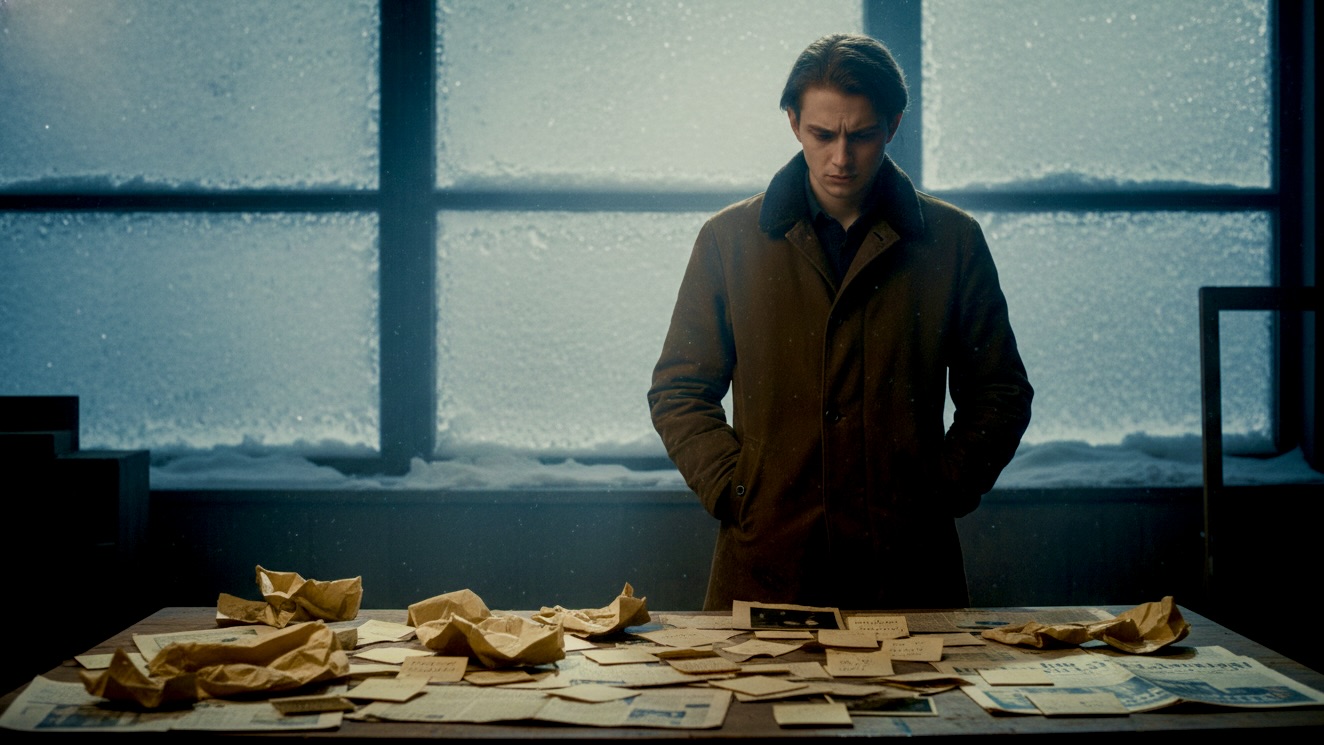
The realization hit me with the force of an oncoming train, not just of my forgotten lunch, but of the elaborate, terrifying conspiracy I had so painstakingly constructed around a simple, borrowed pencil, and now, the profound, unsettling silence that followed, was only broken by the frantic, echoing beats of my own, suddenly very lonely, heart.
Share This Story


