Generator's Lament
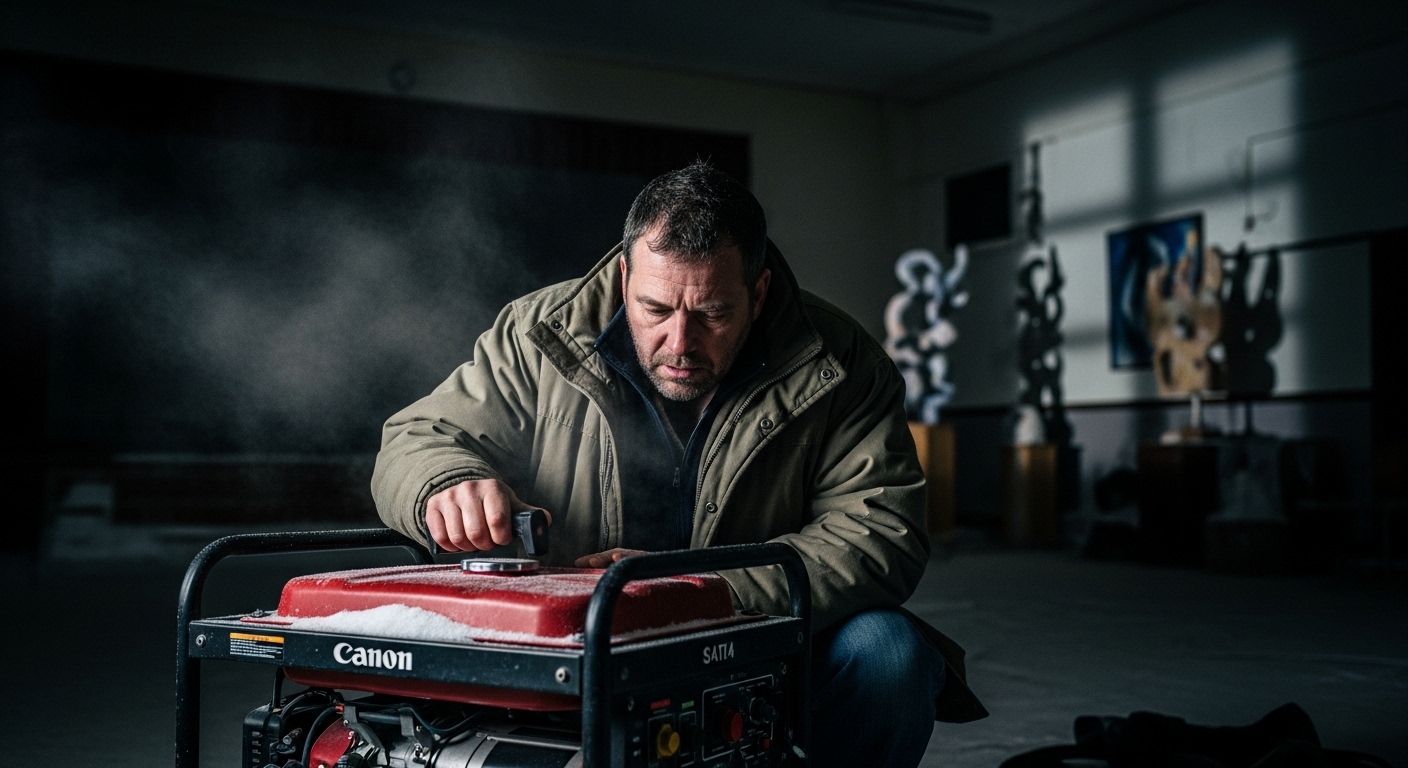
The Borealis Hub was a frigid tomb, the silence broken only by the wheeze of the wind against ill-fitting windowpanes and the desperate, metallic coughs of a dying generator. Snow piled against the grimy exterior, sealing us in a pocket of profound, icy inconvenience. Every breath misted, every surface radiated a deep, unyielding cold that promised to turn any exposed limb into a brittle, useless thing. It was a perfect setting for an art exhibition, if your chosen medium was frostbite.
My breath, a ragged plume of white, hung in the air for a moment before dissolving into the pervasive cold that clawed at every exposed bit of skin. My knuckles, already scraped raw from wrestling with the infernal machine, were sticky with cold grease and something I hoped wasn't old mouse droppings. The portable generator, a relic from the early 90s, coughed one last, asthmatic shudder, and then, with a final, dying whimper, it went silent. The emergency lights, strung up with a distinct lack of enthusiasm by yours truly, flickered once more, then plunged the Borealis Hub into an even deeper, more profound gloom. The wind, which had been merely a suggestion of a gale, now seemed to roar with triumphant malice against the thin walls of the old building.
“No, no, no,” I muttered, more to myself than to the defunct metal box that had just betrayed me. My fingers, numb despite the threadbare wool gloves I wore, fumbled with the pull cord again. It was useless. The fuel gauge had been hovering on ‘empty’ for two days, and my last run for petrol had ended with a snowdrift that swallowed my old pickup whole. I still hadn't dug it out. This was how it always went in Perch River, Ontario, especially in late February. Just when you thought you’d reached the absolute nadir of logistical despair, the universe would lean in and whisper, ‘Oh, you sweet summer child.’
A shadow detached itself from the deeper darkness near what we optimistically called the ‘gallery space.’ It was Denise Girard, our lone, perpetually earnest volunteer. Her ski jacket, a truly obnoxious shade of neon green, was zipped up to her chin, making her look like a particularly anxious, brightly coloured caterpillar. Her arms were wrapped around a lumpy, misshapen sculpture that I vaguely remembered being titled ‘Winter’s Embrace.’ It looked less like an embrace and more like a terrified badger trying to escape a particularly aggressive snowball fight.
“Tyler? Is it… is it really out this time?” Denise’s voice was a reedy whisper, barely cutting through the building’s creaks and groans. Her eyes, wide and nervous, darted around the cavernous main hall. I could see the tiny white puffs of her own breath as she spoke. She was twenty-seven, fresh out of some art history program down south, and still possessed a baffling, almost childlike faith in the inherent goodness of people and, more bafflingly, art.
“Yeah, Denise. Really out,” I confirmed, dropping the pull cord with a thud that echoed ominously. My teeth were starting to ache with the cold. I rubbed my hands together, trying to coax some warmth back into them, a futile gesture against the encroaching chill. “Looks like ‘The Great White Blank’ exhibit is getting a rather authentic, unheated experience.”
Denise took a step closer, gingerly adjusting her grip on the badger-snowball. “But… the ice. What about Mrs. Davison’s ice sculpture? It’s supposed to be the centrepiece!”
Mrs. Davison’s ‘ice sculpture’ was, in reality, a meticulously carved, highly abstract rendition of what she claimed was a moose in mid-stride. To anyone else, it looked like a block of ice that had lost a fight with a beaver. I had to admit, the cold wouldn’t do it any favours. It would simply melt, and then refreeze into a puddle, then melt again, until eventually, it became indistinguishable from the puddles that already formed randomly across the hall floor.
“Mrs. Davison’s moose will return to its natural state, Denise. Water,” I stated, injecting a dry humour that was entirely lost on her. “It’s a comment on the ephemeral nature of… well, everything, I suppose.”
Denise’s face fell. “But the unveiling is tomorrow night! And Mayor Carleton said she’s bringing that critic from Toronto, the one who writes for that big city magazine!”
The critic. Right. I’d almost forgotten that particular, exquisitely painful detail. Brenda Carleton, our esteemed mayor, had a way of ‘securing’ high-profile guests for our events without, you know, actually asking if the events were capable of hosting high-profile guests. She operated on a level of unshakeable optimism that bordered on delusion. My internal monologue, a constant companion of cynical observations, was already writing the scathing review: ‘Perch River’s cultural scene offers a truly immersive experience… in hypothermia.’
“Well, we’ve got until tomorrow to find a new generator, or invent a portable sun,” I sighed, kicking a loose floorboard. The board groaned in protest, a sound it had perfected over decades. The smell of damp wood and something vaguely like old coffee grounds hung in the air, a familiar scent of the Borealis Hub.
Suddenly, the double doors at the main entrance creaked open with a gust of wind that was less a sigh and more an arctic blast. Snow swirled in, momentarily obscuring a figure bundled in a coat of truly formidable proportions. It was Brenda Carleton herself, her cheeks rosy from the cold, a smile plastered on her face that seemed to defy all laws of physics and common sense. She clapped her gloved hands together with an audible smack.
“Oh, dear! The power, it seems to have… gone out!” Brenda declared, her voice a bright, chirping thing that seemed entirely out of place against the sudden, bone-deep silence. She gestured vaguely at the gloom, as if the darkness itself were a misbehaving child. Her eyes, however, seemed to shine with an unshakeable inner light, perhaps powered by sheer willpower or, more likely, an industrial-strength battery pack concealed somewhere in her voluminous coat.
“No kidding, Brenda. Thought it was just a particularly aggressive eclipse myself,” I mumbled, finally giving up on the generator. My fingers curled into fists, trying to warm them. They felt like rigid, frozen sausages.
Denise, ever the dutiful one, managed a weak smile. “Mayor Carleton! We were just trying to keep everything from… well, freezing.” She gestured helplessly at the collection of local art: a watercolour of a particularly sad-looking beaver, a collage made entirely of dryer lint, and a series of photographs depicting various shades of grey snow.
Brenda waved a dismissive hand. “Nonsense, dear! A little chill builds character! And besides, it adds to the ambience, doesn’t it? The rustic, authentic North! The critic, Mr. Fitzwilliam, he’ll adore it. He’s all about raw, unfiltered experience, you know.” She beamed, apparently mistaking ‘unfiltered experience’ for ‘the imminent onset of hypothermia.’
“He’ll adore the dripping condensation on his cashmere scarf, I’m sure,” I muttered under my breath. My teeth chattered, a little jig of despair. This was a new level of self-delusion, even for Brenda. But then again, Perch River was founded on self-delusion, mostly about finding gold that turned out to be pyrite.
Brenda began to bustle around the main hall, her heavy boots crunching on the dusty floor. She paused in front of a particularly abstract piece, a collection of rusted metal scraps bolted to a salvaged piece of driftwood. “Ah, young Thomas’s ‘Urban Decay in the Boreal Forest’! So poignant. So… rusty.” She turned, a thoughtful expression on her face. “We should put a spotlight on it! Oh, wait.” She chuckled, a sound like dry leaves skittering across ice. “No power.”
As if on cue, a distant, unsettling gurgle echoed from the back of the building, followed by a faint, high-pitched whine. It sounded suspiciously like a pipe under duress. My internal warning system, usually quite reliable in its predictions of impending doom, went into overdrive.
“What was that?” Denise asked, her voice several octaves higher than before. Her grip on the badger-snowball tightened visibly.
“Probably just Beaulieu, trying to fix the boiler again,” Brenda chirped, entirely unfazed. “He’s always tinkering.”
Beaulieu was our resident handyman/grumpy sage. He knew more about the inner workings of this dilapidated building than anyone, mostly because he’d probably built half of it in his youth. But his ‘tinkering’ often led to… unexpected results. Like the time he tried to fix the leaky roof with tar and old license plates.
The gurgling intensified, quickly escalating into a frantic, splashing torrent. It was getting closer. Too close. It sounded like a small, angry waterfall. And it was coming from the direction of Mrs. Davison's prized ice moose.
“That’s not Beaulieu tinkering,” I said, a cold dread seeping into my stomach, colder than the room itself. “That’s a burst pipe.”
Denise gasped, a small, choked sound. Brenda, however, only furrowed her brow. “A burst pipe? Oh, how… dramatic! Perhaps it’s a performance art piece? A commentary on the fluidity of… existence?”
I didn’t wait for her to finish her philosophical musings. I sprinted, or rather, slid and stumbled, through the darkness towards the sound, Denise hot on my heels. The smell of cold, fresh water was now distinct, a clean, sharp scent that momentarily cut through the old-building mustiness. Around the corner, past a display of ‘found objects’ (mostly old bottle caps), we found the scene of the disaster.
A thick, copper pipe, running along the wall just above Mrs. Davison’s melting moose, had split along a seam. A geyser of icy water, surprisingly powerful, was arcing outwards, directly onto the already beleaguered ice sculpture. Water was pooling rapidly on the concrete floor, already starting to sheen with ice. Mrs. Davison’s moose, what was left of it, was being unceremoniously washed away, its abstract contours smoothing into formless lumps. The dryer lint collage, innocently positioned beneath, was now a sodden, grey mess, its carefully arranged fibres disintegrating into a swampy pulp.
“Oh, dear,” Brenda said, finally catching up, her voice losing a fraction of its indomitable cheer. Even she seemed to register the severity of the situation. “That’s… quite a lot of water.”
“Quite a lot of water?” I practically shouted, my voice cracking with a mixture of frustration and something close to hysterical amusement. This was beyond a joke. “Brenda, we’ve got a flash flood in the middle of our art gallery, and Mrs. Davison’s magnum opus is currently performing a vanishing act!”
Just then, Beaulieu shuffled into the scene, a weathered and eternally unimpressed figure. He wore an ancient, faded Carhartt jacket that seemed to have absorbed every spill and stain the Borealis Hub had ever produced. He didn’t say anything, just peered at the spraying pipe with narrowed eyes, then spat a stream of tobacco juice into a nearby (thankfully empty) bucket. “Thought I heard something,” he grunted, his voice like gravel in a blender. He reached into his pocket and pulled out a rusty monkey wrench, the tool looking like an extension of his own gnarled hand.
“Can you stop it?” Denise pleaded, wringing her hands, her face a mask of genuine distress. She looked at the ruined dryer lint collage with the kind of heartbreak usually reserved for lost puppies.
Beaulieu just gave a noncommittal shrug. “Valve’s seized up in the basement. Gonna need more than a wrench for that. And power. The old pump’s frozen solid.” He gestured vaguely towards the basement access hatch. “Best we can do is try to divert it for now.”
For the next twenty minutes, we descended into a chaotic, freezing ballet of buckets, mops, and Beaulieu’s surprisingly nimble, if slow, pipe-patching efforts. Brenda, to her credit, joined in, though her contributions mostly involved cheerfully but ineptly sloshing water towards already full buckets, or slipping precariously on the icy floor. Denise, tearful but determined, tried to salvage what she could of the smaller pieces, carefully moving them to a 'safer' (i.e., less actively flooding) section of the hall.
My hands were beyond numb now; they felt like frozen claws. My teeth chattered so violently I thought I might chip one. But there was a strange, almost perverse satisfaction in the absurdity of it all. Here we were, in the middle of nowhere, battling the elements to save a collection of art that, if I was being brutally honest, probably belonged in a skip. Yet, we were doing it. We were fighting. For what? For community? For a shred of beauty in a relentlessly bleak landscape? Or just because we were too stubborn, or perhaps too stupid, to give up?
We managed to slow the geyser to a steady, manageable drip, temporarily shunting it into a series of increasingly overflowing buckets. The main gallery space, however, was a disaster. A thin sheet of ice now coated a significant portion of the floor, and Mrs. Davison’s moose was nothing but a memory, a wet patch, and a few stray carrot shavings (her signature, apparently). The dryer lint collage was a total loss, a pulpy grey blob that looked even sadder than the beaver watercolour.
“Well,” Brenda announced, wiping a smudge of dirt from her cheek with the back of her glove, her smile miraculously restored to full wattage. “That was quite the… unexpected development! But we’ve proven our mettle, haven’t we? Resourcefulness! Resilience! Mr. Fitzwilliam will simply adore our spirit!”
I just stared at her, too cold and too tired to argue. My hip ached from where I’d slipped on the ice. Denise was mournfully poking the remains of the lint collage with her boot.
“Actually,” Brenda continued, suddenly looking a little sheepish, a rare crack in her armour of unwavering optimism. “About Mr. Fitzwilliam. I might have… slightly embellished. He’s not just a critic. He’s also looking for a location for his next… documentary. Something about the tenacity of the human spirit in challenging environments.” Her eyes gleamed. “And he’s arriving first thing tomorrow morning for a surprise ‘walk-through’ before the main event.”
My head spun. A documentary? Surprise walk-through? Before the main event, which was now a slushy, half-frozen disaster zone? I looked from the dripping, useless installation to Brenda’s beaming face, then to Beaulieu’s stoic gaze. One night. A single night to conjure an entirely new centrepiece from thin air, or whatever frozen detritus we could salvage. And I knew, with the chilling certainty of a man who’d seen too many winters, that this was just the beginning.
I looked from the dripping, useless installation to Brenda’s beaming face, then to Beaulieu’s stoic gaze. One night. A single night to conjure an entirely new centrepiece from thin air, or whatever frozen detritus we could salvage. And I knew, with the chilling certainty of a man who’d seen too many winters, that this was just the beginning.
Share This Story


