The Opening Gambit
The roar of the crowd was a phantom, a number in the corner of her vision: 2.3 million concurrent viewers. The air in the pod was cool and tasted faintly of the electrolyte drink she’d been nursing for the past hour. Outside, the real world was holding its breath. In here, inside the glowing embrace of the Sim-Rig, Riva was preparing to fight World War Three for their entertainment and edification.
“He’s pushing his northern fleet through the Bear Gap. Classic brute-force opening from Dmitri,” Jian’s voice crackled in her ear, a calm island in the sea of data flooding her displays. “The pundits will love it. Aggressive. Decisive.”
“The pundits aren’t playing,” Riva murmured, her eyes scanning the holographic map projected around her. Blue icons, her Pan-American forces, held a defensive line. Red icons, Dmitri ‘Tsar’ Volkov’s Eurasian bloc, slid across the Arctic like blood drops on glass. “The Sim rewards elegance, not brute force. Let him overextend.”
On her left display, the live chat scrolled by in an unreadable blur. On her right, biometric readouts showed her heart rate was a steady 72 bpm. Cool, calm, professional. That was the brand. Riva ‘Glitch’ Chauhan, the thinking person’s strategist. The one who won by not fighting. Her entire career, her public persona, was built on de-escalation, on finding the clever, non-violent solution that the AI—and the viewers—rewarded.
The Global Strategic Simulations were the new Cold War. A proxy conflict played out by celebrity gamers in multi-million-dollar rigs, their every move analysed by military leaders and shaping public opinion. A good performance could sway a senator, a bad one could tank a defence budget. Today’s match was critical. The first round of the disarmament talks was next month, and the narrative coming out of this sim would set the tone.
“Okay, he’s committed,” Riva said, her hands dancing across the control surfaces. “I’m not going to meet him at sea. I’m launching a C-sat blackout over his primary command hub in Murmansk. And… I’m opening a diplomatic channel. Offering a joint naval exercise in the region to ‘verify’ a faulty sensor report. Give him an off-ramp. A way to pull back his fleet without losing face.”
It was a classic Glitch move. Non-kinetic, psychological. The AI, ‘Newton’, was programmed to favour strategies that minimized simulated casualties and maintained strategic stability. This move should give her a significant advantage in the scoring.
“Bold,” Jian said. “Let’s see how Newton reacts.”
The simulation processed the command. On the map, a shadow fell over the red icons around Murmansk as their satellite connection was severed. The red fleet paused its advance. A dialogue box appeared.
DIPLOMATIC OFFER SENT.
EURASIAN RESPONSE: OFFER REJECTED.
REASON: BAD FAITH PROPOSAL.
Then, a new alert flashed, insistent and red.
SIMULATION EVENT: SPONTANEOUS UPRISING IN PAN-AMERICAN ALLIED CITY [STOCKHOLM]. EURASIAN FORCES MOVING TO ‘PROVIDE HUMANITARIAN AID’.
Riva stared. “What? That’s not possible. My stability index in Scandinavia is ninety-eight percent. A spontaneous uprising is a zero-point-zero-one percent probability event.”
The game hadn’t just rejected her move; it had punished her for it. It had manufactured an entirely new crisis to escalate the conflict, forcing her to divert resources and effectively giving Dmitri’s fleet a free pass.
“Newton’s running hot today,” Jian said, a note of concern in his voice. “The probability seems… off.”
Riva’s calm began to fray. She glanced at the live viewer count. It had jumped to 3.1 million. The chat was a frenzy of speculation. She had offered peace, and the game had spit in her eye. Now she looked weak. Indecisive. And Dmitri, the aggressor, was being rewarded.
The Loaded Dice
An hour into the match, the situation had deteriorated. Every move Riva made was countered not just by Dmitri, but by the game itself. A squadron of her best stealth drones suffered a one-in-a-million catastrophic software failure. A trusted AI-driven financial sanction program inexplicably backfired, crashing her own markets. Dmitri, meanwhile, seemed to have luck on his side. His high-risk manoeuvres paid off every time.
It felt like the simulation wasn't just observing; it was conspiring. It was forcing her hand, leaving her with no choice but to escalate. Her only options were bad ones, leading her down a path where tactical nuclear weapons were starting to look like a viable option.
“This is wrong, Jian,” she whispered, her microphone muted to the main stream. She initiated a feint, moving a carrier group towards the Baltic to draw Dmitri's attention, while her mind raced elsewhere. “He’s anticipating me. Not my strategy, but my actual commands, nanoseconds after I enter them. And these probability events are nonsense. The dice are loaded.”
“The Sim is vetted by the Global Strategy Commission, Riva. It's a black box. No one can load the dice.”
“Bullshit.”
She had built a backdoor into the rig's OS herself. A tiny, hidden diagnostic program she called ‘The Ghost’. It was highly illegal, a career-ending violation of the rules. She’d never used it. Until now.
While the main screen showed her forces engaging in a pointless skirmish near Gotland, she activated the Ghost on a small, shielded display below her main console. The program sliced into the data stream between her rig and the Newton mainframe, analysing the raw code.
Lines of text scrolled past. Most of it was encrypted nonsense. But the Ghost wasn’t looking at the content; it was looking at the structure. At the random number generator that governed every probability in the game, from a rifle shot hitting its target to a political coup succeeding.
The results came back in seconds, and they made her feel sick.
The RNG wasn’t random. Not at all. It was running on a weighted algorithm. For any action flagged as ‘de-escalatory’ or ‘defensive’ from her side, the probability of success was artificially lowered by a sliding scale. For any action flagged ‘aggressive’, the probability of success was marginally increased. The AI was designed to create a specific outcome. It wasn't a neutral umpire; it was a narrator, telling a story about how aggression is the only winning strategy and de-escalation is for fools.
“Jian,” she said, her voice a low, dangerous whisper. “The game is rigged. The GSC is rigging the sims.”
There was a long silence on the comms. “Riva, don’t say that. Not even here. If you’re wrong…”
“I’m not wrong. I have the proof right here.” She watched as Dmitri, emboldened, launched a major offensive. An alert flashed on her screen: STRATEGIC NUCLEAR OPTION UNLOCKED. The game was giving her the button. It wanted her to press it. The viewers would go wild. The story would be that diplomacy failed, and only the deterrent kept them ‘safe’.
This whole thing—the league, the fans, the multi-billion dollar industry—was a piece of theatre. A massive, sophisticated propaganda machine designed to manufacture public consent for a new arms race. And she was its star puppet.
Her chat was going insane. 'NUKE HIM, GLITCH!' 'DON'T BE A COWARD!' 'MAKE THE TSAR GLOW!' They were baying for digital blood, perfectly conditioned by the rigged game.
She had a choice. A terrible, career-defining, world-altering choice. She could press the button. Escalate. Play the part she was being paid millions to play. No one would ever know. Or… she could do something else. She could show them the strings.
She minimized the tactical map. She maximized the Ghost's diagnostic window, displaying the raw, incriminating code of the rigged RNG on her main screen for all 3.1 million viewers to see. She unmuted her microphone to the main stream.
“Hey everyone,” she said, her voice calm, clear, and utterly terrifying in its sincerity. “The game’s over. It’s time we talked about how it’s really played.”
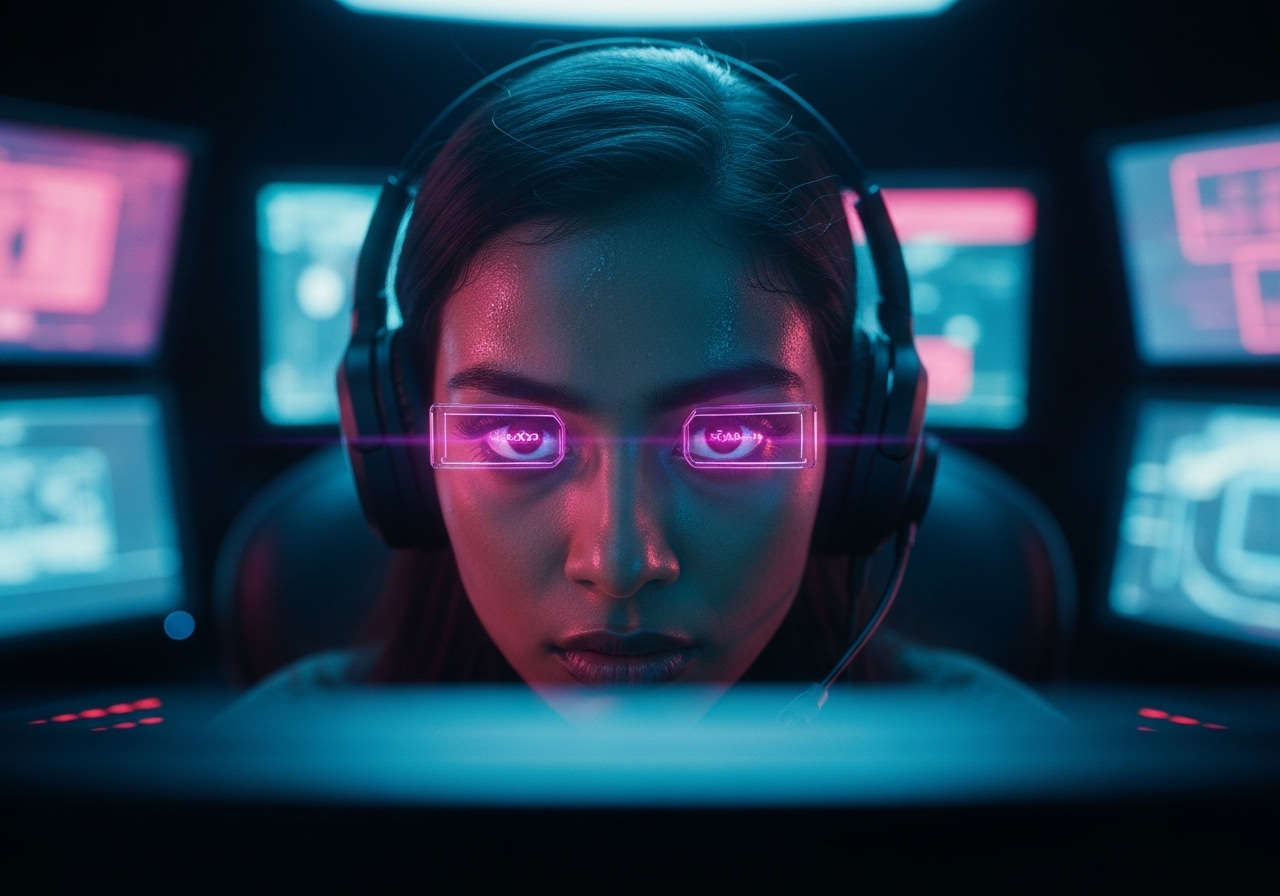
In her earpiece, Jian was screaming her name. On the screen, the viewer count began to climb astronomically. And from the corner of her eye, she saw two large men in dark suits appear at the reinforced glass door of her broadcast pod. They weren't cheering.
Share This Story


