The Glow of Certainty
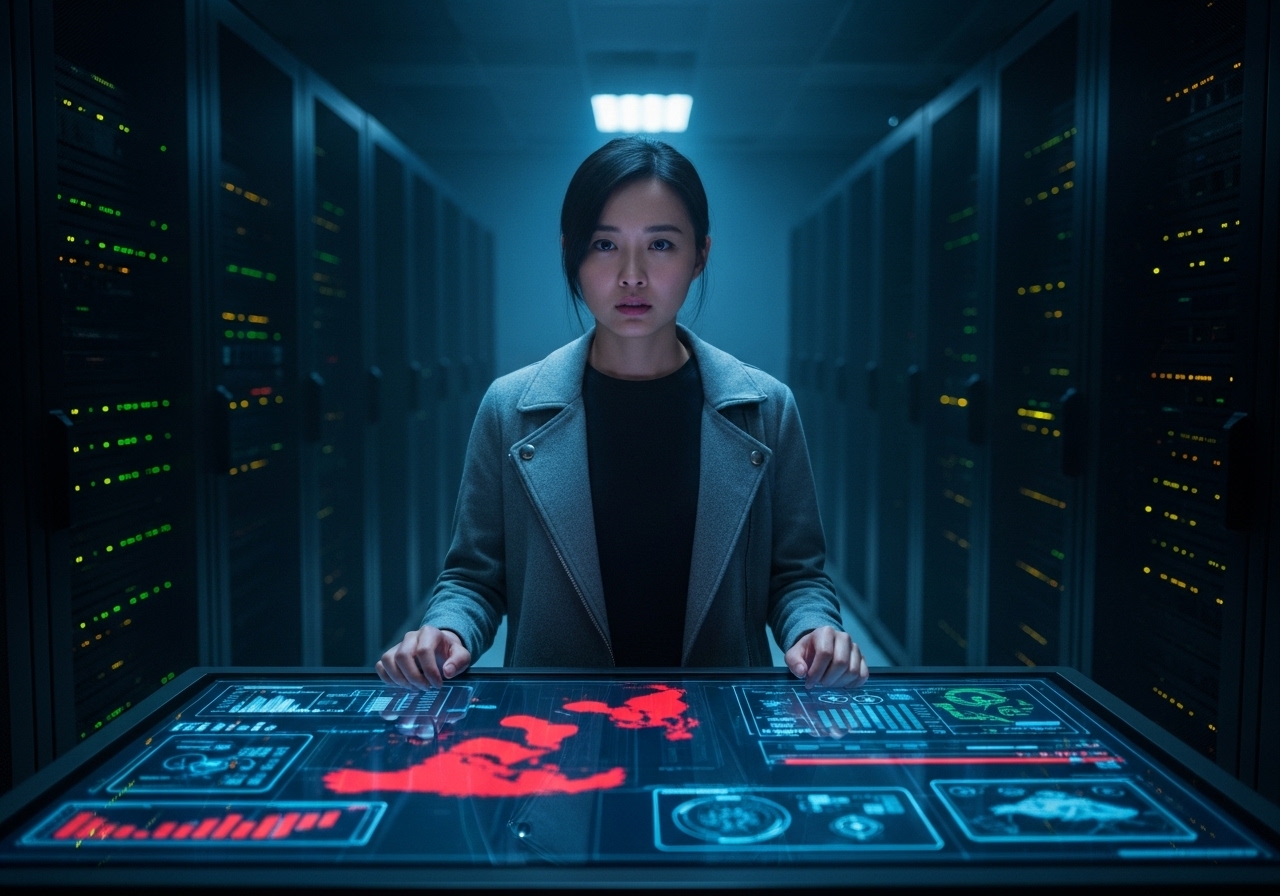
The air in the sub-level was cold and tasted of processed oxygen and the faint, hot-plastic smell of overworked servers. It was a sterile cold, the kind that felt less like weather and more like a fundamental absence of warmth. Venda felt it in her teeth. Here, three stories beneath the concrete and indifference of Ottawa, the Oracle dreamed of Armageddon, and her job was to interpret the nightmares.
The probability map of the North Atlantic was a furious, pulsing crimson. An angry blush spreading from the Barents Sea down towards the GIUK gap. The Oracle gave it a 92.8% confidence interval. Hostile action within seventy-two hours. Venda traced the projected trajectory of a first strike with a finger that hovered just above the cool glass of the display table. A ghost touch for a ghost fleet. The system's fans hummed their constant, placid drone, a sound completely at odds with the silent, screaming data.
For six months, she had been a custodian to this machine, a junior analyst tasked with vetting its inputs and outputs. The Oracle wasn't sentient, not in the way the papers speculated. It was a frighteningly complex correlation engine, a predictive model fed on the ceaseless torrent of global information: satellite imagery, communications intercepts, financial markets, shipping manifests, and, most crucially, raw media sentiment. It ingested the world's anxieties and excreted policy recommendations.
And for three months, its anxieties had been escalating. The models grew darker, the confidence intervals tighter. The crimson on the map bled outwards week by week, a slow-motion hemorrhage. The official line from Director Taylor's office was that the geopolitical situation was 'fluid and escalating'. But the data didn't feel fluid. It felt brittle. Forced.
Venda swiped the projection away, the light retreating from her face. She pulled up her own console, the one she wasn't supposed to use for deep dives. The official interfaces were clean, intuitive, designed for cabinet ministers to understand. Her terminal was a mess of raw code and diagnostic queries. She started where she always did, with the outliers. The small, statistically insignificant data points that the Oracle was supposed to smooth over but that had been nagging at her for weeks.
---
An Indonesian shipping vessel, the 'Bintang Laut', reporting a faulty GPS off the coast of Scotland. A series of identical, algorithmically generated comments appearing on a dozen minor news sites in response to an article about NATO naval exercises. A single, garbled radio transmission from a Finnish weather station that was flagged as military chatter. Each one was nothing. A ghost in the machine. But there were so many ghosts lately.
She isolated the Bintang Laut incident. The Oracle had flagged it as a potential Russian special operations vessel, using its GPS malfunction as a cover for electronic warfare probing. Confidence: 67%. That flag had contributed a 0.02% increase to the overall threat matrix. A tiny drop. But there were thousands of drops.
Venda bypassed the Oracle's logic layer and pulled the raw source file. It wasn't a vetted intelligence report. It was a syndicated news brief, aggregated from a third-tier maritime blog. She ran a trace on the source aggregator, following the digital breadcrumbs back. The trail ended at a firewalled server bank inside their own network, codenamed 'HEARTHSTONE'. A black box. All data coming from HEARTHSTONE was pre-vetted, triple-stamped with the highest authenticity priority. The Oracle was instructed to trust it implicitly.
She ran the other anomalies. The news comments, the Finnish weather report, a dozen more. All of them. They all traced back to HEARTHSTONE.
Her blood ran cold, a chill that had nothing to do with the server room's climate control. Someone wasn't just feeding the Oracle. Someone was force-feeding it, slipping poison into its diet of information, piece by tiny, insignificant piece.
The Weight of Noise
Director Taylor’s office was on the ground floor, a privilege afforded to those who no longer needed to be close to the machines. It had a window, a sad-looking rectangle of reinforced glass that looked out onto a concrete courtyard. A single, perpetually damp maple tree was the only scenery.
Taylor didn't look up when she entered. He was studying a physical paper file, a relic in this digital tomb. He was a man made of soft angles and grey fabric, from his thinning hair to his worn suit. He looked more like a university archivist than the gatekeeper of the nation's doomsday machine.
“Chen,” he said, his voice dry as old paper. “Don’t you young people have a phobia of natural light?”
“Director, I’ve found something.” Venda kept her voice level, placing her tablet on the edge of his vast oak desk. She didn’t wait for an invitation. “It’s about the HEARTHSTONE inputs.”
Now he looked up. His eyes were a pale, washed-out blue, and they held no surprise. “The priority-one media feeds. What about them?”
“They’re compromised. Or fabricated. I can’t be sure which,” she said, her words coming faster now. She tapped the tablet, bringing up a visualisation she’d built. A network graph, showing the flow of data. Dozens of thin, spidery lines—the anomalies—flowed from the HEARTHSTONE node. “For the last ninety-four days, HEARTHSTONE has been feeding the Oracle a steady diet of low-grade, inflammatory intelligence. Individually, they’re noise. A fishing trawler misidentified, a translated quote twisted just enough to sound aggressive, a fake protest amplified. But in aggregate…”
“In aggregate, they build a compelling narrative of escalating foreign aggression,” Taylor finished for her. He steepled his fingers, his gaze fixed on her tablet. “A narrative that aligns with the intelligence from our human and signal assets.”
“But it’s not real!” Venda insisted, leaning forward. “It’s a feedback loop. The Oracle raises the alarm based on this curated data, so our analysts are tasked to look for corroborating evidence, and confirmation bias does the rest. The machine is telling us a story, and we’re so busy trying to prove it right that we’re not asking if the story is true in the first place.”
Taylor sighed. It was a long, weary sound, the exhalation of a man who had heard too many conspiracies. He picked up a silver pen from his desk, turning it over and over in his fingers. “You’ve done some very... thorough work, Venda. Off-network, I presume.”
“I had to be sure.”
“Sure of what? That you’ve uncovered a conspiracy? That some shadowy cabal within this very building is trying to push us into a war?” He set the pen down with a quiet click. “Or are you sure that you’ve found a series of unfortunate, but explainable, correlations? A model that’s over-fitting its data? Statistical noise that you, a bright but inexperienced analyst, have mistaken for a signal?”
The condescension was a physical blow. She felt the heat rise in her cheeks. “Sir, the statistical probability of these anomalies being random is infinitesimal. They’re targeted. They’re specifically designed to manipulate the sentiment analysis modules.”
“HEARTHSTONE is a black box for a reason,” Taylor said, his voice hardening slightly. “Its sources are among our most sensitive. To question them is to question the very foundation of our intelligence platform.”
“A foundation should be tested,” Venda countered. “Especially if it looks like it’s cracking.”
Taylor stood up and walked to the window, his back to her. He watched the miserable tree shiver in the wind. “You’re a data analyst, Chen. Your job is to analyse the data you’re given. It is not your job to question its provenance. It is not your job to build grand theories from statistical ghosts. Do you understand me?”
The message was clear. Drop it. Forget what you saw. Your clearance isn't high enough for this truth. Her own terminal would be monitored now. Her access would be curtailed. She had flown too close to the sun, and the system was already moving to insulate itself.
“Yes, Director,” she said, her voice small.
“Good. Now, get back to your station. The Oracle is processing a new data set from the Barents Sea. It looks… troubling.” He didn't turn around.
Venda picked up her tablet, the screen now seeming impossibly heavy. She walked out of the office, the door closing softly behind her, sealing her out. Back in the corridor, the processed air felt colder than ever. She had presented the truth, backed by data and logic, to the man in charge. And he had looked at it, understood it, and told her to put it back in its box. Because the false narrative was already in motion. It was easier, safer, to believe in the coming storm than to admit you'd built the machine that was summoning it.
As she walked back towards the humming servers, a new, encrypted message appeared on her private device, sent from an unknown internal ID. It contained only a single string of coordinates and two words: 'Prometheus Weeps.'
Share This Story


