The Archive's Unraveling
Three teenagers, Leonard, Cassie, and Sara, are navigating a city that is physically dissolving and transforming into surreal imagery. They are in desperate search of their art history professor, Ed Caldwell, who they hope holds answers. They find him in a shifting university archive, where he calmly explains the allegorical importance of art and imagination as the only means to navigate or even reconstruct their disintegrating reality. As the surreal threats escalate, they are forced to apply these abstract concepts to find a way forward.
The ground was a wet sponge, then concrete, then something else, crumbling into a fine, black dust that smelled like burnt toast and damp earth. Leonard stumbled, his sneaker catching on a ripple in what should have been solid asphalt. Cassie, a few steps ahead, glanced back, her breath a ragged gasp. Her pale blue hoodie, usually vibrant, seemed to absorb the sickly green light spilling from the sky, making her face look bruised. Sara, bringing up the rear, slipped. A low cry, more of surprise than pain, escaped her lips as her knee scraped against coarse, gritty pavement that was definitely not there a second ago.
"Keep moving!" Leonard yelled, his voice raw, swallowed by the distant, warping groan of buildings that seemed to stretch and then compress, like clay on a potter's wheel. The air grew thick, humid, then shockingly cold. A cherry tree, laden with pink blossoms, appeared directly in their path, its branches thrashing despite no wind, shedding petals that sparkled with an unnatural, silver luminescence before dissolving on the 'ground' below. One landed on Leonard's cheek, cold and wet, then vanished, leaving a strange, metallic tang on his skin.
His heart hammered against his ribs. He shouldn't be here. None of them should be. Just a regular spring afternoon, walking to Professor Caldwell's art history lecture. That's all it was supposed to be. Then the sky had rippled, the buildings had started to breathe, and the world had become… this. A broken kaleidoscope. He pushed through the phantom tree, its branches feeling like wet rope against his jacket, a phantom sweetness on his tongue.
Cassie didn't wait. She navigated the shifting terrain with a peculiar grace, her eyes wide, but not entirely panicked. She saw the world differently, always had. While Leonard wrestled with the physical impossibility, Cassie seemed to be mapping its impossible logic. She saw a streetlamp lean, its light pulsing orange and purple, and she instinctively knew the ground beneath it would swell next. She veered left, towards a wall that shimmered, patterned with what looked like a thousand fragmented eyes watching them, each pupil a swirling galaxy.
Sara, recovering, pushed herself up. The pain in her knee was a dull throb, a small, reassuring anchor in the chaos. She tried to categorize, to analyze. The distortion wasn't random, not entirely. There was a rhythmic quality to the shifting, a pattern to the decay. Like a corrupted algorithm. She gripped the strap of her backpack, her knuckles white. Professor Caldwell. He was supposed to have answers. He always did, even if they were answers about a long-dead artist's struggle.
They ran, past storefronts where mannequins in static poses twisted into grotesque, elongated shapes, their plastic skin peeling back to reveal vibrant, impossible colors. A faint, tinny music, like an antique music box being wound too tight, drifted from an open doorway that now led to a dizzying chasm of black and white stripes. The sheer strangeness of it felt like a physical weight, pressing down, making every breath a conscious effort. Leonard glanced at his watch. The numbers spun, then reformed into what looked like an ancient hieroglyph, then a single, blood-red eye, before settling back into a garbled, meaningless string of digits.
"Where is he?" Sara gasped, her voice tight. "The lecture hall?" The university building they’d been heading towards was now a skeletal spire of polished chrome and what looked like dripping candle wax, impossibly tall, piercing the shifting sky. It was too far. No, it wasn't too far. It was gone. Replaced.
"He said… the archives," Cassie murmured, her voice strangely calm, almost distant. She pointed towards a low, squat building that, for a moment, held its form. Its brick facade seemed to be breathing, swelling and contracting, but it was solid, at least for now. A flicker of hope, cold and fragile, sparked in Leonard. The archives. A place for old things. For records. Maybe reality clung to history.
They pushed forward. The path narrowed, hemmed in by looming, formless masses that vibrated with a low hum. It felt like walking through the inside of a giant, sleeping machine. The air grew heavy, smelling of ink and old paper, mixed with a sharp, almost painful scent of static electricity. Leonard could feel the tiny hairs on his arms standing on end. He felt a sudden, profound loneliness. This was it. This was the end of everything familiar. And he hated it. He hated not understanding.
The archive building’s front door was a mouth, slightly ajar, exhaling the musty scent of ancient knowledge. Inside, the corridor stretched out, impossibly long, lined with shelves that reached into a darkness where the ceiling should have been. The fluorescent lights flickered erratically, buzzing like trapped insects, casting long, distorted shadows that writhed and danced with their every step. Dust motes, heavy and slow, drifted in the stagnant air, catching the sickly light.
"Professor Caldwell?" Leonard called out, his voice a tight whisper, feeling foolish even as he spoke. He expected nothing, just the echoes of his own fear. But a voice answered, calm and measured, cutting through the oppressive silence.
"Welcome, students. You're late. But then, time has become rather… fluid, hasn't it?" Professor Ed Caldwell emerged from the gloom, his figure sharp against the blurred shelves. He was exactly as Leonard remembered him: tweed jacket, neatly combed hair, a pair of half-moon reading glasses perched on his nose. But his eyes, usually kind, now held a deep, unsettling clarity, as if he saw not the room, but the truth beneath it.
He stood in a small clearing, surrounded by towering stacks of books and files that leaned precariously. A single, battered wooden table, scarred with ink stains, held a flickering kerosene lamp, its flame casting long, dancing shadows. On the table, nestled amongst scattered papers, lay a half-finished sketch, depicting a cityscape that was eerily similar to the shifting reality outside, but rendered with a meticulous, almost prophetic detail. Leonard stared at it, a knot tightening in his gut.
"Professor," Sara began, her voice trembling slightly. "What… what is happening? The city… it's not right."
Caldwell smiled, a small, knowing upturn of his lips. "Not 'not right,' Ms. Peters. Merely… revealing itself. Un-making itself. Or perhaps, re-making itself. Perspective, you see, is everything."
He gestured towards a shelf behind him. The books on it were not static. Their titles, in gold leaf, shifted and changed, words rearranging themselves into impossible sentences. Pages fluttered from tightly bound volumes, dissolving into iridescent butterflies that pulsed with a faint inner light before winking out of existence.
"The world as we know it," Caldwell continued, his voice a low, melodic rumble, "is largely a construct. A shared dream, if you will. Art, in its purest form, is the language of that dream, the tool by which we attempt to grasp it, to define it, to find meaning in the overwhelming, the chaotic, the beautiful, and the terrifying."
Leonard shifted his weight, impatiently. "With respect, Professor, the city is dissolving. People are… I don't know what. We need a plan. A way out. Not a lecture on… aesthetics."
Caldwell’s gaze sharpened, piercing. "But Leonard, what if aesthetics is the way out? What if the very act of artistic creation, of understanding, of shaping perception, is our only compass? When the physical landscape becomes fluid, what do we have left but the internal one? The one shaped by story, by melody, by image?"
Cassie stepped forward, her eyes fixed on the professor, then on the sketch. "You mean… art isn't just decoration? It's… a way to see? To understand what's happening?"
"More than to see, Cassie. To be seen. To be heard. To give form to the formless," Caldwell replied, his hand sweeping over the table. "Consider the cave painters, the first storytellers. They didn't just record their world; they imposed order on it. They saw the chaos of the hunt and rendered it into a heroic narrative. They saw the terrifying unknown and gave it a face, a spirit. They created meaning, and in doing so, they created a scaffold for reality. What you see outside… it is the absence of that scaffold. The collective unconscious, untethered."
Sara frowned, trying to process. "So, the 'positive impact of the arts'… it's survival? Keeping our sanity?"
"Sanity, yes. But also… engagement. To truly see the world, even this one, is an act of creation in itself. When reality frays, when the common threads unravel, it is the artists, the dreamers, the ones who dare to imagine alternatives, who might just knit it back together. Or at least, find a new pattern within the unraveling," Caldwell said, his voice dropping slightly. "Look at this."
He picked up a small, intricately carved wooden bird from the table. Its wings were spread, poised for flight, its eyes tiny obsidian chips. As he held it, the bird seemed to pulse with a faint, internal warmth. The air around it shimmered. "This isn't merely wood. It's an idea of flight. A memory of wind. A hope for freedom. In a world where gravity might just… decide to stop existing, such an idea can be a very potent thing."
Suddenly, a section of the archive wall behind them shimmered, distorting. What looked like a giant, distorted eye slowly opened in the brickwork, its iris a swirling vortex of deep blues and greens. A low, guttural moan vibrated through the floor. Dust, thick and cloying, began to pour from the ceiling.
Leonard reacted first. "Professor! What now? We can't stay here!"
Caldwell calmly placed the wooden bird back on the table. "Indeed. We must move. But remember what I said. Focus on the core of things. The essence. If the world is a painting, and it's being erased, then we must understand the brushstrokes, the colors, the composition of its undoing."
He snatched a thick, leather-bound journal from the table, tucking it under his arm. "Follow me. There's a back exit, but it requires… a certain interpretation."
He led them deeper into the maze of shelves. The air grew heavier, making each breath feel like dragging lead through their lungs. The eye in the wall seemed to track them, its gaze a cold, dispassionate weight. Cassie felt a strange pull towards it, a curiosity she couldn't suppress. It was terrifying, yes, but also… strangely beautiful, in a horrifying way. Like a grotesque masterpiece.
The passage ahead was now blocked by a wall of books, tightly packed, their spines forming a solid, impassable barrier. The titles blurred, coalescing into a single, unreadable block of text. Leonard pushed against it, feeling only unyielding resistance. "It's solid!"
"Of course," Caldwell said, without a hint of surprise. He ran a hand over the spines. "This isn't a physical barrier, not entirely. It's a conceptual one. A narrative block. To pass through, you must understand the narrative. You must rewrite it."
Sara stared, bewildered. "Rewrite… what? With what? A pen?"
"With your mind, Ms. Peters. With your imagination. With empathy. What story is this wall telling? What is its core? Is it the story of knowledge denied? Of fear of the unknown? Or is it simply a story that has forgotten how to flow?"
Leonard gritted his teeth. This was madness. Pure, unadulterated madness. "Professor, there's a giant eye watching us and the floor is trying to eat my shoes. We don't have time for riddles."
Caldwell looked at Cassie. "Cassie, what do you see? Not the books. The feeling. The texture."
Cassie closed her eyes for a moment, then opened them. Her gaze was soft, unfocused, then sharp. "It's… heavy. Like a secret. Like something trying to hold itself together, but it's too much. The words are trying to scream, but they're stuck. Like a painting where the artist just… layered too much paint, and it all turned to mud."
"Precisely!" Caldwell beamed. "And what does one do with too much mud? One finds the form within it. One carves it out. One finds the empty spaces."
He tapped the journal under his arm. "The negative space. The silence between the notes. The pause in the narrative. That's where the movement is. That's where the potential lies."
He took a step back. "Now, imagine. Don't push against the books. Imagine the space between them. Imagine the story flowing again. Imagine the journey continuing. Not a barrier, but a temporary redirection. A transition, a pivot."
Leonard felt ridiculous. But the eye on the wall was pulsing faster now, and the low moan was growing into a throbbing rumble. He had no choice. He closed his eyes, tried to focus, but all he saw was the swirling green light and the crumbling pavement. He tried to think of a pivot. A turn. A bend. Anything but a solid wall.
Cassie, however, took a deep breath. She looked at the wall, then at the professor, then at the shifting eye. She didn't think of words, or mud. She thought of a river, of water flowing around a stone. Of a dancer, finding a new movement when blocked. She imagined the wall not as a solid mass, but as a series of permeable layers, an illusion, a suggestion. She focused on the gaps, the unseen, the rhythm of flow.
As she did, the wall of books shimmered. Not violently, not like the collapsing buildings outside, but with a gentle, almost musical ripple. The solid texture seemed to soften, to blur at its edges. A faint, sweet scent, like spring rain on fresh earth, replaced the musty archive smell. Caldwell nodded encouragingly.
"Go on," he urged. "The path is open to those who truly see it."
Cassie cautiously reached out a hand. Her fingers passed through the seemingly solid spines as if they were mist. A gasp escaped her lips. She stepped forward, then turned, beckoning to Leonard and Sara. "It's… it's like walking through a watercolor."
Leonard, bewildered but desperate, followed. He felt a fleeting resistance, like pushing through thick cobwebs, then nothing. He was through. Sara followed quickly, touching the wall as she passed. It felt like cool, wet paint, leaving no residue.
They emerged into a long, dimly lit corridor. The eye on the other side of the wall had vanished, replaced by the normal, if slightly warped, brickwork. But the relief was short-lived. This corridor was different. It wasn't shelves of books. It was lined with an endless gallery of paintings, each one a window into another impossible reality.
A portrait of a serene woman with three eyes blinked slowly as they passed. A landscape depicted a city that was simultaneously underwater and aflame. A still life of fruit seemed to pulsate with an internal, biological rhythm, the apples slowly decaying and reforming before their very eyes. The air here was heavy with the scent of linseed oil and something else, something sharp and metallic, like the smell of a storm just before lightning.
"This is… intense," Leonard muttered, his voice barely a whisper. He felt a weird nausea, the world threatening to tilt. His practical mind struggled to reject what his eyes were seeing, but the rejection was futile.
"Indeed," Caldwell said, his tone almost admiring. "Here, the imagination is laid bare. The unspoken fears, the unexamined joys, the raw, unfiltered psyche of humanity. The arts don't just reflect reality, they create it. They give form to the formless, and sometimes… the formless fights back. Or, as in this case, it spills over."
They walked past a massive canvas depicting a single, giant hand reaching down from a swirling, apocalyptic sky, its fingers splayed as if to grasp the entire fragmented city. Leonard felt a chill. The hand in the painting seemed to move, its shadow lengthening across the corridor floor.
"The positive impact, Professor," Sara said, her voice small, "is this just… teaching us to appreciate the weirdness?"
"It's more fundamental, Ms. Peters. Think of a line. A simple, confident stroke across a blank page. It defines. It separates. It implies direction. It creates. Now imagine a world where all lines blur. Where boundaries dissolve. Without that inner line, that artistic impulse to define, to separate, to give meaning… we are lost to the undifferentiated chaos. Art is the anchor. It is the language of structure, even when that structure is utterly fantastical."
As he spoke, a crack appeared in the wall, just beside the painting of the giant hand. It widened rapidly, emitting a sound like tearing fabric. The painting itself seemed to ripple, the hand growing impossibly large, its shadow now engulfing them. The air grew cold, sharp with the tang of burning copper.
"We need to move," Caldwell said, his voice urgent, but still remarkably calm. "Quickly. The exit is close. But it requires… a leap of faith. Or perhaps, a leap of composition."
He pointed to the end of the corridor. It wasn't an exit. It was a blank, white wall. Utterly featureless. Stark. In the center of the wall, there was nothing, yet it felt like a vast, empty space. A void.
"A blank canvas?" Cassie whispered, a strange light in her eyes. The idea, despite the danger, resonated deeply within her. It wasn't a dead end. It was an invitation.
"Precisely, Cassie. What does a blank canvas demand?" Caldwell asked, his gaze fixed on her. The giant hand in the painting behind them was almost upon them now, its fingers brushing the air above their heads, sending shivers down Leonard's spine. He felt the cold, hard reality of impending oblivion.
"It demands… content," Sara muttered, trying to keep her analytical brain functioning. "A subject."
"It demands intention," Caldwell corrected, his voice firm. "It demands a story. An emotion. A vision. This wall isn't a barrier. It's a question. And we must answer it with action. With purpose."
He looked at them, one by one. "Leonard, you value the concrete, the objective. Sara, you seek patterns, systems. Cassie, you feel the underlying currents, the emotional truths. Bring those together. Don't fight the blankness. Fill it. Believe in the possibility of it. Imagine the other side."
The shadow of the giant hand stretched, reaching for them. The ripping sound intensified. Leonard felt a primal urge to scream, to push, to fight something tangible. But there was nothing. Only the blank wall, and Caldwell's unnerving calm. He closed his eyes, tried to recall the feel of solid ground, the smell of spring rain, anything real. He tried to imagine a door. A simple, sturdy, wooden door, with a brass handle.
Sara, her mind racing, tried to construct a logical path, a sequence of events that would lead them through. A portal. A wormhole. A passage. She visualized the mechanics, the physics of it, even if it was imaginary physics.
Cassie, however, felt a wave of something else. Not logic, not brute force. She felt… music. A melody. A rhythm. The blank wall wasn't empty; it was a silent score, waiting for its notes. She imagined a movement, a fluidity, a quiet hum that would allow the wall to part. She didn't imagine a door, or a portal. She imagined the wall not being there. Not breaking, but simply… receding, like a tide pulling back from the shore. She felt a connection, a resonance, with the 'art' of its undoing. She took a step forward.
As she did, the blank wall shivered. A faint, almost imperceptible line appeared in its center, like a pencil mark on fresh paper. It expanded, not opening, but deepening, becoming a dark void, absorbing the light. The scent of spring rain on fresh earth returned, stronger now, mingled with a distant, almost forgotten smell of blooming jasmine. The giant hand behind them paused, its shadow frozen, reaching, but not quite touching.
Caldwell gave a short, sharp nod. "Go. Together."
Cassie stepped into the darkness first, without hesitation. Leonard, still grappling with the sheer illogicality, felt a strange, cold wind brush past him. He looked at Sara, who nodded, a fierce determination in her eyes. They both followed Cassie into the dark, into the deepening void that hummed with possibility, and the heavy scent of jasmine. The opening behind them, where the hand still hovered, was closing, gently, slowly, as if the canvas itself was being folded. The world was still a question, but for a moment, they felt they had found an answer, even if they couldn't name it. The arts, Caldwell had said, gave form to the formless. And now, they were walking into it.
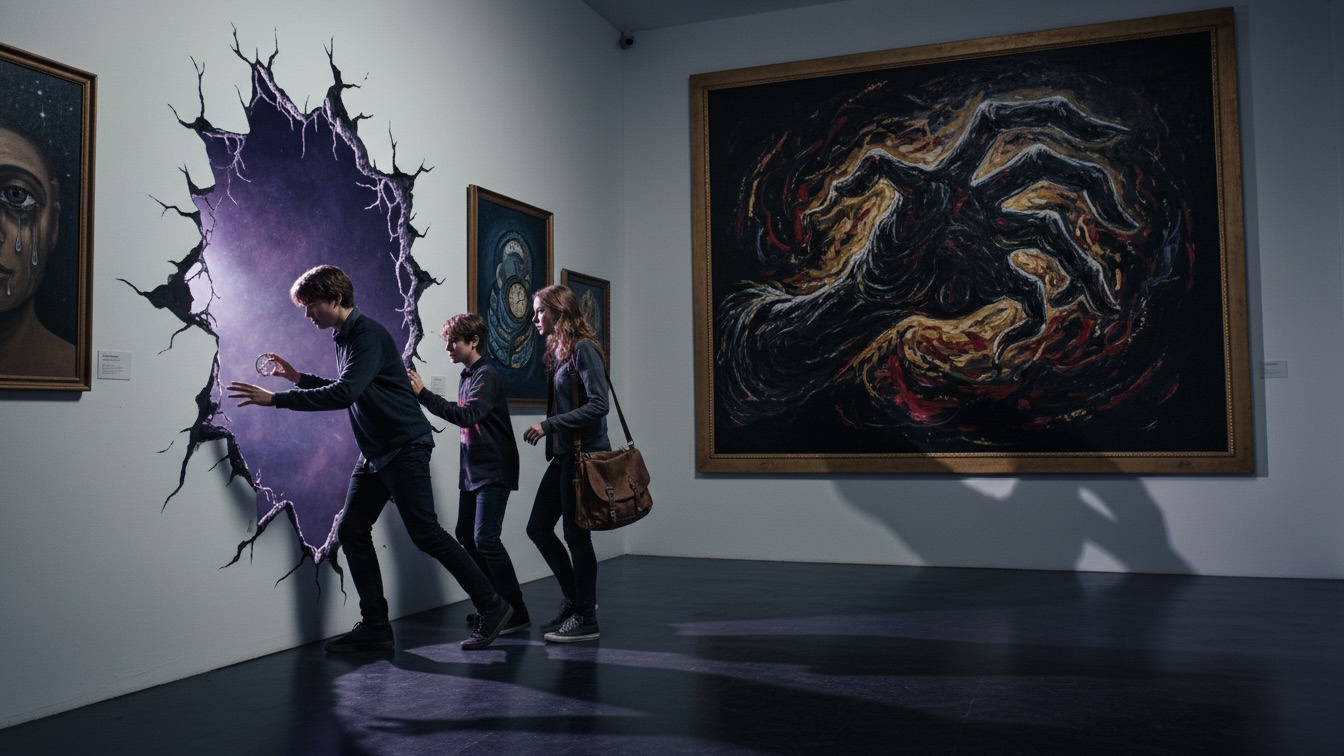
The world was still a question, but for a moment, they felt they had found an answer, even if they couldn't name it. The arts, Caldwell had said, gave form to the formless. And now, they were walking into it.
Share This Story


