Rust and River Stones
A thin, persistent drizzle slicked the already sodden ground, turning the narrow track that once served the old mill into a slick, treacherous ribbon of mud and shattered shale. The air hung heavy with the smell of damp earth, decaying leaves, and the sharp, metallic tang of industrial neglect wafting from the forgotten structures further upriver. Spring, despite its tender promises of new growth, offered little comfort here, only a colder, wetter clarity to the slow, inevitable collapse of everything.
A thin, persistent drizzle slicked the already sodden ground, turning the narrow track that once served the old mill into a slick, treacherous ribbon of mud and shattered shale. The air hung heavy with the smell of damp earth, decaying leaves, and the sharp, metallic tang of industrial neglect wafting from the forgotten structures further upriver. Spring, despite its tender promises of new growth, offered little comfort here, only a colder, wetter clarity to the slow, inevitable collapse of everything. The world itself seemed to be shrugging off the pretence of recovery, content to rot, to seep, to allow the river to chew at the banks with a steady, liquid hunger.
Lindsay pressed her lips together, tasting the grit on them, a constant companion since they’d left the relative safety of the last paved road. Her boots, too big, clomped through the mire, each step a small, sucking struggle. Her left sock, she knew without looking, was bunched uncomfortably around her ankle, the elastic long gone. Grown-ups always said, 'You’ll grow into them,' but growing felt like a slow, pointless exercise when the world around them was shrinking, fading. The track narrowed further, overgrown with tenacious brambles that snagged at the cuffs of her threadbare jacket, pulling at loose threads like tiny, persistent questions.
Behind her, Pete whined, a low, breathy sound lost in the rustle of the budding alder trees. "Are we, like, nearly there? My feet are all… squishy."
Will, who walked with his head tilted, always searching for something invisible in the branches, didn’t answer right away. He just kicked at a loose stone, sending it skittering into a puddle. "It’s just… squishy, Pete. It’s mud."
"Yeah, but… extra squishy," Pete insisted, his voice cracking slightly. Lindsay didn’t bother turning. She knew Pete’s brand of squishiness. It meant he was nervous, his stomach probably doing little flips. It was always like this. Every time they ventured beyond the known paths, Pete’s internal squish-o-meter spiked. And Lindsay, by some unspoken, unfair decree, was always the one who had to hold it together.
"It’s not much further, I think," Lindsay said, her own voice tighter than she liked. She wasn’t sure if it was true. The map, hand-drawn by her grandfather from memory before his eyes had truly failed him, was less a guide and more a series of hopeful smudges. The landmarks were gone, swallowed by weeds and the apathy of the council. "Just gotta get past the old bridge."
The mention of the bridge seemed to hang in the damp air between them, heavier than the moisture itself. A silence, thick and uncomfortable, settled. It wasn’t a silence of peace, but of shared apprehension, a grey shroud pulled over their childish bravado. Lindsay could feel Pete fidgeting behind her, his breath catching in small, ragged hitches. Will, usually immune to such anxieties, slowed his pace, his gaze now fixed on the ground directly in front of him, as if searching for something solid that wasn't there.
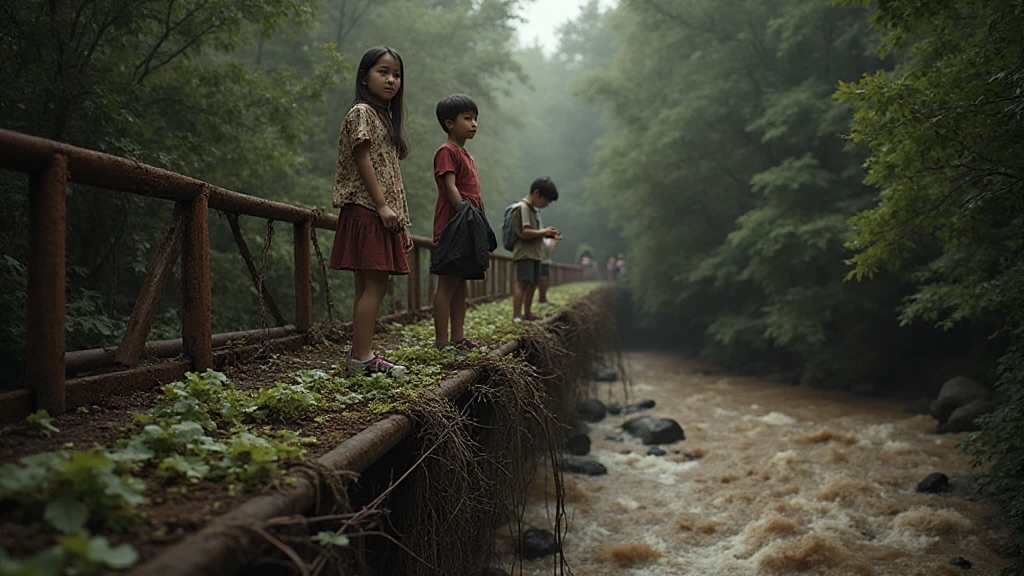
Lindsay pushed through a thicket of what looked like skeletal dogwood, the white blossoms not yet arrived, leaving only bare, grasping branches. The path, if it could still be called that, curved sharply, and then, through a thinning of the saplings, the river revealed itself. Not the placid, tamed creek that ran through the edge of their village, but a broader, faster surge of grey-brown water, swollen with melted snow and spring rains. And spanning it, a skeletal framework of corroded steel: the old mill bridge.
It wasn’t much of a bridge anymore. More a monument to slow, deliberate decay. Rust, a virulent, angry orange, had devoured most of the paint, flaking away in great scabs that powdered the slick concrete approach. The metal girders, once stout and purposeful, now sagged in the middle, their connections weeping dark, wet streaks onto the churning current below. Here and there, plates of the walkway were missing entirely, exposing the furious river, roaring like a hungry beast, its voice a constant, cynical reminder of their smallness. A faint smell of burning copper seemed to cling to the air around the structure, a ghost of the electricity it once carried, or perhaps just a trick of the spring wind.
"Oh, wow," Pete whispered, his voice truly small this time. "It’s… really old."
Lindsay felt a familiar knot tighten in her gut. It was always Lindsay who had to see the worst of it, who had to gauge the danger, decide if it was truly impossible. No one else ever seemed to look, not really. The grown-ups just talked about ‘progress’ and ‘modernisation’ and ‘new opportunities’ – words that sounded like thin, brittle lies when you stood here, facing down the wreckage of what they’d simply let go. This bridge, this mill, this entire river bend, it was all part of the community’s story, a story they were letting fall apart, one rusted bolt at a time. And no one cared. Or rather, they cared about other things. Easier things. Less… muddy things.
"We have to cross it," Lindsay stated, the words sounding less like a command and more like a grim inevitability. She didn’t look back at her friends, didn’t want to see the fear in Pete’s wide eyes, or the calculating caution in Will’s. She just started walking towards the approach, her boots squelching loudly.
The first few steps onto the concrete were solid enough, though cracked and uneven. Then came the metal grating, where the rust was so thick it had formed intricate, delicate patterns, like lace made of decay. It felt spongy underfoot. A groan, deep and metallic, vibrated up through her soles as she put her full weight onto a particularly corroded section. Her heart gave a sudden, hard thump against her ribs. She risked a glance down. The river, a swirling vortex of brown and grey, seemed impossibly far away, and impossibly close.
"Careful," Will said, his voice quiet, almost a whisper, from behind her. "Don’t look down."
Lindsay gritted her teeth. Easy for him to say. Her eyes, despite themselves, kept flicking to the gaps, the places where the river showed through the rusted metal. She thought about her grandfather’s stories, about how this bridge used to hum with life, with wagons and people, carrying grain and lumber to the mill. He'd talked about community, about everyone pulling together. What would he say now, if he could see it? If he could see three kids, alone, trying to fix what all the grown-ups had broken, or just ignored?
She remembered him telling her once, ‘A place remembers. Even if people forget.’ And that was why they were here. For the Heartstone. The core of the mill, he’d said. The thing that kept the town’s memories alive, even when the grown-ups were too busy looking forward to see what they were leaving behind. A silly thought, maybe, for kids. But no one else was doing anything.
A sharper, louder creak echoed from the structure, a sound like tortured metal. Lindsay flinched, her hand shooting out to grip a rusted railing that felt slimy under her fingers. Her knuckles went white. "Just… keep going. Slowly. One foot in front of the other." Her own instructions sounded hollow, thin.
Pete let out a small, strangled gasp. "It’s moving! I think it’s moving!"
"It's just the wind, Pete," Will said, trying to sound calm, but Lindsay heard the tremor in his own voice. He was closer now, behind her, his breath warm on the back of her neck. He probably had his eyes glued to her boots, trying to mimic her steps.
The wind was picking up, whipping strands of Lindsay’s hair across her face, carrying the cold dampness of the river. The bridge swayed, a barely perceptible shudder, but enough to make her stomach lurch. Her mind, usually so determined, began to spin, associative leaps flitting from the smell of the damp river to the smell of her mum’s old laundry detergent, then to the chipped ceramic mug her dad used for tea, all of it a jumbled, meaningless mess of home, of safety, of things they’d left behind.
"Don't think about it," she muttered to herself, as much as to them. "Just… cross."
Each step felt like an eternity. The metal groaned with every footfall, a symphony of decay and protest. The gaps in the grating seemed to widen, beckoning. Her knees felt weak, almost buckling, but the thought of going back, of giving up, felt even worse. They couldn't. Not now. Not when the council was already talking about clearing the mill, levelling it, building some new, bland apartment blocks that would erase every trace of what had been here.
They reached the far bank, scrambling off the unstable metal onto more solid, if still muddy, ground. Lindsay’s legs felt like jelly, her muscles screaming with the effort of holding herself steady. She stumbled, nearly scraping her knee on a sharp rock, but caught herself just in time. She turned, looking back at Pete and Will, who were carefully stepping off the last section of the bridge, their faces pale, relieved.
Pete sank onto a mossy boulder, pulling his knees up to his chest. "I really thought… I thought it was gonna fall apart." His voice was shaky.
"It looked pretty sturdy to me," Will said, though his own breathing was ragged. He pulled a sticky piece of spring-green moss from a crack in the boulder, rolling it between his fingers. "Just… old."
Lindsay didn't correct him. She was too busy catching her own breath, watching the river rush beneath the swaying bridge. It really had seemed like it was going to fall. Her clothes felt heavy with damp, clinging to her skin. A small, cold shiver ran down her spine, not from the temperature, but from the raw, undeniable reality of their situation. This wasn’t a game. Not anymore. It was… important.
The path from the bridge to the mill itself was even worse. A dense tangle of thorny bushes and gnarled roots had reclaimed the narrow track, forcing them to push through, scratching their arms and tearing at their clothes. The trees here grew thicker, their bare spring branches forming a canopy that blocked out much of the already weak light, casting the approach into a perpetual, dim twilight. The air grew colder, still reeking of wet earth, but now with an added layer of stagnant water and something metallic, like ancient machinery left to rust.
Finally, through a particularly dense screen of gnarled hazel, the full, imposing bulk of the old mill appeared. It was enormous, a grey, hulking beast of stone and corroded iron, its broken windows like vacant eyes staring out at the indifferent river. Weeds, thick as a grown-up’s arm, snaked up its walls, slowly prying apart the mortar, claiming the edifice for the relentless march of nature. Parts of the roof had caved in, leaving gaping holes that allowed glimpses of the grey sky, but mostly just darkness within.
A profound silence emanated from the mill, broken only by the distant rush of the river and the drip of water from its eaves. It wasn't a peaceful quiet, but an oppressive one, a silence that spoke of abandonment, of forgotten purpose, of things that had simply ceased to matter. Lindsay felt a sudden, heavy weight settle in her chest. This was it. The place her grandfather had called the 'Heart of the Community.' It looked more like a tomb.
"So, this is it," Will said, his voice hushed, the usual bright curiosity in his eyes dimmed by the sheer scale of the decay before them. He shuffled his feet, then reached out a tentative hand to touch the rough, damp stone of the nearest wall. It felt impossibly cold.
"Gross," Pete muttered, staying a few steps behind, his arms wrapped around himself, shivering despite his thick jacket. "Looks like… like a ghost place."
Lindsay said nothing, her gaze sweeping over the grim structure. They’d come all this way, braved the squishy mud, the terrifying bridge, the grasping bushes. For this. A dead place. But her grandfather had insisted. 'The Heartstone remembers,' he'd said, his voice raspy with age and conviction. 'It just needs someone to listen.' And they were the only ones listening.
She found the main entrance, or what was left of it. A colossal archway, choked with dead vines, the massive wooden doors long rotted away, leaving only a gaping, black maw. A chill wind, smelling of damp rock and trapped air, blew out from the darkness within, making the hairs on her arms stand on end. Taking a deep breath, trying to steady the frantic beat of her heart, Lindsay stepped into the cavernous, echoing interior.
The air inside was even colder, thick with fine dust that shimmered in the few weak shafts of light piercing the broken roof. The floor was uneven, littered with crumbled masonry and the silent, skeletal remains of vast, rusted machinery. Everything was colossal, overwhelming, yet inert. Lindsay took a few hesitant steps, her boot kicking a loose piece of brick that skittered across the floor with a shockingly loud clatter. The sound seemed to hang, then dissipate into the oppressive stillness. She looked for the symbol her grandfather had drawn for her, a rough circle with a single line through it, the sign that marked the location of the Heartstone.
Pete and Will followed, their steps more cautious now, their voices completely silent. The sheer scale of the place seemed to swallow their fear, leaving only a wide-eyed awe. Or maybe it was just the dark. Lindsay walked deeper, navigating around a massive, toppled gear, its teeth worn smooth with age and disuse. The silence was unnerving. She could hear her own breathing, ragged and fast. She could almost feel the weight of the years, the forgotten purpose, pressing down on her.
Then she saw it. Tucked away in a alcove, partially obscured by a fallen beam, was a pedestal, and on top of it, what looked like a large, dull grey stone, roughly shaped like an egg, with the familiar, carved circle and line. The Heartstone. It looked so… ordinary. So small, against the immense, decaying machinery around it. Just a rock. After all that. All this, for a rock.
She reached out a hesitant hand, her fingers brushing against the cold, smooth surface of the stone. It felt heavy, inert. Not humming, not glowing, not doing anything. A wave of bitter disappointment washed over her, thick and suffocating. It was just a rock. All her grandfather’s stories, all their effort, all their fear… for nothing. The adults were right. This place was just old junk. Her lip trembled slightly. She’d been so stupid. So incredibly, childishly stupid.
But then, just as she was about to pull her hand back, to admit defeat, to tell Pete and Will it was all a waste, a barely perceptible tremor ran through the stone. It wasn’t a vibration, not yet, but a faint, deep thrum, like something far away was stirring, deep beneath the ground. Lindsay froze, her hand still pressed against the cold rock. Her eyes darted to Pete and Will, who were now standing close behind her, their eyes wide, their attention fixed on the stone.
A low rumble, not from the river, but from somewhere deep within the very stone beneath their feet, vibrated through the structure. Dust, thick and grey, drifted down from unseen crevices, tasting of old iron and forgotten things. The mill groaned, not like a building settling, but like a vast, injured beast taking its last, rattling breath, and then, from the blackness ahead, a new sound began, a distinct, rhythmic thrum
A low rumble, not from the river, but from somewhere deep within the very stone beneath their feet, vibrated through the structure. Dust, thick and grey, drifted down from unseen crevices, tasting of old iron and forgotten things. The mill groaned, not like a building settling, but like a vast, injured beast taking its last, rattling breath, and then, from the blackness ahead, a new sound began, a distinct, rhythmic thrumming that made the air itself throb against Lindsay's eardrums.
Share This Story


