The Feather and the Print
A crisp, late autumn afternoon in Willow Creek Hollow, a small, charming town. The Harvest Festival has just concluded, leaving a quiet, almost empty town square. The scene transitions to the edges of town, into a dense, atmospheric patch of woods bordering a shallow creek. The overall mood is subtly tense, with hints of an approaching mystery.
The air tasted of damp earth and the last, stubborn sweetness of apples. It clung to the thin, brittle leaves that still stubbornly held on to the maple branches, refusing to surrender to the inevitable. Clorence pulled the collar of her worn flannel tighter, the fabric scratching faintly against her neck. The chill was more than just the season; it was an unspoken promise of the long, cold quiet ahead. Willow Creek Hollow, usually a hum of small-town life, felt muted, holding its breath. The late afternoon sun, thin and pale, barely managed to cut through the high, scattered clouds, casting long, distorted shadows that stretched across the empty stalls of the town square.
She scuffed her sneaker against a loose cobblestone, dislodging a cascade of tiny pebbles into the grimy grate of a storm drain. Her breath plumed in front of her, a fleeting ghost. The Harvest Festival, usually a riot of color and noise, had packed up early this year. A few forgotten hay bales, now damp and smelling faintly of mildew, sagged near the bandstand. Ribbons, once vibrant orange and gold, hung limp, streaked with mud. It felt like the town itself had exhaled, a collective sigh of something... incomplete. Not quite sad, not quite disappointed, just… unfinished.
A knot tightened in her stomach, just below her ribs. It wasn't about the festival. It was about Mr. Smith. Everyone knew Mr. Smith. Not just for his general store with the perpetually squeaky floorboards that sang a tune every time you stepped inside, but for the Nativity figures. Every year, without fail, he carved a new one. A shepherd, a camel, a particularly grumpy donkey. They were the heart of the town’s Christmas display, placed one by one around the enormous blue spruce in the square. A tradition that stretched back further than anyone could remember. And Mr. Smith was simply... gone.
The last person to see him was Mrs. Johnston, the postmistress. Her voice, usually a cheerful chirp, had been a tight, thin thread over the phone to Clorence’s mom that morning. "Not a trace. Shop open. Dust on the counter. His special chisel… just sitting there." Clorence had listened from the kitchen, pretending to study a pre-calculus text, but every word had been a sharp, cold point. Mr. Smith never left his shop unlocked. He never left his tools out of place. And he certainly never just vanished before the first frost had truly bitten.
She walked toward the general store, the old bell above the door still there, even if it wouldn't ring for him today. The windows, usually gleaming, were dull, smeared with a fine film of dust. Inside, the usual clutter was visible: stacks of flour sacks, neatly arranged jars of preserves, a dizzying array of tiny hardware bits. But the woodworking corner, tucked away at the back, felt wrong. Clorence pressed her face against the glass, cupping her hands to block the weak daylight. His workbench, usually covered in wood shavings and the faint scent of cedar, was strangely clear. A single block of uncarved basswood sat in the middle, pristine. Next to it, glinting under the dim interior light, was a specific, familiar carving tool. The one he called 'The Whisper,' he'd told her once, because it made the wood sing.
A shiver ran down her spine, not from the cold, but from the stillness. It wasn't just a missing person; it was a missing piece of Willow Creek Hollow. And Christmas… without Mr. Smith’s figures, it would feel like a hollow shell. Her own family’s Christmases were often… complicated. Her dad, always stressing about the store's annual inventory, her mom trying to make everything perfect. Last year, the argument over burnt cookies had ended in a tense silence that lasted until New Year’s. The Smith figures were, in a strange way, the one thing that always felt reliably good, reliably simple.
She turned from the window, her gaze sweeping over the deserted square. A flash of iridescent blue caught her eye. It was small, no bigger than her thumbnail, caught on a splinter of wood near the base of one of the old festival stalls. A tiny feather. Too bright for any bird she knew around here. She knelt, picking it up. The quill was almost translucent, a delicate thing. She turned it over in her fingers, frowning. It felt… out of place. Like a misplaced puzzle piece. Not important, probably, but she tucked it into her pocket anyway. Her mom always said she noticed the strangest things. Maybe that was why she liked mysteries so much. Or maybe she just liked knowing why things were the way they were.
A sound. A rustle from the narrow alleyway between the bakery and the old town hall. She froze, her hand still in her pocket, clutching the feather. It sounded like movement. Slow, deliberate. She held her breath, listening. The wind picked up, rattling a loose shutter on the bakery’s second floor. Then, silence. Just the distant hum of a car on the highway, a sound that always felt too loud for this quiet town. She slowly stood up, her eyes narrowed, trying to peer into the shadows. Nothing. Just overflowing bins and the faint, sweet smell of burnt sugar. Her heart thrummed a little faster than it should have. Just the wind, she told herself. Or maybe a stray cat. But the alley seemed too quiet, too still for a cat.
She glanced back at Mr. Smith’s store. The empty light. The waiting wood. The chisel. It all felt like a question mark hanging in the crisp autumn air. The sheriff had said it was likely Mr. Smith had simply gone for a walk, or visited a relative without telling anyone. But Mr. Smith wasn’t like that. He was a creature of habit, a man whose days were as predictable as the turning of the seasons. Every morning, a cup of Earl Grey. Every afternoon, a few hours in his workshop. Every evening, a game of solitaire by the window. His routine was Willow Creek Hollow's heartbeat.
Clorence began to walk again, but not toward home. She found herself drifting towards the edge of town, where the creek meandered through a small patch of woods. It was a place Mr. Smith often walked, she knew. He’d told her once, during a quiet afternoon at his store, that the sounds of the creek helped him clear his head, helped him 'find the shape in the wood.' The path was overgrown now, mostly fallen leaves and thorny brambles, but she remembered the way. Her hiking boots crunched on the fallen leaves, each step a distinct, loud sound in the hushed woods.
The sunlight barely pierced the canopy here. It was a mosaic of browns and muted greens, the air thick with the smell of wet moss and decaying wood. She imagined him here, his hands clasped behind his back, his head tilted slightly, listening. She tried to think like him. What would he see? What would he hear? Maybe a particular type of bird call, or the way the water rushed over certain rocks. She knew so little, really, about what moved him, beyond the carving. She just knew that he cared about the town, about Christmas, more than almost anyone.
Up ahead, where the path opened slightly, she saw a flicker of color. Red. She moved closer, careful to avoid the brittle branches that snapped underfoot. It was a scrap of fabric, snagged on a low-hanging branch. A bit of plaid. Mr. Smith wore plaid. Almost exclusively. This was a scrap torn from a lumberjack-style shirt, a deep crimson and forest green. Not just any plaid. She recognized the pattern. It was the same as the shirt he’d been wearing last week when she’d stopped by his store to buy her mom some twine. He’d been telling her about his plans for this year’s Nativity figure. A small lamb, he’d said. “Something gentle.”
Her heart pounded a frantic rhythm against her ribs. This wasn't just a walk. This wasn't just a visit to a relative. This was… something else. Her eyes darted around, searching. The ground here was soft, muddy in spots from recent rain. She knelt again, her knees sinking slightly into the cold, damp earth. A faint impression. A boot print. Not her own. Larger, deeper. And another, beside it. Two sets of prints. One faded, almost gone, as if the person had tried to be careful. The other, clearer, deeper. It looked like someone had been dragged, or had stumbled. The print belonged to a heavy boot, maybe a work boot, with a distinctive tread pattern: two parallel lines and a small diamond shape.
She didn't know what to do. Her phone was in her backpack, useless with no signal here. Panic, cold and sharp, began to prickle at the edges of her resolve. This wasn’t like the cozy mysteries in the books she devoured, where the clues were neat and the danger always felt distant. This felt… real. The scrap of fabric. The boot print. Mr. Smith. The quiet of the woods pressed in on her, heavy and unforgiving. She felt watched. A twig snapped somewhere behind her, and she spun around, her breath catching in her throat. Nothing. Just the shadows deepening, the trees swaying slightly.
She had to go to the sheriff. But what would she say? That she’d found a piece of plaid and a boot print? He'd already dismissed her mom's concerns. He’d probably dismiss hers even faster. “Teenage imagination,” he’d say. She could almost hear his gruff voice. But this felt different. This felt like a path, a tangible connection to a man who had simply disappeared. And the feather in her pocket, the one that felt so out of place, now seemed to whisper something. A foreign element. Something not from Willow Creek Hollow. Or not usually.
She moved deeper into the woods, driven by an urgency she couldn’t name. The path narrowed further, the trees pressing in, their bare branches like skeletal fingers. The cold intensified. She spotted another mark on the ground. A shallow gouge, like something heavy had been dragged. Then, another piece of evidence. A small, wooden toy soldier. It was painted in bright, faded colors, missing an arm. It wasn't one of Mr. Smith's intricate carvings, but a simple, mass-produced toy. Why would it be out here? Had he dropped it? Or had it been dropped by someone else?
She picked it up, her fingers tracing the rough, chipped paint. It felt old, well-loved. Maybe it was something he’d kept from his own childhood. Or something he’d been mending for a grandchild. He didn't have grandchildren. So it must have been for someone else. Her mind raced, trying to connect the disparate pieces. Plaid. Boot prints. A wooden soldier. The iridescent feather. None of it made sense, yet all of it felt connected to the strange, unsettling absence of Mr. Smith. This wasn't a random walk. Something had happened out here.
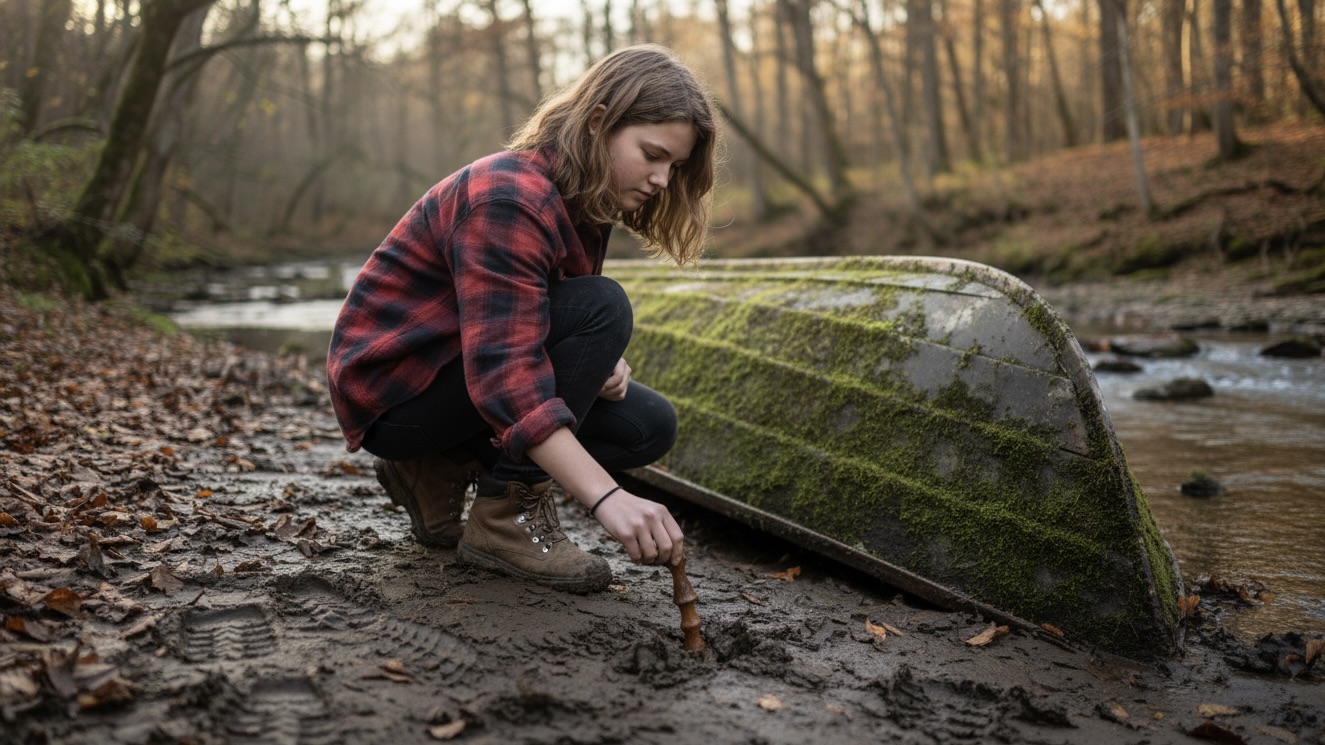
The woods grew denser, the creek's gurgle becoming louder, a constant whisper over the rustling leaves. She pushed through a curtain of low-hanging branches, ducking under a particularly thick one that scraped against her hood. There, on the bank of the creek, was a small, overturned rowboat. It was old, painted a faded green, half-submerged in the shallow, stony water. Water dripped from its mossy underside. It hadn't been there before. She was sure of it. She walked carefully towards it, her gaze sweeping the area. A small, damp patch of earth next to it looked disturbed, as if something heavy had rested there, then been moved.
And then she saw it. Tucked underneath the overturned boat, half-buried in the mud, was a small, ornate carving tool. It glinted. Not ‘The Whisper,’ the one he left in his shop. This one was different. Smaller. Finer. It was the one he used for the delicate details, for carving the tiny eyes of the sheep, the folds of a robe. He called it ‘The Eye of the Needle.’ He never, ever left his tools out in the elements. He treated them like extensions of his own hand. If this was here… it meant he hadn't left by choice. It meant he’d been here. And someone else, perhaps, had also been here. Someone who had overturned a boat, disturbed the earth, and left his most precious tool behind.
She knelt beside the boat, her fingers hovering over the tool. The metal felt cold, slick with creek water. The distinctive diamond pattern boot print was clear in the soft mud near the boat, almost fresh. And beside it, a smaller print, more defined now, leading directly into the creek. Not just into the water, but across it. The creek wasn't deep here, but it was wide. Someone had crossed over. Her eyes followed the line of the prints. Across the water, the trees were even thicker, the path less defined, leading towards the old abandoned mill on the other side. A place nobody ever went anymore. A place that felt like the kind of secret only Willow Creek Hollow held onto.
Her phone vibrated in her pocket. Her mom. She ignored it. Her mind raced, the pieces suddenly snapping into a horrifying, incomplete picture. Mr. Smith hadn’t just vanished. He had been taken. Or, he had gone with someone, in a hurry. And they had gone across the creek. Towards the mill. But why? And who? The mystery, which had felt like a distant cloud, was suddenly right in front of her, cold and sharp. She had to tell someone. But what if the person with the diamond-tread boots was still around? What if they were watching? The thought sent a jolt of ice through her veins.
She stood up, slowly, her eyes scanning the dense woods on the other side of the creek. The fading light made everything seem sinister. The hum of the distant highway had died down. All she could hear was the rush of the water and the frantic pounding of her own heart. She had found something. Something important. But what to do with it? Who to trust? She clutched ‘The Eye of the Needle’ in her hand, the cold metal digging into her palm. Her eyes fixed on the path across the creek, leading into the deepening gloom. She knew she shouldn’t go there. But she also knew, with a certainty that chilled her to the bone, that she had to.
She knew she shouldn’t go there. But she also knew, with a certainty that chilled her to the bone, that she had to.
Share This Story


