Beneath the Overgrowth
The smell of damp earth and dying leaves hung heavy, a bittersweet perfume of autumn. A chill wind sliced through the thinning canopy, rustling dry branches like old paper. This part of the woods, far from any marked trail, always felt a little off-kilter, the trees growing in stranger angles, the light filtering down in an uneven, almost bruised pattern. It was here, amidst the encroaching chill and the silent, patient decay, that something truly peculiar began to reveal itself.
The saw bit into the maple trunk with a guttural groan, splinters of pale wood exploding into the cool autumn air. Shaun leaned into it, his shoulders working, the scent of fresh sap sharp and clean against the pervasive dampness of the forest floor. He’d picked this spot because the maples here were overgrown, too close to the old, winding creek bed that was usually dry by late summer but now gurgled with recent rain. Gareth, a few yards away, was wrestling a younger, thinner pine, its branches shedding needles in a green, sticky shower. They hadn't spoken much in the last hour, the rhythm of their work a comfortable, almost meditative drone against the quiet hum of the woods. It was good. The kind of good that didn't need words, just shared effort and the occasional, sharp crack of a branch underfoot.
Tobin felt the bite in his own hands, the roughness of the axe handle against his palms. He preferred the axe, the clean, decisive swing, the immediate gratification. He watched Shaun for a moment, the steady, almost hypnotic motion of the saw. Shaun was all slow burn, patient and methodical. Tobin was the opposite, a quick, impulsive strike. The ground beneath his boots was a riot of colour: crimson maple leaves, the ochre of fading birch, and the deep, wet green of moss clinging to half-buried stones. He kicked at a particularly vibrant pile, sending a flurry of reds and yellows spiralling upwards, then settling again, a silent, soft rain.
A dull clang echoed from deeper in the woods, a sound entirely out of place amidst the organic sighs and rustles. Shaun paused, the saw blade still, dripping sap onto a patch of fern. He looked towards Tobin, a question in his eyes.
“What was that?” Tobin asked, though it wasn't really a question. More of a statement, an acknowledgement of the jarring intrusion.
Shaun shrugged, a slight shifting of his weight. He wiped a hand across his forehead, leaving a smudge of sawdust. “Deer maybe? Kicked something?”
Tobin shook his head. “Sounded… metal. Like a car door.” He listened, the only sound now the distant gurgle of the creek and the gentle sigh of the wind through the pines. He took another swing at the maple, aiming for a lower branch, but the clang had unsettled him, an itch behind his ear. He missed his mark slightly, the axe skidding with a dull thud against the trunk, sending a spray of bark flying. He grumbled, adjusting his grip.
Shaun resumed sawing, but his movements were less fluid now, a slight hesitation in each pull. The silence stretched, then another clang, closer this time, followed by a faint, grating screech, like something being dragged over stone. It was definitely metal.
“Right,” Shaun muttered, dropping the saw. The heavy tool landed with a soft thud in the damp leaves. “Let’s just… see.”
Tobin nodded, lowering his axe. His breath hitched a little. Not from exertion, but from the sudden shift in the air, a different kind of quiet descending, expectant. He followed Shaun, stepping carefully over roots and decaying branches, his eyes scanning the dense undergrowth. The forest grew thicker here, the trees older, their branches intertwining to form a ceiling that barely let the pale autumn light filter through. Patches of fungi, brilliant orange and sickly white, clung to the base of ancient trunks. He could smell pine, but also something else, something acrid and strange, faint at first, then growing stronger – a metallic tang, like old blood mixed with rain.
The ground began to shift, to become uneven. Not the usual undulations of forest floor, but a distinct humping and mounding, as if giant moles had been at work. Then, through a screen of low-hanging brambles and skeletal branches, he saw it. A glint of dull chrome. Then another. And another.
---
The Unveiling of the Absurd
The brambles gave way to a sudden, impossible clearing. It wasn’t a clearing at all, but a massive, sprawling expanse of human detritus, swallowed by the relentless, patient greed of the forest. Shaun pushed aside a particularly aggressive thorn bush, and they stepped into what could only be described as a junkyard, but one that time and nature had conspired to turn into something else entirely – a surreal, rusting sculpture garden, a monument to everything discarded. It stretched further than Tobin could see, a landscape of forgotten appliances, skeletal cars, and mountains of nameless plastic.
The air here was different. Heavy, with the smell of wet rust, stale oil, and something else, something sweet and sickly, like decay mixed with old sugar. The ground underfoot crunched with shattered glass, ceramic fragments, and desiccated leaves that had been trapped beneath generations of rubbish. A fine, almost invisible dust coated everything, a shimmering veneer of neglect.
“Well,” Shaun said, his voice flat, his hands shoved into his pockets. He whistled low, a tuneless, almost mournful sound. “That’s… something.”
Tobin just stared. A washing machine, impossibly green with moss, tilted precariously atop a pile of deflated tires. A child’s tricycle, its paint long faded to a ghost of yellow, lay on its side, one pedal still stubbornly intact. The sun, which had been hiding behind heavy grey clouds, chose that moment to break through, slanting a weak, buttery light across the scene, making the rust on a fender glow like dried blood. It was beautiful, in a perverse, unsettling way.
“Like a… graveyard,” Tobin finally managed, his voice barely a whisper. He stepped further in, his boots crunching. The sound felt loud, intrusive.
Shaun kicked at a discarded hubcap, sending it spinning across the cracked asphalt that had once, perhaps, been a rough access road. “More like a museum of bad decisions.” He grinned, a quick, dry flash of teeth. It was a dark joke, but it fit the scene. The whimsical cruelty of it.
Tobin walked slowly, head swivelling, taking it all in. An old television set, its screen long smashed, housed a thriving nest of some kind, tiny, desiccated leaves spilling from its back. A doll, missing an eye, sat propped up against a heap of twisted metal, its plastic face grimacing eternally. He felt a weird kinship with the junk, a shared sense of being left behind. He wondered who had dumped all this, why it was so far from any road, and how long it had been here. Decades, surely. Generations.
“Look at this,” Shaun called, his voice echoing slightly in the strange quiet. He was standing by what looked like the remains of a small, compact car, its roof caved in, its windows shattered. Rust had consumed half its body, turning it into a skeleton of its former self. But from within the driver’s side, a single, surprisingly intact, plastic daisy dangled from a rearview mirror that was no longer there, suspended on a thin, almost invisible wire. It swayed gently in an unseen breeze.
Tobin came closer. The daisy, a cheap trinket, was an odd pop of colour in the sea of decay. He imagined some teenager, years ago, driving this car, listening to terrible music, dreaming of escaping this town. Then, one day, they hadn’t needed the car anymore. Or maybe, they just hadn’t needed the daisy. Or maybe, they just hadn't needed to dream.
“What do you think happened?” Tobin asked, gesturing vaguely at the whole sprawling mess. “Why here?”
Shaun shrugged, a loose, easy movement. “People don’t want things. People get rid of things. Out of sight, out of mind. It’s what we do, isn’t it?” He picked up a chipped porcelain teapot, turning it over in his hands. It was decorated with tiny, faded bluebirds. “Probably someone’s grandmother’s. Decided it didn’t fit the new kitchen aesthetic. Or whatever.” He tossed it back onto the pile of shattered crockery. It landed with a dull thunk, not breaking further.
A flicker of something—a small, quick movement—caught Tobin’s eye, darting behind a stack of old washing machines. A rat, probably. Or something larger. The thought made his skin prickle. He shivered, despite the work making him warm. The air was getting colder, the light softer, greyer. This place felt like it was breathing, slowly, in the decaying breath of forgotten things.
He noticed a cluster of ancient, battered suitcases, stacked haphazardly. One was slightly ajar, a glimpse of yellowed fabric escaping. It looked like a silent scream, a final, unsaid farewell. He nudged it with his boot. The latch groaned, and it fell open fully. Inside, nestled amongst moth-eaten clothes, was a single, brightly coloured plastic flamingo, its long, thin legs snapped clean off. It felt absurd, tragic, and hilarious all at once. Who packs a flamingo? A broken one at that?
“Find anything interesting?” Shaun’s voice, a little closer now, made Tobin jump. He hadn’t heard him approach. Shaun was holding a broken, almost melted CD. He held it up to the light, trying to read the title. “Can’t even tell what this was. Just a spiral of iridescent plastic.”
“Broken flamingo,” Tobin said, kicking at the suitcase again. “In a suitcase.”
Shaun peered at it. “Natural habitat, I suppose.” He dropped the CD. “Everything ends up here. Eventually.” His eyes scanned the horizon of junk, a vast, undulating sea of human failure. “Even us, probably. Just in smaller, less noticeable pieces.”
The dark humour was there, sharp and unsettling, making Tobin almost laugh, but the sound caught in his throat. He felt a strange lightness, a bizarre sense of freedom. All this stuff, once cherished, once essential, now just… this. It stripped away a layer of his own anxieties, making them seem small, equally destined for the scrap heap.
He wandered past a heap of old typewriters, their keys missing, their ribbon spools dry and empty. Then a collection of discarded trophies, tarnished and unreadable, their tiny, triumphant figures frozen in mid-leap or swing. He imagined the earnest faces of the children who’d won them, the brief, intense pride. Now, just meaningless metal.
He spotted what looked like a small, wooden puppet, half-buried under a pile of rusted gardening tools. It was missing an arm and one leg, its painted face faded into a perpetual, unsettling grin. Its strings were tangled and broken, trailing into the dirt. He reached down, hesitant, and pulled it free. Its wooden body was surprisingly light, almost hollow. He turned it over in his hand, feeling the rough texture of the old wood. He wondered about the shows it had been in, the tiny, dramatic lives it had lived. Now, just another piece of kindling for the earth.
“Don’t touch that, mate,” Shaun said, a sharper edge to his voice. He had moved on to a section full of old electronics, wires snaking everywhere like metallic vines. “You don’t know what’s been on it. Or in it.”
Tobin dropped the puppet with a small 'thwack'. It landed face down, its unsettling grin obscured. Shaun was right, of course. This was a dump. A place of unknown diseases and unseen things. The whimsy of discovery was starting to give way to the grim reality of decay. He suddenly felt the cold seeping into his bones, and a faint, acrid smell that he hadn’t noticed before, like stale battery acid.
He watched Shaun, who was now prying open the back of an ancient, boxy computer monitor with a small, rusted crowbar he’d found. A shower of tiny, brittle wires and dust rained down. Shaun peered inside, his face illuminated by the faint, diffused light. “Just… circuit boards. So many circuit boards. Like a dead brain.” He pulled out a handful, letting them clatter back into the monitor’s cavity.
Tobin kicked at a bent, aluminium ladder that lay half-submerged in a shallow pool of rainwater, now slick with a rainbow sheen of oil. The water was still, reflecting the grey sky and the skeletal trees around them. He stared at his own distorted reflection, then at the sky. Above, a single, dark bird circled, its cry a thin, piercing sound, lost almost immediately in the vast, encompassing silence of the junkyard. It was a place where sound went to die.
He noticed a small patch of hardy, pale-green weeds pushing up through a crack in a broken microwave door. Life, persistent and unyielding, even here. It was a strange comfort, a small rebellion against the sheer, overwhelming evidence of human abandonment. But then he remembered the bird, and the silence, and the thought twisted. Maybe the life here wasn't for comfort, but for something else entirely. Something colder.
Shaun straightened up, holding something small and dark in his hand. “Found it.” He walked back towards Tobin, his boots crunching methodically. The object glinted dully in his grasp. It was a small, tarnished metal birdcage, about the size of his fist. It looked ancient, its bars bent in places, a fine layer of rust coating its surface. Its tiny door was slightly ajar, barely a crack, as if something had just slipped out, or was waiting to slip in.
Gareth, still half-buried in the old armchair, felt a sudden, inexplicable chill that had nothing to do with the encroaching autumn evening. He looked up, catching Shaun's gaze, and for a fleeting, uncomfortable moment, the silence of the junkyard felt less like an absence and more like a presence, waiting.
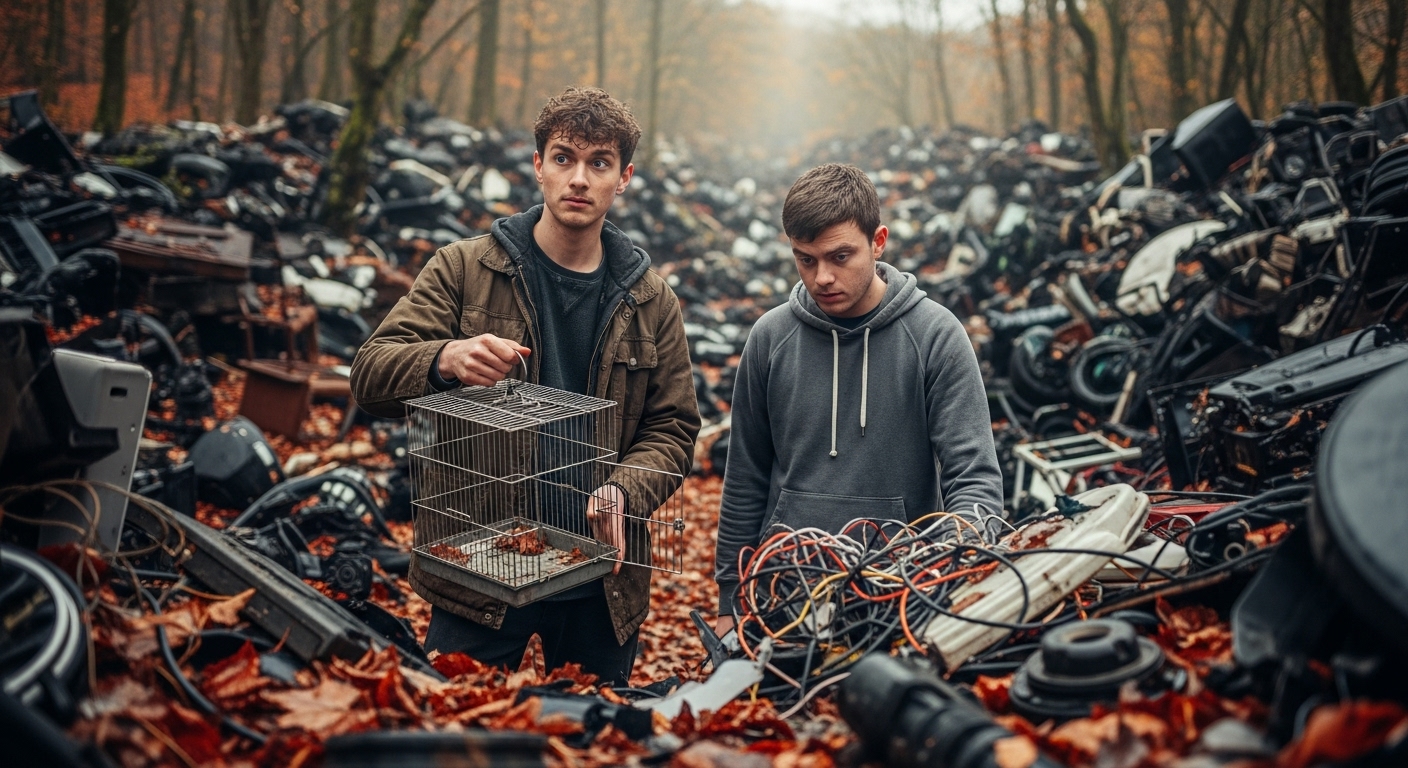
Shaun stared at the small, tarnished metal birdcage, its tiny door slightly ajar, as if something had just slipped out. Gareth, still half-buried in the old armchair, felt a sudden, inexplicable chill that had nothing to do with the encroaching autumn evening. He looked up, catching Shaun's gaze, and for a fleeting, uncomfortable moment, the silence of the junkyard felt less like an absence and more like a presence, waiting.
Share This Story


