The Hum of Uncertain Futures
The air in the community hall was thick with the scent of lukewarm coffee and the damp wool of winter coats. Outside, a blizzard had begun its slow, deliberate crawl, pressing against the windows like a curious, heavy spirit. Inside, a round table, scarred with decades of craft projects and bake sales, served as the epicentre for five young adults, their faces illuminated by the flickering fluorescent lights and the stubborn glow of a projector displaying a chaotic spiderweb of ideas.
“...and that’s why,” Lila finished, her voice a little hoarse, tracing a diagram on the whiteboard that looked less like an organisational chart and more like a nervous system, “we need a collective. Not just a space, but… a backbone. Something that holds us up when the city grants dry up, or when a gallery snubs us.” She tapped a red marker against her chin, leaving a faint streak. The hum of the old heater kicked up a notch, a wheezy, protesting sound that seemed to vibrate in her teeth. Outside, the world was dissolving into grey, the snow hitting the glass in frantic, almost angry flurries.
Eddie, always the one with the folded spreadsheets, cleared his throat. “Lila, I get the vision, truly. But a ‘backbone’ needs, well, actual bones. And muscle. How do we fund this, practically? We’re talking about legal fees, a lease, insurance. Artists don’t exactly roll in disposable income, especially not here in Thunder Bay in January.” He gestured vaguely towards the window, where the cold, indifferent sky was slowly consuming the already brief afternoon light. A slight tremor ran through the pane, a sound like a distant bell being struck.
“But that’s precisely it, Eddie!” Simone leaned forward, her braid, woven with bright, mismatched yarn, swinging. “It’s because we don’t ‘roll in disposable income’ that we need this. It’s about pooling resources, yes, but also about a collective voice. A louder voice. A shield, almost. We can’t just keep waiting for permission, for someone else to open a door.” Her eyes, usually so bright, had a fierce, almost desperate glint. She picked at a loose thread on her worn denim jacket, then rubbed a smudge of dried paint from her thumb.
Mark, who hadn't spoken since offering around the last of the shortbread, finally mumbled, “A shield… yeah. But sometimes a shield just makes a bigger target, doesn’t it?” He looked down at his hands, calloused from carving, then up at the ceiling, where a single bulb flickered, briefly casting the whole room into a strange, strobe-like effect. The scent of pine cleaner and stale coffee suddenly felt overwhelming, almost like a physical weight pressing down.
Lila felt a familiar tightness in her chest. This was always the dance. The soaring ambition, the crushing reality, the quiet, uncomfortable truths. She picked up her own mug, the ceramic cool against her palm, and took a slow sip of coffee that had gone utterly cold. It tasted metallic, like regret. She imagined the words she had spoken, hanging in the air, slowly crystallising into ice, one by one.
---
“No, Mark, that’s… that’s not the point,” Simone insisted, a little too quickly. “It’s about resilience. It’s about saying, ‘We exist, we matter, and we’re doing this regardless.’ We’re not asking for permission anymore. We’re creating the permission.” She slapped the table lightly, a small, startling sound in the hushed room. A faint ripple spread through the surface of Lila’s cold coffee.
Eddie sighed, a puff of visible breath in the cool air near the window. “Resilience is great, Simone. But grant applications are better. Structure. A clear mandate. Who’s going to handle the finances? Who’s writing the grants? Who’s chasing the suppliers for discounts on canvas?” He held up his hands, enumerating the points on his fingers. “These are the unglamorous truths of ‘creating permission’. Someone has to sit there, in the cold, filling out forms that ask about our ‘mission statement’ and ‘community impact’.” He shivered, pulling his wool scarf tighter around his neck.
Lila watched the snow outside, a thick curtain now, blurring the streetlights into hazy, spectral orbs. She thought of all the artists she knew, scattered across the sprawling, winter-hardened city, hunched over their sketchbooks or canvases, creating alone. A collective felt like a warm hand reaching out through the frost. But Eddie was right. A hand needed bones. And a wrist that could hold a pen.
“We build the structure as we go,” Lila offered, pushing the marker back into its holder with a click. “We start small. A shared studio space, maybe. A collective exhibition. Something tangible that shows we’re more than just… talk.” She looked around the table, trying to gauge their faces. Eddie, sceptical but listening. Simone, still simmering with defiant energy. Mark, contemplating the grain of the table as if it held ancient secrets. And Willow, perched on the edge of her seat, a faint, almost imperceptible smile playing on her lips, her eyes, the colour of frozen lake water, fixed on the whiteboard.
---
“Something tangible,” Willow echoed, her voice soft, almost a whisper, yet it somehow cut through the hum of the heater and the distant wail of the wind. “A project. Something huge, so ridiculous it has to work.” Everyone turned to her. Willow rarely spoke at these sessions, preferring to sketch furiously in her notebook, capturing the essence of each speaker in a few swift lines. Her art was always a little unsettling, a little beautiful, like an unexpected dream.
“Ridiculous how?” Eddie asked, his eyebrows inching up his forehead. He had a pencil tucked behind his ear, like a carpenter, and he plucked it out now, twirling it idly between his fingers.
Willow finally looked up, her gaze sweeping over each of them. “We build an ice sculpture. A massive one. In the middle of the harbour, maybe. Or by the Sleeping Giant. Something ephemeral, a monument to… us. To our impermanence, but also our insistence. Something that melts, yes, but while it’s here, it demands attention. It draws people in. A temporary, living gallery of ice.” She spoke with a quiet intensity, and for a moment, the room felt still, frozen in her vision. The cold outside seemed to seep in, not through the windows, but from her words, painting the air with crystalline suggestions.
Lila’s breath hitched. An ice sculpture. In Northwestern Ontario. In the dead of winter. It was insane. Utterly, beautifully insane. The kind of idea that made your blood sing and your teeth ache at the same time. The kind of idea that might just work, precisely because it was so improbable.
“That’s… wild, Willow,” Simone breathed, a slow smile spreading across her face. “But brilliant. Think of the press! Think of the community involvement! We could have people come help us carve, paint it with natural pigments, light it from within…” Her words tumbled out, already envisioning the possibilities, the problems melting away, replaced by vibrant colour and shimmering light.
Eddie, surprisingly, didn’t immediately shut it down. He frowned, tapping his pencil against his notebook. “Logistics would be a nightmare. Safety. Permits. Heavy machinery. How do you even… sculpt a harbour-sized ice block?” But there was a flicker in his eyes, a spark that suggested the pragmatist in him was already trying to solve the problem, rather than simply dismissing it.
“We figure it out,” Lila said, her voice firmer now, almost urgent. The metallic taste of cold coffee was gone, replaced by a surge of something like warmth. “We’d need a project lead. Someone with serious vision. And maybe someone who knows how to sweet-talk the city into giving us access to a very large freezer. Or, you know, the lake.” She laughed, a short, slightly nervous sound.
Mark nodded slowly. “I know a few old guys who worked the ice roads. They know ice.” His quiet words carried a strange weight, a groundedness that anchored Willow’s surreal vision to the harsh reality of the landscape. He looked up, meeting Lila’s gaze for a fleeting moment. “It’s… fragile. But strong.”
---
The conversation shifted, the energy crackling now with a different kind of urgency. Less about the existential dread of forming a non-profit, more about the immediate, exhilarating impossibility of carving a temporary cathedral of ice. They brainstormed locations: the Breakwater, Prince Arthur’s Landing, a secluded cove just off the Sleeping Giant where the winds sculpted the snow into fantastical, shifting dunes. They talked about techniques, about what kind of art would lend itself to ice, about the kind of stories they could tell with something so transient.
Lila found herself sketching too, not a logical chart, but swirling patterns, crystalline structures. The heater hummed on, a steady, rhythmic thrum that now felt less like a complaint and more like a heartbeat. The snow outside intensified, coating the world in a thick, insulating blanket, muffling the sounds of the city, leaving them in their small, brightly lit bubble of impossible ideas. She could almost taste the crisp, cold air of the harbour, the sting of ice on her fingertips, the deep, resonant echo of a chisel against frozen water. The surreal images Willow had evoked began to solidify in her mind, taking on a strange, undeniable reality.
“So, the ice monument,” Eddie started, his pencil now furiously scribbling notes. “We’ll need a detailed proposal. A budget. And someone to research the structural integrity of a thirty-foot ice swan.” His tone was still dry, but there was a genuine undercurrent of excitement that hadn’t been there before. He was in, truly in. The thought of it, of the sheer audaciousness, had somehow bypassed his pragmatic brain and gone straight to his artist’s heart.
Simone was already tapping away on her phone, likely looking up artists who worked with ephemeral installations, her face alight. Willow, satisfied, returned to her sketchbook, a ghost of a smile lingering. Mark continued to watch the window, a small, knowing smile on his face, as if he saw the future ice shimmering through the blizzard. The room was no longer just a community hall; it was a crucible, forging something fleeting and profound from the chill of winter and the fervent hope of five young, stubborn artists.
Lila leaned back in her chair, the cold ceramic mug forgotten. She felt a profound sense of… something. Not relief, not exactly. More like the quiet satisfaction of a gear finally slotting into place, a subtle but undeniable click. The ice monument, it was audacious, difficult, and almost certainly doomed to melt. But it was theirs. And in this frigid, isolating landscape, that felt like everything. The snow outside continued its steady, hypnotic fall, covering the world in a clean, hopeful white. For a brief, surreal moment, she imagined their collective, still nascent, already stretching out, a luminous, fragile network beneath the vast, indifferent expanse of the winter sky, a vibrant web of shared purpose, a momentary defiance against the encroaching cold.
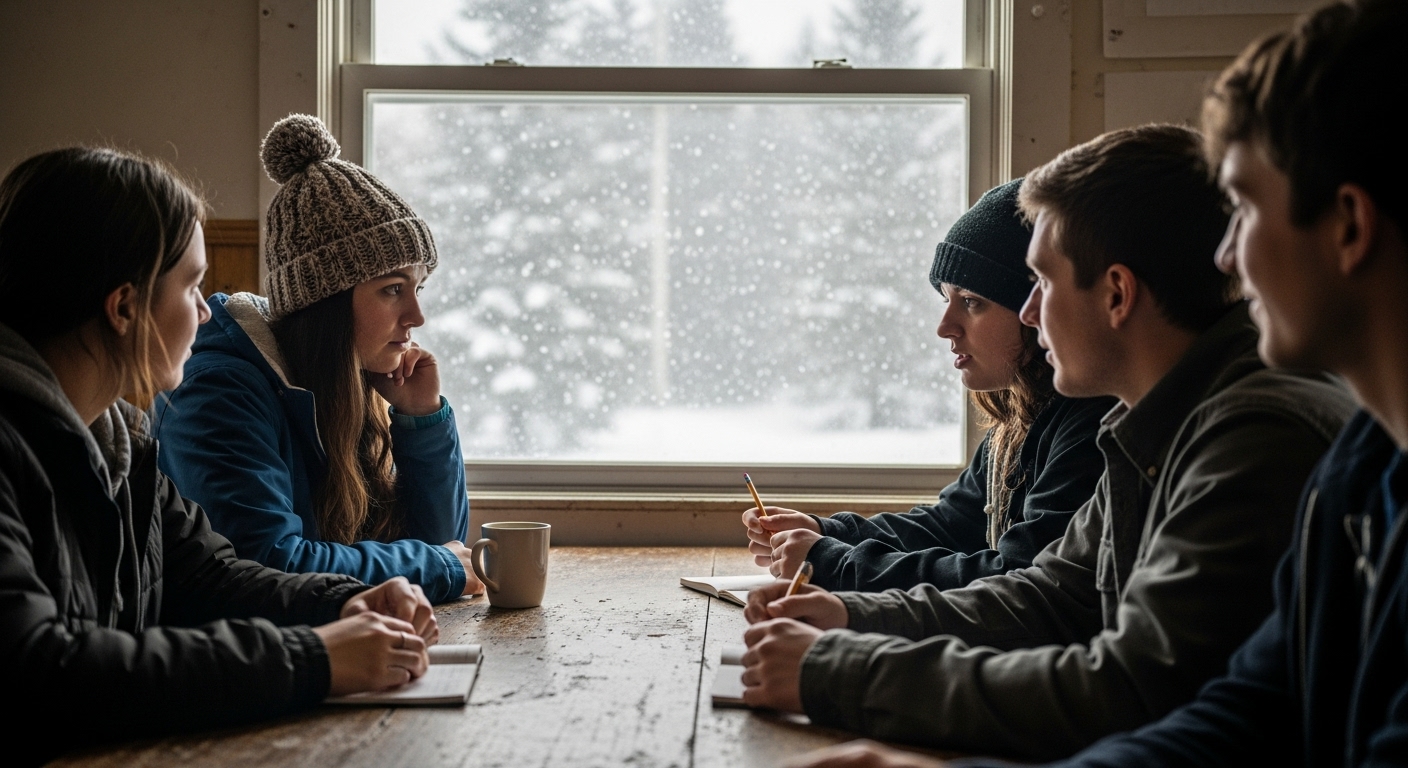
The sheer scale of Willow's vision for an ice monument felt both impossible and inevitable, a temporary defiance against the vast, indifferent winter that now commanded their focus. But as the snow continued to fall, burying the city in a clean, suffocating white, Lila couldn't shake the unsettling thought: what would remain when their audacious creation inevitably melted away?
Share This Story


