The Slow Burn of Asphalt
The asphalt, still radiating the day's forgotten heat, stretched before them like a vast, dark tongue. Overhead, clouds like bruised fruit obscured the moon, leaving only a sickly city glow to paint the humid air in shades of murky grey. A distant siren wailed, a brief, mournful sound, then succumbed to the heavy, insect-laced quiet of a summer night teetering on the edge of the truly late. It was the kind of night where every rustle felt amplified, every shadow a little too deep, and the world seemed to hold its breath.
Bram's left shoe, the one with the perpetually loose sole, scraped against the pavement. A sound like fingernails on a chalkboard, he thought, though only he seemed to hear it over the thrum of cicadas and the distant, almost musical sigh of the bypass. Beside him, Marta hummed a tuneless, off-key melody, her hands shoved deep into the pockets of a jacket she’d undoubtedly stolen from some forgotten ex. He felt the prickle of sweat at his hairline, thick and insistent, despite the late hour. The air was a suffocating blanket, heavy with the scent of hot pavement and something else – something metallic, like rain on rusted iron, but without the rain.
"Did you…" Bram started, then cleared his throat. "Did you hear that?"
Marta stopped humming, just for a beat. "Hear what? The sweet serenade of a thousand dying insects? Or your shoe?"
"No, not –" He gestured vaguely, his hand sweeping through the oppressively still air. "Something else. A sort of… drag. Like a sack of potatoes being pulled over gravel. But a really, really heavy sack."
She finally looked at him, her dark eyes reflecting the meagre streetlamp glow. "Bram, honey, if you're trying to make this walk home more interesting by inventing phantom potato sacks, you're succeeding. Barely. I thought maybe we'd see a badger. Or, you know, a ghost with a really bad attitude."
His chest felt tight, a specific, unpleasant constriction, like someone had cinched a drawstring around his lungs. It wasn't the heat, not entirely. It was the feeling, the growing certainty, that they weren’t alone. That something was following. He glanced back, over his shoulder, the movement quick, almost involuntary. The street was empty. Just the flickering orange glow of a sodium lamp at the corner, and beyond it, the deeper, impenetrable blackness between houses. A shadow, he realised, was just a little too long, a little too still, against a neighbour's hedge. Not a hedge shadow. Something more defined.
"There," he mumbled, nudging Marta with his elbow. She stumbled, swore softly, and then followed his gaze. "Right there. Don’t you see it?"
Marta squinted, her brow furrowing in what he knew was a mixture of genuine effort and profound skepticism. "See what? Mrs. Henderson’s prize-winning petunias? I think they're looking a bit leggy this year. Probably needs more sunlight."
"Not the petunias!" Bram felt a sudden, irrational surge of anger. "To the left of them. Against the bush. It’s… it’s like a tall shadow. Not human. Too thin. But it’s definitely there."
She stared for a few more seconds, then shrugged. "That's just the way the light's falling, Bram. Or maybe Mrs. Henderson's put up a particularly avant-garde garden gnome. You know how she gets after a sherry or three."
He wanted to argue, to point out the impossible angle, the way the shadow seemed to absorb the light rather than merely reflecting its absence. But the moment he looked, it was gone. Just the hedge, the petunias, and the dull, orange bleed of the streetlamp. His stomach lurched. Was he imagining it? The thought made him feel worse, a self-inflicted wound. He hated feeling paranoid. But the metallic smell, faintly like copper and ozone, was still there, clinging to his nostrils.
"Right," he said, the word coming out a little breathless. "Fine. Shortcut. Through the old railway lands. Let’s get home."
---
The Periphery's Patient Gaze
The 'old railway lands' was less a designated path and more a suggestion of neglect. Weeds grew shoulder-high, their seed heads brushing against their faces, prickling like tiny, unseen insects. Discarded fast-food wrappers clung to thorny bushes, plastic ghosts in the humid night. The ground was uneven, a patchwork of cracked concrete and loose shale that threatened an ankle at every other step. Bram concentrated on his footing, the rhythmic crunch of their shoes against the debris a small, temporary comfort.
Marta, however, seemed to revel in it. She kicked at a discarded tin can, sending it clattering into a patch of nettles. "At least it's cooler here," she mused, wiping a stray leaf from her arm. "Less streetlamp pollution. You can almost imagine you're… anywhere else."
He didn't correct her. The air here wasn't cooler, it was just different. Denser. He felt an odd vibration under his feet, a low, almost subsonic hum that resonated through the soles of his shoes. It wasn't the train line; that had been defunct for decades. It was something else. A subtle pressure, like the air itself was vibrating with a silent, unseen presence. He risked another glance back. Nothing concrete. But the shadows among the overgrown saplings seemed to shift, coalesce, then dissipate with a speed that defied logic.
"You know," Bram began, his voice a little strained, "we could have just taken the main road. It's only a few metres longer."
"And miss this exhilarating journey through urban decay?" Marta laughed, a short, sharp sound that seemed to scatter the invisible hum for a second. "Besides, I like the thrill. Builds character. And besides, I’m starving. Did you actually eat that appalling quiche tonight?"
He hadn't. The quiche, an aggressively beige offering at their friend’s dreadful garden party, had looked suspiciously like a failed science experiment. His appetite had certainly vanished the moment that cold, watchful feeling had begun to settle over him. Now, as they picked their way over a crumbling retaining wall, he felt a sudden, distinct chill, a brief draught of unnaturally cold air that raised goosebumps on his arms despite the oppressive summer heat.
"Did you…" he started again, then caught himself. "Forget it."
Marta paused, her head tilted slightly, a sliver of genuine curiosity momentarily piercing her usual veneer of amused detachment. "Forget what? That you’re suddenly convinced we're being stalked by a particularly slow-moving specter who really enjoys derelict properties? Honestly, Bram, you're usually so much more creative with your existential dread."
He wanted to tell her about the metallic smell, about the hum, about the shadow that wasn’t a shadow. But how could he articulate the specific, unsettling absurdity of it all? It felt less like a monstrous threat and more like a cosmic prank, a joke played by the universe, and he was the only one who didn't quite get the punchline. He tripped over a loose brick, nearly going down, and Marta caught his arm with a surprising grip.
"Easy there, chief," she said, her voice softer than before. "Don't want you breaking an ankle before we figure out if this is a ghost or just a really committed neighbourhood watch."
He mumbled a thanks, his heart hammering against his ribs. The cold draught had passed, leaving behind a faint, almost sickly sweet scent, like overripe fruit mixed with something acrid. He pushed past a curtain of sagging bindweed, the leaves slick against his cheek. Something small, unseen, rustled deep within the undergrowth to their left. Then silence. An absolute, perfect, unnatural silence, even the cicadas seeming to hold their breath.
---
The Unblinking Perimeter
They emerged from the railway lands into a narrow back alley, bordered by the tired, peeling paint of old garages. The air here felt thicker still, pressing down. The streetlamps on the main road, a few dozen metres away, cast long, distorted shadows of their own. For a moment, Bram felt a fleeting sense of relief. They were out. Almost home. Then he saw it.
On the corrugated metal door of the nearest garage, barely visible in the indirect light, was a smear. Not a stain, not grime. A smear of something slick, iridescent, like oil on water, but with a faint, almost imperceptible pulsation to it. It wasn't large, perhaps the size of a child's hand. But it glistened with an unnatural, internal light, shifting through purples and greens before settling on a sickly, almost jaundiced yellow.
"Marta," he breathed, stopping dead. His voice was a bare rasp.
She followed his gaze, her usual composure finally cracking. Her lips parted slightly, a tiny gasp escaping. "What… is that?" Her tone was less sarcastic, more genuinely bewildered. "Did someone… spray paint a rainbow slug?"
He shook his head, unable to speak. The smear pulsed again, a slow, deliberate beat. He felt the cold touch return, not as a draught, but as if it was radiating directly from the garage door. It seeped into his bones. His mind, usually a whirlwind of anxious thought, went utterly blank. All he could focus on was that unnatural luminescence, that single, unblinking eye of colour on the dull metal.
"It's moving," Marta whispered, her eyes wide. "It’s… changing."
Indeed, it was. The edges of the smear began to ripple, tiny tendrils of the iridescent goo extending, retracting, like some alien amoeba searching for purchase. The yellow deepened, became a toxic chartreuse, then a throbbing, furious orange. The metallic smell was overpowering here, mingled with that sickeningly sweet, overripe fruit aroma. It felt less like a smell and more like a flavour, coating the back of his throat, leaving a bitter aftertaste.
A distant dog barked, a desperate, solitary sound that seemed to tear at the fabric of the oppressive silence. It snapped Bram out of his stupor. "Run!" he choked, grabbing Marta's arm. "Just run!"
They bolted, their feet pounding on the rough asphalt, a desperate, clumsy sprint through the narrow alley. Bram didn't look back. He couldn't. The fear was a physical thing now, a clawing beast in his gut, but it was overlaid with a strange, almost hysterical hilarity. Running from a rainbow slug-smear. This was his life now. He could hear Marta's ragged breathing beside him, a choked giggle caught in her throat. She was laughing. She was actually laughing.
They burst out onto their street, their own street, bathed in the comforting, albeit dim, glow of two working streetlamps. Their house, a modest semi-detached with a slightly wonky fence, looked like a beacon of sanity. They stumbled up the path, fumbling with keys, hands shaking.
"That… was…" Marta panted, leaning against the front door, her chest heaving, still laughing, a little wildly now. "That was amazing!"
Bram finally managed to get the key in the lock, his fingers numb. He pushed the door open, the familiar creak a symphony. Relief washed over him, so potent it made his knees weak. They were inside. Safe. The stale, warm air of their tiny hallway had never felt so welcoming.
He turned to Marta, ready to collapse onto the sofa, perhaps demand a strong cup of tea, maybe a bottle of something stronger. He was ready to dissect the absurdity, to share the bizarre release of it all. But she wasn't looking at him. Her gaze was fixed, not on the inside of their home, but over his shoulder, through the open doorway, out into the dim summer night. Her eyes were wide again, no longer bewildered or amused, but frozen in a silent, absolute horror. And then, he felt it. A cold, soft touch against his ankle. Something slick. Something pulsing. Something that had followed them inside.
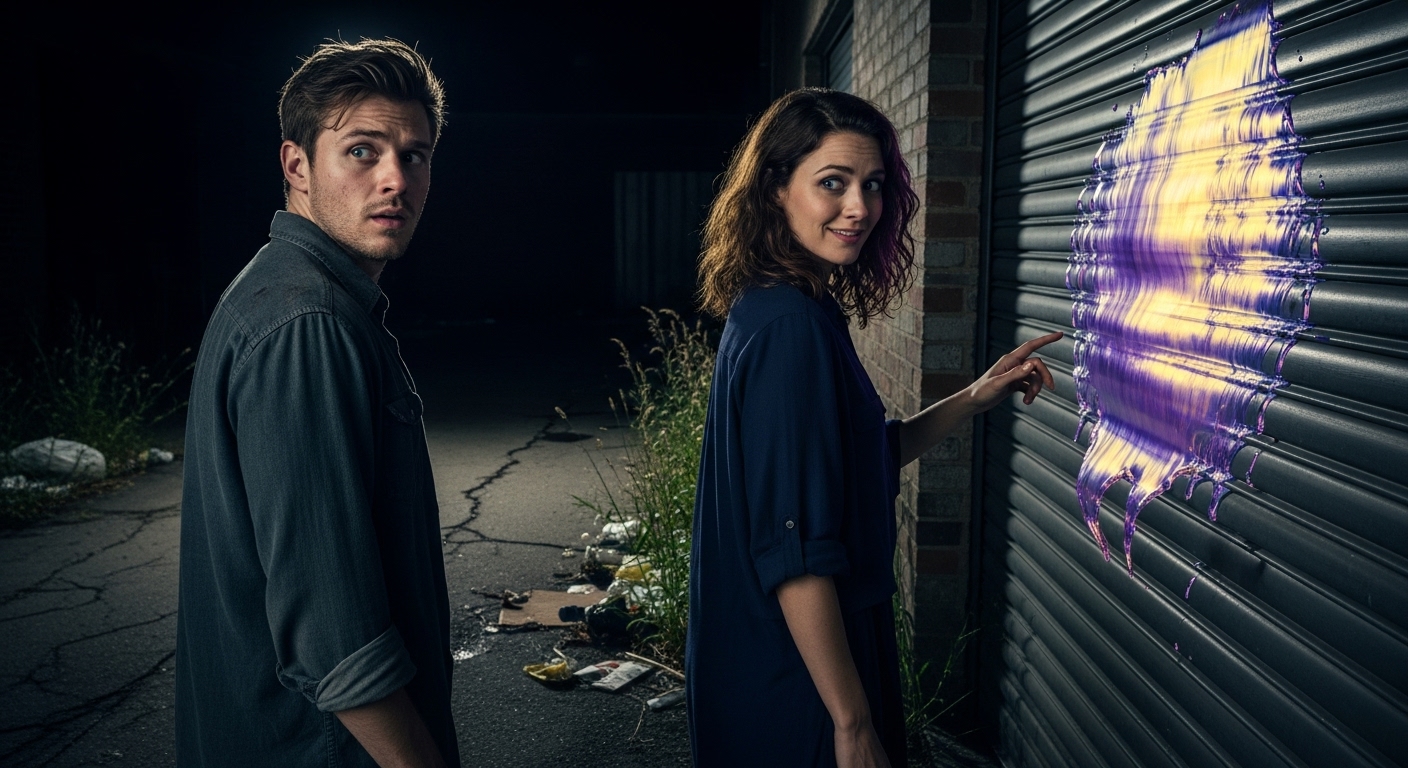
A cold, slick touch against his ankle shattered the illusion of safety, proving the absurdity wasn't left outside, but had followed them into the supposed sanctuary of their home, pulsing with an unnatural light.
Share This Story


