The Scrutiny of Light
The hospital's liminal hours, just before dawn, held a particular melancholy, a suspension between the exhausted night and the demanding day. It was in these moments that the weight of decisions, both made and deferred, settled heaviest, a quiet hum beneath the sterile glow of fluorescent fixtures and the distant, rhythmic beeps of machines.
The window offered little comfort. Not this particular window, streaked with the fine grime of urban spring, overlooking the concrete arteries of the city just beginning to thrum with the first, hesitant pulses of morning. Simon, at fifty-six, felt that same hesitant pulse within himself, a dull ache beneath the surface of decades spent in sterile theatres, performing miracles and confronting inevitability. Outside, a skeletal cherry tree by the staff parking lot showed the first blush of pink, a fragile rebellion against the lingering chill. Spring. A season of unfurling, of decisions. He’d told himself that for years. That this spring, perhaps, would be different.
He traced a phantom line on the cold glass. Forty years, almost, since he’d first picked up a scalpel with conviction. Before that, the charcoal sketches tucked away in his university dorm, the half-formed idea of an architecture course, the smell of turpentine lingering on his hands after midnight sessions in the art block. Later, the brief, intense flirtation with public health policy, the notion of systemic change rather than individual repair. Each path, a door. Each choice, a closure. Medicine had won, a demanding lover who tolerated no rivals. Now, staring at the grey-pink sky, the victory felt… heavy. Not triumphant.
His scrubs, still clean, felt like a uniform for a role he was rehearsing, not living. The air in the staff lounge was stale, tasting faintly of burnt coffee and antiseptic. He thought of his small workshop at home, the unfinished sculpture of reclaimed metal, the tools laid out with a reverence he sometimes struggled to find for his surgical instruments. Those were choices too. To pick up one and put down the other. He could still smell the sawdust, even here, in the antiseptic silence. Or perhaps it was just memory, sharp as a blade.
A shrill, insistent squawk from his pager tore through the quiet. The sound was a visceral jolt, pulling him back from the precipice of his thoughts. Trauma bay, ETA five minutes. "Multiple blunt force," the short code read. Motorcycle versus sedan. High velocity. Instantly, the melancholic fog lifted, replaced by the precise, ice-cold clarity of routine. This was the demand. This was why he stayed.
He moved with a speed that belied his weariness, the corridor a blur of pale green walls. The emergency department was already a maelstrom. Flashing lights from a newly arrived ambulance pulsed through the automatic doors. A young paramedic, face grim, was barking details to Dr. Harding, whose usually jovial features were set in a mask of grim efficiency. Harding, in his late forties, caught Simon’s eye. A brief, knowing nod. No words needed. Not yet.
The Crucible of Urgent Light
The trauma bay was loud. Monitors screamed, nurses moved with frantic grace, and the air was thick with the metallic tang of fresh blood and the sharp scent of alcohol. The patient, a young man, perhaps early twenties, lay pale and still on the gurney, his helmet cut away, revealing a laceration across his forehead. His motorcycle jacket, a shredded remnant, lay on the floor. "Male, 22. Unresponsive. BP 80/40, HR 130. GCS 3," Harding recited, his voice cutting through the din. "Open tibia/fibula, suspected pelvic fracture. Massive abdominal distension. Looks like internal haemorrhage, Simon. Fast scan showed free fluid everywhere."
Simon’s gaze swept over the patient, processing the chaos into a clinical algorithm. His hands, usually so steady, felt a faint tremor. Fatigue. Or the memory of sawdust on his palms. He pushed it down. "Prep for immediate theatre. Let's get two large bores in. Dr. Chen, get ready to cross-clamp in the abdomen. Nurse Miller, I need an arterial line, now." His voice was calm, authoritative. The tremor was gone. It always was, when it mattered.
Dr. Chen, a resident barely out of his twenties, nodded, his face a mixture of fear and adrenaline. "Yes, Dr. Darvies." Simon could see the questions in the younger man's eyes, the anxiety. Chen had ambition, certainly. But had he ever, Simon wondered, considered building things instead of dissecting them? Creating beauty rather than fighting decay? He dismissed the thought. Now was not the time for philosophical musings.
Nurse Miller, her face a map of countless long nights, worked with a quiet intensity, her movements efficient and precise as she prepared the arterial line. She met Simon’s eyes for a fraction of a second. A brief flicker of understanding passed between them. She’d seen him like this before, operating on fumes, driven by an ingrained sense of duty. She knew the cost, too, in her own way. The unspoken truths of a life bound to urgent bells.
---
The operating theatre, once they were in it, became a world unto itself. The sterile lights beat down, unforgiving, highlighting every bead of sweat on Simon’s brow. The air was cool, smelling of metal and disinfectant. The rhythmic beeping of the cardiac monitor was the only music. He stood at the operating table, his hands encased in latex, already deep inside the young man’s abdomen. The internal bleeding was torrential. A ruptured spleen, liver laceration, small bowel perforations. A brutal cascade of injury.
"Suction," Simon murmured, his eyes fixed on the field, his movements precise, almost balletic. "More lap sponges. Dr. Chen, assist with the packing here." He could feel the patient’s life force, fragile and tenuous, slipping away under his very hands. He fought it, piece by bloody piece, suturing, clamping, packing. The clock, though unseen, ticked loudly in his mind.
Chen's hands were slower, less confident. Simon corrected him with a gentle but firm instruction. "Stay calm. Breathe. Anticipate." He remembered being Chen, the eagerness, the terror, the fierce desire to prove oneself. He also remembered the dreams he had, the ones that didn't involve an OR. The paradox of saving a life while feeling his own life, outside these walls, slowly atrophying, became a sharp, unwelcome intrusion.
The operation stretched on, hours blurring into an intense, focused tunnel. Simon’s shoulders ached, his eyes stung from concentration. He had to stop a deep, hidden bleed near the renal artery, a tricky manoeuvre requiring every ounce of his thirty years of experience. He felt the cold sweat trickle down his back. The young man's heart rate dipped. "Get me some fluid, rapidly!" Simon snapped, his voice taut.
He worked with a grim determination, the sheer mechanical challenge of the repair momentarily eclipsing all other thoughts. This was the pure, undeniable art of it, the craftsmanship. The precise incisions, the delicate handling of tissue, the methodical reconstruction. A different kind of sculpture, he mused, as he tied off a final, crucial suture. A living, breathing one.
After the Tempest
Eventually, the bleeding was controlled. The damage repaired. The organs, fragile and bruised, were coaxed back into a semblance of order. The patient was stable, barely. A pulse, a shallow breath, a chance. Simon straightened, feeling the exhaustion settle deep into his bones. His mask was damp against his face. He peeled off his gloves, feeling the sticky resistance.
"Good work, team," he said, his voice raspy. "ICU transfer." Chen looked at him, his face streaked with sweat, but a nascent pride shone in his eyes. "Thank you, Dr. Darvies." He meant more than just the surgical assistance. He meant the lesson. The endurance. The steady hand.
Simon watched the patient being wheeled out, a pale, still form beneath the white sheet. He glanced at Nurse Miller, who was tidying the instruments with a quiet efficiency. She caught his eye again. "Another one for the books, Simon," she said, her tone devoid of sentimentality, simply stating a fact. But he heard the unspoken. The toll. The constant demand.
He stripped off his scrubs, the bloodied fabric clinging to his skin. The stark reality of it, always. The physical evidence of the battle. He felt a profound sense of melancholy wash over him, a weariness that went beyond physical fatigue. It was the weariness of the soul, constantly battling against the inevitable, postponing his own quiet aspirations for another person's desperate need.
He walked to the window again, the staff lounge now empty. The spring dawn had fully arrived. The sun, a pale, watery yellow, was climbing above the buildings. The cherry tree outside, defiant, had opened a few more blossoms, tiny flags of hope. He thought of the unfinished sculpture. He thought of the quiet satisfaction of shaping wood, of the smell of fresh-cut pine instead of disinfectant. The thought was a gentle hand on his shoulder, guiding him away.
He took out his phone. His fingers hovered over a name, a contact he hadn't dialled in months – an old university friend who ran a small gallery, who had always encouraged his "other talents." It was absurd, maybe. Leaving this. For that. But the urgency he felt now, wasn't for a patient on an operating table. It was for himself. He needed to build something else. Something new. The air, crisp with the promise of spring, felt like a breath he'd been holding for too long.
He would call. This time, he would make the call.
---
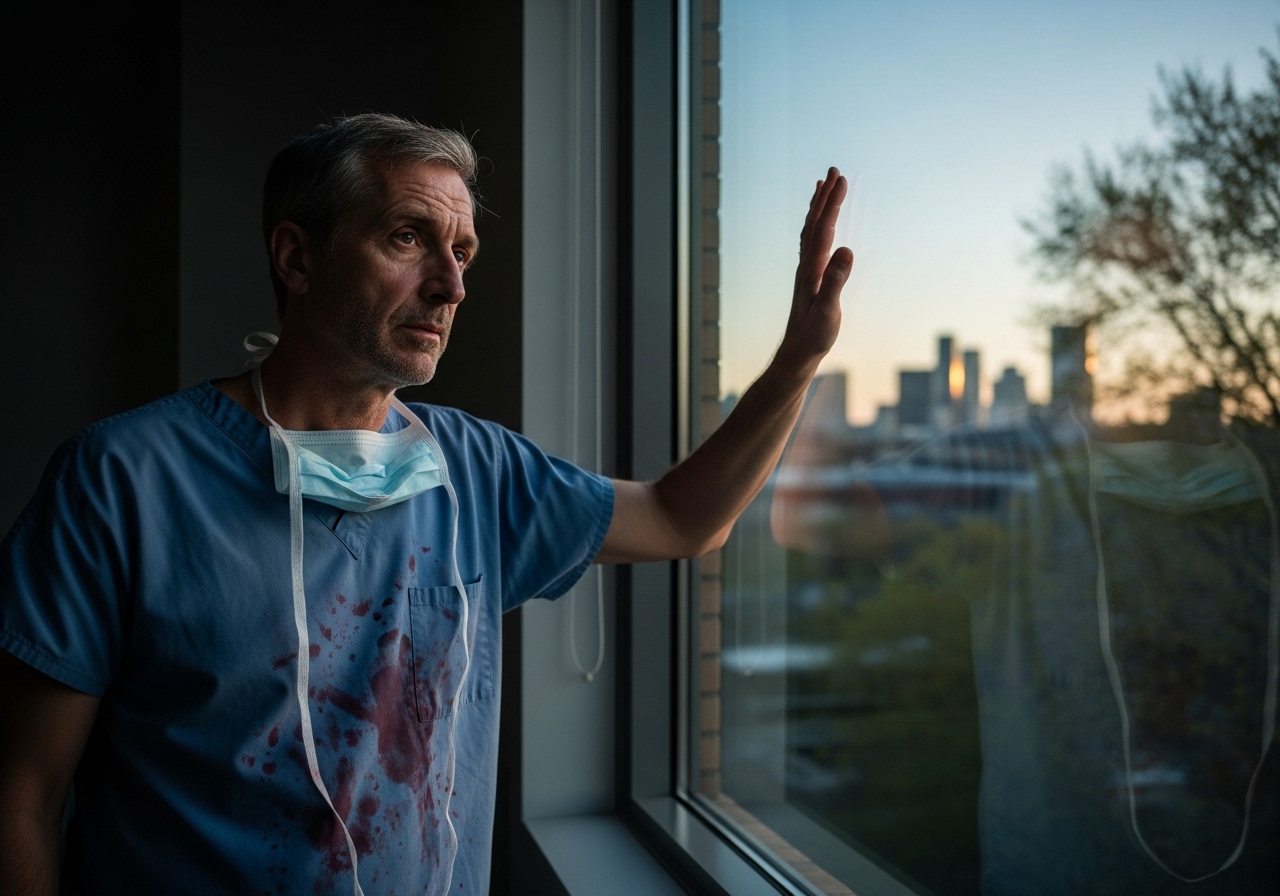
As the first rays of spring illuminated the weary surgeon's face, a silent resolve hardened his features, the weight of a life of healing finally pushing him toward a radical decision he could no longer postpone: a call, a bridge to an entirely different existence, waiting to be built.
Share This Story


